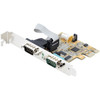
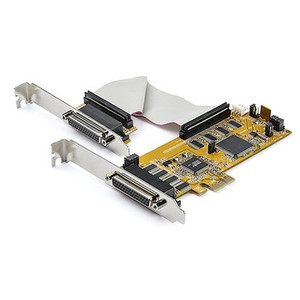
StarTech 21050-PC-SERIAL-CARD 2-Port PCIe x1 RS-232 Serial Adapter Card
Overview
The StarTech 21050-PC-SERIAL-CARD is a PCIe x1 adapter that adds two RS-232 serial ports to any desktop workstation or server with an available PCIe slot. Built around the ASIx Ax99100 chipset with a 16C1050 UART, it targets integrators and IT architects who need reliable COM-port connectivity for serial interface hardware — PTZ camera controllers, access control panels, POS terminals, industrial PLCs, or legacy test equipment — in systems where the motherboard no longer ships with native serial headers. The model number is sometimes searched as 21050 PC SERIAL CARD, but the official MPN is 21050-PC-SERIAL-CARD.
Key Features
- ASIx Ax99100 Chipset: The Ax99100 is a well-documented, widely supported PCIe-to-serial bridge — driver availability under both Windows and Linux is stable and mature, which matters when you're commissioning a workstation that will run headless for years without OS reinstalls.
- 921.6 Kbps Maximum Baud Rate: Most RS-232 legacy peripherals top out at 115.2 Kbps, so the 921.6 Kbps ceiling gives you headroom for higher-throughput serial protocols (Modbus RTU at speed, industrial automation controllers) without hitting an artificial cap in the adapter itself.
- 256-Byte FIFO Buffer per Port: A 256-byte FIFO is 16x the buffer of a classic 16550 UART. In practice this means the adapter can absorb burst traffic from the connected device without dropping characters, even if the host CPU is briefly occupied — important in multi-threaded server environments or lightly loaded edge systems.
- PCIe 2.0 x1 Interface: The card occupies a single PCIe x1 lane and is compatible with x1, x4, x8, and x16 slots. PCIe 2.0 backward-compatibility means it will seat in Gen 1 boards as well — useful when integrating into older rack workstations that are otherwise still serviceable.
- Two DB-9 Male Ports with Activity LEDs: Two standard DB-9 male connectors map directly to COM ports in the OS — no adapters needed for most serial cables already on-site. The green activity LED per port lets you confirm live data flow during commissioning without opening a terminal session, which shortens field verification time.
- Hardware and Software Flow Control: Both RTS/CTS hardware flow control and XON/XOFF software flow control are supported, along with five parity modes (Even, Odd, None, Space, Mark) and all standard data-bit widths (5–9 bits). This covers every legacy serial protocol you are likely to encounter — nothing needs to be re-wired or re-configured at the peripheral end.
- Included Low-Profile Bracket: The card ships with a low-profile bracket alongside the standard height bracket, so it installs directly into slim desktop chassis and 1U/2U rack-mount workstations without ordering additional hardware. If you're deploying into a mix of form factors, you're covered out of the box.
- Windows and Linux OS Support: Driver support spans current Windows and Linux kernels. For Linux, the Ax99100 is handled by a vendor-supplied module; confirm kernel version compatibility against StarTech's driver matrix before deploying on hardened or custom distributions.
Integration and Compatibility
The 21050-PC-SERIAL-CARD installs into any PCIe x1 or wider slot on a standard ATX, micro-ATX, or mini-ITX board. It presents as two standard COM ports in Device Manager (Windows) or as /dev/ttyS* or /dev/ttyUSB* nodes in Linux, depending on driver configuration — existing serial applications see it as native hardware with no application-layer changes required. This makes it a practical fit for surveillance system workstations running PTZ keyboard controllers, for access control head-end PCs driving RS-232 panels, or for any industrial PC that needs deterministic serial I/O alongside its PCIe expansion slots. The card's operating temperature range of 0°C to 55°C suits standard conditioned server rooms and desktop environments; the storage rating extends to -40°C to 75°C for long-term warehousing before deployment. For rack-integrated deployments, pair this with a PCIe expansion card strategy to consolidate serial I/O on a single host without USB-to-serial adapters, which introduce latency and driver instability in 24/7 environments. If you are evaluating StarTech's broader I/O expansion line, the StarTech adapter catalog includes parallel-port, USB, and multi-port serial options for more complex I/O consolidation requirements. See also the serial-to-USB adapter category if a PCIe slot is not available in your target host.
Frequently Asked Questions
Q: What chipset does the 21050-PC-SERIAL-CARD use, and why does it matter?
A: It uses the ASIx Ax99100 chipset with a 16C1050 UART. The Ax99100 has broad OS driver support — including stable Linux kernel modules — which reduces integration risk in enterprise and industrial deployments compared to less-documented alternatives.
Q: What is the maximum baud rate supported?
A: The card supports up to 921.6 Kbps per port. Most RS-232 peripherals run at 115.2 Kbps or lower, so this ceiling provides significant headroom for higher-speed industrial protocols without the adapter being the bottleneck.
Q: Does the 21050-PC-SERIAL-CARD work in a low-profile or slim desktop chassis?
A: Yes. The card includes a low-profile bracket in the box alongside the standard bracket, so it fits slim desktop and 1U/2U rack-mount systems without any additional hardware purchase.
Q: Which operating systems are supported?
A: Windows and Linux are both supported. For Linux, driver availability depends on your kernel version — verify compatibility against StarTech's driver documentation before deploying on custom or hardened distributions.
Q: What PCIe slot does this card require?
A: It uses a PCIe x1 interface (PCIe 2.0), but it is physically compatible with x1, x4, x8, and x16 slots. It is also backward-compatible with PCIe Gen 1 motherboards.
Q: What is the warranty on the 21050-PC-SERIAL-CARD?
A: StarTech covers this card with a 2-year manufacturer warranty.
The spec that consistently drives purchase decisions on the 21050-PC-SERIAL-CARD is the 256-byte FIFO buffer — it's 16 times the depth of a classic 16550 UART. In practice, that difference shows up in environments where the host CPU has variable interrupt latency: the deeper buffer absorbs burst data from the connected RS-232 device without character drops, something a shallow FIFO cannot guarantee on a loaded server.
Technical Highlights:
- 921.6 Kbps Baud Rate Ceiling: Far above the 115.2 Kbps that most legacy RS-232 peripherals use — the adapter will not be the limiting factor if you need to push higher-speed Modbus RTU or proprietary industrial protocols.
- ASIx Ax99100 / 16C1050 UART: A chipset combination with documented, stable driver support under current Windows and Linux kernels — critical for 24/7 unattended operation where a driver regression after an OS update could take down a COM-port-dependent control system.
- Dual-Bracket Included: Standard and low-profile brackets both ship in the box, confirmed by the included accessories list — no separate bracket order required when deploying into slim chassis or 1U rack workstations.
Deployment Considerations:
- Operating temperature is rated 0°C to 55°C — fine for a conditioned server room or office workstation, but not suitable for unheated industrial enclosures in cold climates without supplemental heating.
- Linux deployments require a vendor-supplied kernel module for the Ax99100; verify the module builds cleanly against your specific kernel version before finalizing the OS image, especially on hardened or RHEL-derived distributions that restrict unsigned modules.
This card is the right call for a physical security head-end workstation running RS-232-based PTZ controllers or access control panels — environments where USB-to-serial adapters introduce unacceptable driver instability and a PCIe slot is available in the host system.