Lenovo 7Y79A00GWW 2U24 All-Flash SAN Controller Enclosure
Overview
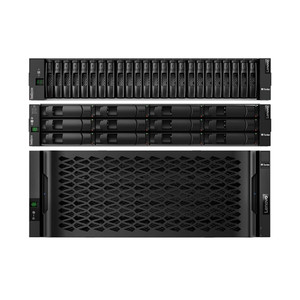
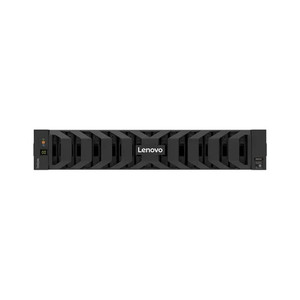
The Lenovo ThinkSystem DE6000F 7Y79A00GWW is a 2U24 all-flash SAN controller enclosure built for mid-range enterprise storage environments where latency and throughput consistency matter. Packing 24 x 2.5" SFF drive bays into 2U of rack space, it houses dual Fibre Channel controllers and supports NVMe/FC and NVMe/RoCE — making it a practical fit for workloads that have outgrown hybrid arrays but don't require the expense of a hyper-scale all-NVMe backend. This is the ThinkSystem DE6000F series controller enclosure, part of Lenovo's ThinkSystem storage line for data center and enterprise SAN deployments.
Key Features
- 24 x 2.5" SFF All-Flash Drive Bays: Fitting 24 SSD slots into a 2U form factor means you can build out substantial all-flash capacity without burning rack space — critical in dense SAN storage environments where every U costs money. All-SSD population eliminates the latency variability of spinning media, which matters for database and virtualization workloads with mixed I/O profiles.
- Dual Fibre Channel Controllers: Two controllers provide active-active redundancy — if one fails, the other continues serving I/O without a storage blackout. For production workloads, single-controller configurations are an unacceptable risk; the dual-controller architecture here removes that failure point from the design.
- 32Gb FC 4-Port HICs: Each controller carries a 4-port 32Gb Fibre Channel HIC. At 32Gb per port, you have headroom well above what most mid-range initiators saturate today, and 4 ports per controller gives you enough paths for multi-host zoning without buying add-in cards. This is the connectivity spec to verify against your existing FC switch infrastructure — ensure your switches support 32Gb negotiation, or you'll step down to 16Gb.
- NVMe/FC and NVMe/RoCE Support: Beyond traditional FC block access, the DE6000F supports NVMe over Fabrics via both FC and RoCE. This future-proofs the array against host-side NVMe adoption — servers provisioned with NVMe initiators can connect without a protocol translation penalty. If your fabric is already Ethernet-based, NVMe/RoCE avoids a full FC infrastructure investment.
- RAID Levels 0, 1, 3, 5, 6, and 10: The full RAID menu gives you the flexibility to tune protection vs. usable capacity per volume group. RAID 6 (dual parity) is the right choice for large SSD populations where a double-drive failure during rebuild is a real statistical concern. RAID 10 trades capacity for rebuild speed — relevant for tier-1 databases where rebuild time is a SLA risk.
- Gigabit Ethernet Management Port: Out-of-band management over GbE means you can access the storage management interface independently of the data fabric. This is a non-negotiable for production arrays — you don't want a SAN congestion event to block your ability to reconfigure or diagnose the array.
- 2U Rack-Mount Form Factor (17.7" W x 21.8" D x 3.3" H): At 3.3" high (2U) and 21.8" deep, this enclosure fits standard 19" 4-post racks without requiring extended-depth rail kits in most deployments. Verify your rack's usable depth against the 21.8" figure — shallow-depth racks in edge or telco environments may require custom rails or a deeper cabinet.
- USB Ports (x2): The two onboard USB ports support firmware update media and diagnostic tools without requiring network access to the management interface — useful during initial commissioning or when the management network is not yet provisioned.
Integration and Compatibility
The DE6000F 7Y79A00GWW connects into existing Fibre Channel SANs via 32Gb FC HICs and supports standard FC zoning topologies. NVMe/RoCE connectivity integrates with data center Ethernet switching infrastructure running lossless RoCE (PFC/ECN required on the switch side — verify this before specifying RoCE). RAID configuration and array management are handled through Lenovo's SANtricity storage management software, which is the standard management plane across the DE series. Expansion beyond the 24 SFF bays in this controller enclosure is achieved through additional drive enclosures connected to the controllers' expansion ports — the DE6000F is designed to scale out without replacing the controller hardware. For enterprise storage planning, pair this controller enclosure with compatible SFF SSD drives rated for SAN duty cycles; consumer-grade SSDs are not appropriate for this platform.
Frequently Asked Questions
Q: How many drives does the 7Y79A00GWW support?
A: The 7Y79A00GWW controller enclosure houses 24 x 2.5" SFF drive bays, all intended for SSD population in the all-flash DE6000F configuration. Additional capacity can be added via expansion enclosures connected to the controller.
Q: Does this enclosure support NVMe?
A: Yes. The DE6000F supports NVMe over Fabrics via both NVMe/FC and NVMe/RoCE, in addition to traditional Fibre Channel block access. NVMe/RoCE requires a lossless Ethernet fabric with PFC and ECN configured on the switch infrastructure.
Q: What RAID levels does the 7Y79A00GWW support?
A: Supported RAID levels are 0, 1, 3, 5, 6, and 10. RAID 6 provides dual-parity protection suitable for large all-flash pools; RAID 10 prioritizes rebuild performance for tier-1 database volumes.
Q: What Fibre Channel speed does this array support?
A: The included HICs are 32Gb FC with 4 ports per controller. The array will negotiate down to 16Gb if connected to older FC switch infrastructure, but to get full 32Gb throughput your SAN switches must support 32Gb FC.
Q: Is this a single-controller or dual-controller enclosure?
A: The 7Y79A00GWW is a dual-controller enclosure, providing active-active redundancy. Both controllers service I/O simultaneously, and a single controller failure does not cause a storage outage.
Q: What rack space does the DE6000F controller enclosure require?
A: The enclosure occupies 2U of rack space with dimensions of 17.7" W x 21.8" D x 3.3" H. Standard 19" four-post rack mounting is supported; verify usable rack depth before ordering rail kits.
The 7Y79A00GWW is one of those arrays that rewards careful fabric planning before it ever gets racked. The dual 32Gb FC HICs — 4 ports per controller, 8 ports total — give you serious multipath flexibility, but 32Gb FC is only as fast as your switch infrastructure allows; if you're running a legacy 16Gb fabric, that's your actual ceiling, not a DE6000F limitation. Worth confirming switch firmware and SFP compatibility before the array ships.
Technical Highlights:
- Dual 32Gb FC 4-Port HICs: Eight FC ports across two controllers means you can zone 4+ hosts with 2-path redundancy each without port contention — a real advantage in dense virtualization environments where every VM needs multipath I/O coverage.
- NVMe/FC and NVMe/RoCE: Having both NVMe fabric options in a mid-range enclosure means you're not locked into a single host-side protocol as infrastructure evolves. RoCE is particularly attractive for shops already running 25GbE or 100GbE leaf-spine — no separate FC SAN infrastructure required for NVMe.
- 24 x 2.5" SFF All-Flash Bays in 2U: The density here is the point. 24 SFF SSDs in 2U means you can build multi-hundred-terabyte all-flash pools without monopolizing rack space — important when collocating with compute in space-constrained enterprise or edge data center deployments.
Deployment Considerations:
- NVMe/RoCE requires lossless Ethernet with Priority Flow Control (PFC) and Explicit Congestion Notification (ECN) enabled at the switch level — deploying this on a standard best-effort Ethernet fabric will cause I/O instability; confirm switch capability and DCBX negotiation before specifying RoCE.
- The 21.8" depth dimension is worth measuring against your specific rack's usable interior depth, not just the manufacturer's rated depth — cable management panels and PDU placements can reduce usable depth by 2–4 inches in production racks.
This enclosure is a strong fit for mid-size virtualization clusters or database environments consolidating from hybrid arrays onto all-flash, where 32Gb FC multipath and RAID 6 protection are non-negotiables and the team wants a proven SANtricity management stack without moving to a hyper-scale platform.