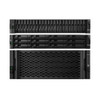
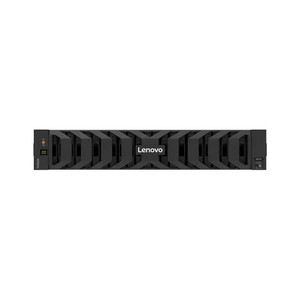
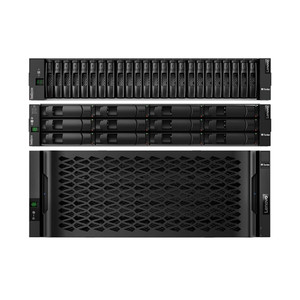
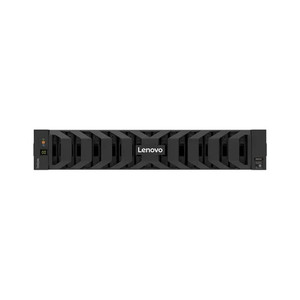
Lenovo 7Y75A00SWW 2U 24-Bay Hybrid Storage Array
Overview
The Lenovo ThinkSystem DE4000H — sold as model number 7Y75A00SWW — is a 2U rack-mountable hybrid storage array designed for enterprise environments that need high-density SAS-3 capacity paired with multi-protocol block storage connectivity. With 24 SFF drive bays across a 17.7" W x 21.8" D footprint, it fits cleanly into standard 19-inch rack infrastructure without sacrificing the controller redundancy that production workloads demand. This is a purpose-built array, not a server with bolt-on storage — the distinction matters for latency-sensitive applications like surveillance video repositories, database back-ends, and tiered storage pools in Lenovo ThinkSystem deployments.
Key Features
- 24 SFF SAS-3 Drive Bays (2U): Packing 24 small-form-factor bays into a 2U chassis means you can build a dense pool of SAS or SSD capacity without sprawling across half a rack. For video retention workloads or tiered storage architectures, that density directly reduces rack space and cabling overhead compared to LFF alternatives at the same drive count.
- 16Gb Fibre Channel Connectivity: At 16Gb FC, each host port delivers roughly double the bandwidth of legacy 8Gb FC links. For environments already running a Fibre Channel fabric — think large-scale surveillance recording servers or virtualization clusters — 7Y75A00SWW slots into existing infrastructure without forcing a fabric rebuild. Host adapters and switches need to match; plan that during pre-sales if FC is the chosen path.
- 12Gb SAS Host Connectivity: The 12Gb SAS option is the right call for direct-attach deployments where a Fibre Channel fabric isn't justified. SAS 12Gb/s provides enough throughput for multi-stream HD video recording or server-attached workloads, and the cabling is simpler and cheaper than FC for short-reach direct connections. If you're consolidating storage for a handful of network video recorders or application servers in the same rack, SAS direct-attach is often the cleaner architecture.
- Dual Active/Active Controllers with 8GB Cache Each: Active/active controller pairs mean both controllers handle I/O simultaneously rather than one sitting idle in standby. Losing a controller doesn't cause a failover pause — the surviving controller already owns the workload. Each controller carries 8GB of cache, which buffers write bursts and smooths out the bursty I/O patterns common in surveillance recording and database logging. Total cache across both controllers is 16GB — meaningful headroom for mixed read/write workloads.
- Hybrid Storage Architecture: Hybrid arrays let you mix spinning SAS drives for bulk capacity with SSDs for hot-tier performance within the same 24-bay chassis. That matters when workloads have both a large cold-storage requirement (archived video, historical logs) and a performance-sensitive tier (active databases, live recording streams). Tiering policy configuration happens at the storage array management layer — verify your host software supports the DE4000H's management interface before provisioning.
- 2U Rack Form Factor (17.7" W x 21.8" D): Standard 19-inch rack width with a 21.8-inch depth is compatible with most mid-depth and full-depth rack enclosures. At 2U, it stacks efficiently in high-density rows. Measure your rack's usable depth against 21.8 inches plus cable management clearance — shallow wall-mount racks may not accommodate it without extension hardware.
Integration and Compatibility
The 7Y75A00SWW supports dual host connectivity paths — 16Gb Fibre Channel and 12Gb SAS — which positions it as a shared storage resource for multi-host environments or as a direct-attach array for single-server deployments. In a storage networking context, the dual active/active controller architecture supports multipath I/O (MPIO) configurations, so hosts can maintain redundant paths to the array for both performance and availability. Pair it with compatible HBAs on the host side: 16Gb FC HBAs for fabric-attached deployments, or 12Gb SAS HBAs for direct-attach. Verify firmware and driver compatibility against Lenovo's hardware compatibility list for the DE4000H series before provisioning. For planning scale-out storage infrastructure, consult a storage architecture guide to match drive count, tier ratios, and controller cache to your retention and throughput requirements. The DE4000H management stack supports out-of-band management — factor that into your network topology so the management interface isn't on the same segment as production traffic.
Frequently Asked Questions
Q: What host connectivity protocols does the 7Y75A00SWW support?
A: The 7Y75A00SWW supports 16Gb Fibre Channel and 12Gb SAS host connectivity. This covers both fabric-attached SAN environments and direct-attach server configurations.
Q: How many drive bays does the ThinkSystem DE4000H provide, and what drive type does it accept?
A: The 7Y75A00SWW provides 24 SFF (small form factor) bays designed for SAS-3 drives, including both spinning SAS hard drives and SSDs for hybrid tiering configurations.
Q: Is the controller configuration redundant?
A: Yes. The DE4000H uses dual active/active controllers, each with 8GB of cache memory. Both controllers handle I/O simultaneously, so a single controller failure does not cause a storage outage or failover delay.
Q: What are the physical dimensions of the 7Y75A00SWW, and will it fit a standard rack?
A: The chassis measures 17.7 inches wide by 21.8 inches deep and occupies 2U of rack space. It is compatible with standard 19-inch rack enclosures. Verify your rack's usable depth is at least 21.8 inches plus clearance for cable management before installation.
Q: Can this array be used for surveillance video storage?
A: Yes. The 24-bay SAS-3 configuration, dual active/active controllers, and hybrid storage capability make the 7Y75A00SWW suitable for large-scale video retention workloads, particularly in environments where a mix of high-capacity spinning drives and SSD cache or hot-tier storage is required.
Q: Does the DE4000H support multipath I/O for host redundancy?
A: The dual active/active controller design supports multipath I/O (MPIO) configurations, allowing hosts to maintain multiple redundant paths to the array. This requires compatible HBAs and MPIO software on the host side — verify against Lenovo's hardware compatibility list for the DE4000H series.
When I look at the 7Y75A00SWW, the spec that anchors the deployment decision is the dual active/active controller pair with 8GB cache per controller — 16GB total. That's not a redundancy afterthought; it's a genuine performance architecture. In enterprise surveillance environments where you're writing continuous streams from dozens of cameras, write cache buffering is what keeps latency flat when the mechanical drives can't sustain peak burst rates. Without it, you get frame drops or dropped recordings under load spikes.
Technical Highlights:
- 24 SFF SAS-3 Bays in 2U: Drive density of 12 bays per rack unit is the practical ceiling for SFF arrays at this price tier — you're not giving up capacity headroom to hit the 2U target.
- Dual 16Gb FC + 12Gb SAS Host Ports: Having both protocol options on the same chassis means you can decide at deployment time whether you're going fabric or direct-attach — you're not locked in at the hardware purchase stage.
- Active/Active Controllers: Unlike active/passive designs where failover triggers a momentary I/O pause, active/active keeps traffic flowing on both controllers continuously. For 24/7 recording environments, that's the correct controller model — passive standby introduces risk during controller events.
Deployment Considerations:
- At 21.8 inches deep, measure rack usable depth before ordering — shallow wall-mount enclosures commonly run 18–20 inches and will not fit this chassis without a rack extension shelf.
- Validate HBA firmware versions against Lenovo's DE4000H compatibility matrix before going live — mismatched HBA firmware is the most common cause of path instability in SAS and FC direct-attach configurations.
The 7Y75A00SWW is the right fit for a centralized surveillance storage node in a mid-to-large enterprise deployment: a security operations center consolidating recording streams from multiple NVR servers onto shared SAN storage, where controller-level redundancy and dual-protocol flexibility justify the array over direct-attached JBOD alternatives.