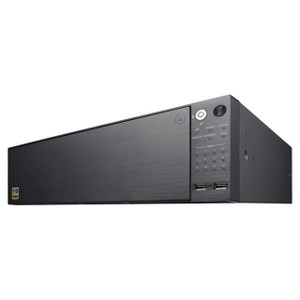
Hanwha BRR-P2H1SH7-480TB Network Video Recorder
The Hanwha BRR-P2H1SH7-480TB is a network video recorder from Hanwha's enterprise NVR lineup, identified by its 480TB storage designation — a capacity tier suited for large-scale, long-retention surveillance deployments where on-site storage eliminates recurring cloud costs. If you are sizing a system that needs weeks or months of continuous multi-camera retention, the storage ceiling here is the defining selection factor. Consult the Hanwha NVR product line for full channel, codec, and throughput specifications before committing this unit to a design.
Overview
Within the Hanwha surveillance portfolio, the BRR series targets high-capacity recording applications — broadcast-scale camera counts, forensic-grade retention windows, and environments where pulling footage from cloud storage under bandwidth constraints is not operationally viable. The BRR-P2H1SH7-480TB sits at the high-capacity end of this family. For integrators scoping a network video recorder at this storage tier, the key pre-deployment questions are channel license count, supported codec profiles, redundant storage configuration options, and rack unit footprint — all of which should be confirmed against the Hanwha datasheet for this specific SKU before finalizing the bill of materials.
Key Features
- 480TB Onboard Storage: 480TB of integrated storage capacity supports extended retention across large camera counts without requiring supplemental NAS or cloud offload — reducing both infrastructure complexity and ongoing bandwidth overhead on high-camera-count sites.
- Enterprise NVR Platform: Positioned within Hanwha's commercial NVR range, the BRR-P2H1SH7-480TB is built for deployments where consumer or SMB recorders cannot meet uptime, throughput, or retention requirements. Verify channel licensing and supported camera models against the current Hanwha compatibility matrix before deployment.
- Scalable for Large Sites: At this storage capacity, the unit is appropriate for campus, warehouse, transit, or critical infrastructure environments where multiple camera streams must be retained simultaneously at full resolution for compliance or investigative purposes.
Integration and Compatibility
Hanwha NVRs in the BRR series are designed to integrate with IP cameras within the Hanwha ecosystem and typically support ONVIF-compliant third-party cameras — however, camera channel counts, codec support (H.265/H.264), and VMS compatibility for the BRR-P2H1SH7-480TB must be confirmed against the manufacturer's current specification sheet. For PoE switch pairing and structured cabling to support a deployment at this scale, review your PoE switch capacity alongside the camera and NVR specs. A surveillance system planning guide can help size the full stack before procurement.
Frequently Asked Questions
Q: What is the storage capacity of the BRR-P2H1SH7-480TB?
A: The model designation indicates 480TB of storage capacity. Verify the exact drive configuration and RAID options with the manufacturer specification sheet for this SKU.
Q: How many camera channels does the BRR-P2H1SH7-480TB support?
A: Channel capacity for the BRR-P2H1SH7-480TB should be confirmed against Hanwha's current datasheet for this model. Contact pre-sales for configuration assistance before specifying this unit in a design.
Q: Is the BRR-P2H1SH7-480TB compatible with third-party IP cameras?
A: Hanwha BRR-series NVRs typically support ONVIF-compliant cameras in addition to native Hanwha cameras, but compatibility for specific third-party models should be verified against Hanwha's published compatibility list for this SKU.
Q: What VMS platforms work with the BRR-P2H1SH7-480TB?
A: VMS integration details — including support for Milestone, Genetec, or Hanwha's own Wisenet WAVE — should be confirmed with the manufacturer's integration documentation for this specific model number.
The BRR-P2H1SH7-480TB lands in the part of the Hanwha catalog where storage capacity is the primary selection driver — 480TB is not a spec you see on edge or SMB recorders, and its presence in the model number tells you this unit is targeting high-channel, long-retention enterprise environments. Before quoting this NVR into a project, the single most important step is pulling the current Hanwha datasheet to confirm channel licensing and throughput ceiling: a 480TB chassis that can only drive 64 channels at 4K is a very different design constraint than one handling 128 or 256.
Technical Highlights:
- 480TB Storage Designation: At this capacity tier, you're looking at weeks to months of retention across dozens of full-resolution streams — the right fit for compliance-driven environments (transit authorities, correctional, critical infrastructure) where footage must be available for forensic review without cloud dependency.
- BRR Series Platform: The BRR family in Hanwha's lineup is distinct from the PRN/QRN/XRN consumer-adjacent recorders — it signals a purpose-built, high-density architecture. That positioning matters when you're specifying against uptime SLAs or redundant-storage requirements.
- Hanwha Ecosystem Integration: Native integration with Wisenet cameras and Wisenet WAVE VMS is the expected baseline for this platform — confirming which camera models are channel-licensed and which require an additional license at purchase avoids surprises during commissioning.
Deployment Considerations:
- At 480TB, you're almost certainly looking at a multi-drive rackmount chassis — verify rack unit height and power draw before finalizing your rack design, especially in dense IDF or data center rows with cooling constraints.
- Do not assume RAID configuration out of the box: confirm whether the default storage mode is RAID 5, RAID 6, or JBOD, as this directly affects usable capacity and rebuild time risk on a drive failure at this scale.
The BRR-P2H1SH7-480TB is the right conversation starter for a transit hub, large campus, or government facility where the retention window and camera count have outgrown everything in the SMB recorder tier — but spec-sheet confirmation is non-negotiable before it goes on a BOM.