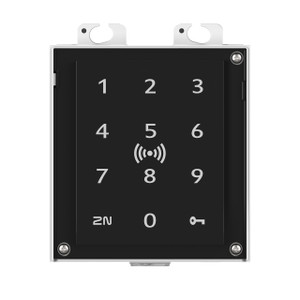
2N 02262-001 AU 2.0 Touch Keypad
The 2N 02262-001 is a network-connected touch keypad purpose-built for IP-based access control and intercom deployments. It replaces mechanical push-button and keypad interfaces with a capacitive touch surface, reducing maintenance burden in high-traffic entry points while integrating into standardized 2N AU 2.0 control architectures and Axis security ecosystems. This is a control endpoint — not a standalone device — designed to work within larger networked security systems where central credential provisioning and audit logging are required.
Key Features
- Capacitive Touch Interface: Eliminates mechanical wear inherent in push-button and membrane keypads. Over a multi-year deployment, this means fewer service calls to replace stuck buttons or failed contacts — a tangible cost savings on high-traffic doors handling dozens of credential entries per day.
- IP-Based Deployment: Communicates across standard network infrastructure, eliminating the need for dedicated access control wiring runs. Wherever you have network connectivity (Ethernet, PoE, or managed wireless), you can position the 02262-001. This flexibility simplifies retrofit installations in buildings where running new conduit would be prohibitively expensive.
- 2N AU 2.0 Architecture Compatibility: The 02262-001 operates as a standardized endpoint within 2N's modular access control platform. This means firmware updates, credential synchronization, and system-wide configuration changes deploy centrally without per-device manual steps — reducing provisioning overhead compared to proprietary or isolated keypads.
- Axis Infrastructure Support: Integrates natively with Axis networked infrastructure, allowing you to manage access control endpoints, IP cameras, and intercoms through a single control plane. If you're already running Axis or 2N IP cameras in your facility, adding the 02262-001 doesn't require a separate management tool or learning curve.
- Indoor-Rated Design: Optimized for controlled environments (lobbies, corridors, secured access zones). Absence of weatherproofing means no extra sealing or gasket maintenance. If your deployment includes outdoor entry points, you'll need a weather-sealed variant instead — see "When to Choose a Different Model" below.
- IP Intercom System Integration: When paired with compatible 2N or Axis intercom endpoints, the 02262-001 becomes a unified interface for both credential entry and voice communication. This consolidates hardware at entry points, reducing installation clutter and cable runs compared to deploying a separate intercom and access reader side-by-side.
Integration & Compatibility
The 02262-001 functions as a control node within IP security and communication infrastructure. It supports standard IP deployment protocols consistent with Axis and 2N platforms, meaning central provisioning, firmware updates, and credential push policies work uniformly across your keypad fleet. Compatibility with your specific network video recorder, VMS platform, and access control backbone depends on ONVIF profile support and API alignment with your deployed infrastructure. Verify integration paths with your system integrator, particularly if you're pairing the 02262-001 with third-party VMS platforms or legacy access control systems.
Applications
- Commercial building and office park entry control
- Institutional multi-building credential management (corporate campuses, universities, healthcare facilities)
- IP intercom integration for distributed sites requiring central audit and call routing
- Retrofit deployments where network cabling already exists and access control wiring runs are impractical
- Indoor secured corridors, tenant suites, and access vestibules
When to Choose a Different Model
The 02262-001 is indoor-only. If your entry points face weather exposure (rain, direct sun, freeze-thaw cycles, salt spray), this keypad lacks the sealing and wide operating temperature range necessary for reliability. Look for an outdoor-rated touch or mechanical keypad variant within the 2N product family — typically designated with IP67 or higher and a wider temperature specification. Additionally, if your deployment needs only basic proximity or RFID reader functionality without intercom integration or networked management, a simpler wired reader may be more cost-effective and reduce your IT management footprint.
Frequently Asked Questions
Q: Does the 2N 02262-001 require a dedicated power supply, or does it draw power via PoE?
A: Power delivery depends on your 2N AU 2.0 system architecture and installation method. The 02262-001 integrates with the AU 2.0 control unit, which may be powered via PoE or external supply depending on your deployment. Consult your system integrator and the AU 2.0 datasheet for your specific power and connectivity topology.
Q: Can I use the 02262-001 with a third-party VMS like Milestone XProtect or Genetec?
A: Compatibility is conditional on ONVIF support and how the 02262-001 connects to your access control and intercom backbone. If your 2N AU 2.0 system or intercom platform exposes endpoints via ONVIF or standard APIs, third-party VMS platforms may integrate. Verify with your integrator and the VMS vendor that your specific platform supports the 2N architecture you're deploying.
Q: Is the 02262-001 suitable for outdoor use in covered areas (e.g., a sheltered vestibule)?
A: No. Even covered outdoor areas experience temperature swings, humidity, and dust beyond the indoor keypad's design envelope. Use an outdoor-rated variant if the keypad faces any direct environmental exposure.
Q: What credential technologies does the 02262-001 support?
A: The keypad itself is a touch interface for PIN entry and command selection. Credential reader technology (RFID, proximity, NFC, magnetic stripe) integrates via the connected 2N AU 2.0 unit or access control system. Confirm supported reader types with your control system documentation and integrator.
Q: Can I update firmware on the 02262-001 remotely, or do I need physical access?
A: Firmware provisioning follows your 2N AU 2.0 system's central management practices. Most networked deployments support remote updates via your access control backbone. Verify with your system integrator whether your deployment architecture enables over-the-network updates.
Q: Does the 02262-001 support multi-language interfaces?
A: Localization and display settings are configured within your 2N AU 2.0 control system. Check your AU 2.0 documentation for supported languages and display customization options.
Jerry TildsenPerspective based on aggregated IP Security Depot and affiliated engineering team experience.
The 2N 02262-001 is a mature, architecturally sound choice for indoor networked access control deployments where you're already running 2N AU 2.0 or Axis infrastructure. The capacitive touch interface trades mechanical reliability (fewer moving parts, reduced failure modes) for a more intuitive credential entry experience — a meaningful upgrade when you're managing high-volume traffic through a single access point. Where I see integrators win with the 02262-001 is retrofit and campus consolidation: if you've got network backbone already in place, avoiding dedicated access control wiring runs cuts labor costs by 20–40% compared to traditional hardwired readers and intercoms.
Technical Highlights:
- Capacitive Touch Over Mechanical Buttons: Eliminates the wear-and-failure cycle of push buttons — over a 5-year lifecycle, this reduces unscheduled maintenance calls and component replacement compared to traditional membrane or mechanical keypads, particularly in climates with thermal cycling.
- IP-Based Architecture: The 02262-001 leverages your existing Ethernet backbone, meaning you deploy it anywhere you have network access. No separate low-voltage runs = no extra conduit, no additional cable termination labor, no second contractor call — all provisioning, updates, and credential syncs flow through your existing IP infrastructure.
- 2N AU 2.0 Standardization: Sits within a modular platform, so firmware, credential policies, and audit logging centralize without per-device manual configuration. In multi-building or multi-tenant deployments with dozens of keypads, this saves weeks of ongoing management overhead.
Deployment Considerations:
- Indoor-Only Rating: Non-negotiable limitation. If any entry point faces weather exposure, wind-driven rain, freeze-thaw cycling, or salt spray, the 02262-001 will fail prematurely. Plan a separate outdoor reader or weather-rated keypad variant for perimeter access.
- VMS Integration Verification Required: While ONVIF compatibility is standard for 2N AU 2.0 endpoints, confirm your specific VMS platform (Milestone, Genetec, Pelco, etc.) actually supports the 02262-001 within your access control architecture. Don't assume — verify API and profile alignment with your integrator before purchase.
- Power Topology Dependency: The keypad's power model (PoE vs. external supply) is tied to your AU 2.0 unit, not standalone. Account for this in your PoE budget and UPS planning if you require failover power on door strike circuits.
Position the 02262-001 for corporate offices, institutional campuses, and secure tenant suites where network infrastructure is mature and you need a low-maintenance, centrally audited credential interface. Skip it for outdoor or semi-outdoor applications — that decision mistake costs far more in field service calls than picking a different keypad at procurement time.