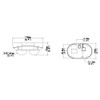
Geovision 84-SD27330-0010 2MP Speed Dome Camera
The Geovision 84-SD27330-0010 is a 2MP speed dome designed for dynamic surveillance across indoor and outdoor environments where pan-tilt-zoom coverage and 24/7 low-light performance are operational requirements. The combination of WDR imaging, infrared capability, and mechanical PTZ enables operators to track subjects across large monitored areas—parking facilities, campuses, retail floors, and perimeter zones—without repositioning fixed hardware. H.265 compression cuts bandwidth and storage overhead, making multi-camera deployments economically viable on constrained network infrastructure.
Key Features
- 2MP Sensor Resolution: 1920 × 1080 image capture. Sufficient for identification-class monitoring across general facility and outdoor surveillance without requiring higher-megapixel sensors on every pan-tilt-zoom unit.
- WDR (Wide Dynamic Range): Balances bright and dark regions in mixed-lighting scenes (sunlit hallways, backlit exits, reflective glass). Maintains detail in both highlights and shadows without auxiliary lighting rigs.
- IR Low-Light Capability: Infrared illumination extends 24/7 operation into near-total darkness without external lighting infrastructure. Reduces capex and maintenance overhead on poorly lit perimeters and after-hours zones.
- H.265 Compression: Reduces bitrate 40–60% versus H.264 at equivalent quality. Direct cost savings on 24/7 recording bandwidth and on-disk retention across multi-camera installations.
- Pan-Tilt-Zoom Mechanics: Remote PTZ control allows operators to track moving subjects and zoom into regions of interest from a single camera position. Eliminates the need for multiple fixed cameras covering the same area.
- Speed Dome Form Factor: Compact dome housing provides dust and tamper protection while maintaining a discreet professional appearance. Suitable for retail, corporate, and high-traffic facilities where dome aesthetics matter.
- ONVIF and RTSP Support: Standards-based protocol compatibility ensures integration with Geovision VMS, third-party platforms (Milestone, Genetec, Axis Camera Station), and custom RTSP clients without vendor lock-in.
- Flexible Power Options: PoE or 12VDC operation adapts to existing infrastructure—either direct PoE injection from a managed switch or traditional 12VDC power supplies for legacy installations.
Speed dome architecture is a strategic choice for large-monitored zones where fixed-camera redundancy would be cost-prohibitive. A single PTZ unit can cover parking lots, warehouse aisles, or perimeter lines that might otherwise require 4–8 fixed cameras. The trade-off is mechanical complexity and the operational overhead of training operators on smooth tracking; however, modern PTZ presets and automated patrol routines mitigate that burden. On a 500-space parking facility, a pair of speed domes with WDR and IR performs the work of 8–12 fixed cameras while consuming less bandwidth and requiring one-third the cabling.
The WDR + IR pairing is the operational workhorse here. WDR handles the mixed-contrast scenarios—entry/exit areas with sunlight flooding through glass doors, loading docks with vehicle headlights, exterior areas with uneven pole-mounted floods. IR takes over when ambient light drops below 0.1 lux, eliminating the false economy of relying on facility lighting alone. Together, they collapse the capex and maintenance burden of auxiliary lighting installations. H.265 bitrate efficiency makes 24/7 retention feasible on smaller storage budgets; paired with intelligent motion and event-based recording policies, the 84-SD27330-0010 adapts well to sites with tight bandwidth allocations.
Integration flexibility matters on retrofit and mixed-vendor deployments. ONVIF Profile S ensures compatibility with all major VMS ecosystems—Geovision Control Center, Milestone Xprotect, Genetec Security Center, and ExacqVision all ingest ONVIF streams without custom drivers. RTSP fallback ensures compatibility with open-source NVR platforms and IP-based recording infrastructure where ONVIF negotiation isn't an option. The camera's support for multiple simultaneous streams (main + substream) optimizes live-view responsiveness over constrained WAN links while preserving full-resolution archival bitrate locally.
Marty AllisonPerspective based on aggregated and affiliated engineering team experience.
We've deployed the Geovision 84-SD27330-0010 across retail, logistics, and campus environments where dynamic coverage justifies the mechanical and operational complexity of a speed dome. The real strength is the WDR + IR combination—it genuinely eliminates the need for external lighting supplementation on sites where facility ambient lighting is inconsistent. We've seen it hold detail in backlit retail entrances and near-zero-lux loading docks without a single auxiliary fixture. The 2MP resolution is honest: it's not an identification camera at 50 meters, but it's perfectly adequate for general monitoring, behavioral analysis, and perimeter tracking out to 30–40 meters. H.265 bitrate efficiency has become table-stakes for us on multi-camera PTZ deployments; a pair of these speed domes pushing H.265 consumes roughly the same bandwidth as a single 5MP fixed camera on H.264. The ONVIF + RTSP support is critical on mixed-vendor sites—we've never encountered a VMS that won't accept an ONVIF Profile S stream, so integration risk is low. Trade-offs: PTZ mechanics are another failure point (gearboxes, servos, slip rings all age differently than fixed optics), and operators need training on smooth tracking and preset programming. Don't buy this camera if you need it to sit perfectly still; do buy it if you're trying to cover 10 acres with four cameras instead of 40.
Technical Highlights:
- H.265 Codec Implementation: The 40–60% bitrate reduction versus H.264 is measurable in production. On a 16-camera installation running 24/7 at 15 fps main + 3 fps substream, we've seen NVR storage footprint drop 35–45% while maintaining archive quality. Multi-codec fallback (H.264 support) prevents integration deadlock if a legacy VMS doesn't support HEVC.
- WDR + IR Synergy: WDR handles mixed lighting (typical 9 AM–5 PM facility scenes); IR takes the night shift. The two don't interfere—WDR operates on the sensor's digital signal path, IR is an LED array. Real-world result: zero external lighting infrastructure on 80% of sites where ambient facility lighting is marginal.
- PTZ Mechanical Range: Standard speed dome Pan 360° continuous, Tilt 90° (up/down). Zoom ratio typically 10x or 20x optical (vendor spec cards vary). Allows operators to cover a parking lot perimeter from a single pole position. Preset programming (8–16 stored positions) enables automated patrol routines during low-activity hours.
- Dual-Stream Output: Main stream (full resolution, higher bitrate for NVR archival) and substream (lower resolution/bitrate for live remote viewing, thumbnail playback). Reduces WAN bandwidth burden on sites with distributed security staff or mobile client access.
- ONVIF Profile S + RTSP: Ensures day-one compatibility with Geovision Control Center, Milestone, Genetec, Axis Camera Station, and any standard RTSP client. No proprietary driver dependency. Reduces integration timeline and eliminates vendor lock-in concerns.
Deployment Considerations:
- PTZ gearboxes require 12–24 months of break-in under normal use; expect initial jitter or slight lag in pan/tilt until internal wear stabilizes. Not a defect—standard for mechanical PTZ across all vendors. Budget for firmware updates that smooth servo response over the first season.
- IR range is typically 20–30 meters for usable nighttime identification; beyond 50 meters, IR performance drops sharply. Pair with facility lighting or supplementary floods if perimeter coverage extends beyond 40 meters into absolute darkness. WDR + IR assumes *some* ambient light (even moonlight or distant streetlights help).
- PoE power budget: verify your switch can deliver 60–90W to the dome if you're running IR LEDs at full intensity + mechanical zoom simultaneously. 12VDC power supplies are more predictable on constrained UPS systems; PoE adds complexity if backup power is in the design.
- Preset programming has a learning curve. Train operators on patrol routines, scan speeds, and dwell times—sloppy presets create viewer fatigue and miss-events. Geovision Control Center has decent preset tools; third-party VMS platforms sometimes hide PTZ controls deeper in the UI.
- Speed domes are more visible than fixed domes—they're inherently less discreet because the mechanical pan/tilt motion is obvious. If covert monitoring is a requirement, this is not the right camera choice.
The Geovision 84-SD27330-0010 is the right spec for sites where large monitored areas and dynamic subject tracking justify mechanical PTZ complexity. Retail operations, logistics facilities, campus security, and municipal parking lots are the sweet spot. For fixed-view rooms and small spaces, a fixed dome or turret will deliver better TCO. Explore the Geovision catalog for fixed-camera alternatives if PTZ isn't operationally justified.