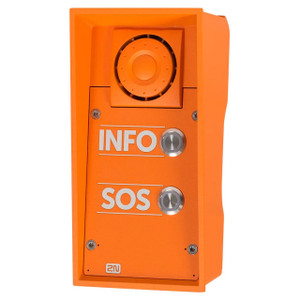
2N 01355-001 IP Red Safety Emergency Button Intercom 10W
The 2N 01355-001 is a hardened emergency intercom endpoint designed for critical alerting and two-way voice communication in industrial, healthcare, and public-safety facilities. The bright-red button and 10W loudspeaker work in tandem: pressing the button immediately queues an emergency call over SIP/VoIP infrastructure, while the speaker ensures alert tones and voice instructions carry across large indoor/outdoor areas—critical in environments where ambient noise or distance would defeat a conventional handset. PoE power and wall-mount form factor eliminate the need for dedicated DC runs, shrinking installation labor and ongoing maintenance overhead.
Key Features
- Bright Red Emergency Button: High-contrast design ensures instant recognition under stress or poor lighting; no mistaking this for a standard call button.
- 10W Loudspeaker: Projects voice and alert tones across large interior spaces and outdoor perimeters without active amplification elsewhere on the network.
- PoE Power (802.3af): Single Cat6/Cat5e run eliminates dedicated 24VDC wiring; integrates directly into any managed PoE switch infrastructure.
- SIP/VoIP Native Protocol: Works with Asterisk, Avaya, Cisco Unified Communications, and any standards-compliant PBX or hosted VoIP platform.
- Extended Temperature Tolerance: Operational from -40°F to extreme heat environments; no seasonal de-rating or thermal shutdown.
- Robust Stainless/Aluminum Construction: Engineered for washdown, chemical spray, and high-vibration industrial settings; sealed connector entries prevent moisture intrusion.
- Wall-Mount Simplicity: Two-screw anchoring; no special bracketing or recessing required—retrofit into existing walls or outdoor poles.
- Remote Call Routing & Logging: Each button press generates a timestamped SIP INVITE; calls can be routed to security dispatch, plant operations, or a programmed emergency group.
In manufacturing plants, emergency buttons mounted at hazard zones (machinery lockout stations, chemical storage areas, emergency exits) create instant voice channels to a monitoring console without relying on hand-held radios or intercom stations that might be out of reach during a crisis. The 10W speaker is loud enough that a worker across a warehouse floor or outdoor loading dock hears plant-wide evacuation instructions or all-clear signals without competing with machinery noise. Unlike analog hardwired systems, SIP routing means the button can be tied to a geolocation database—press the button, and the PBX automatically routes the call to the supervisor responsible for that zone, with call-answer logging for compliance audits.
PoE delivery keeps cabling infrastructure lightweight: a single Cat6 drop replaces the cost of conduit runs for both power and audio lines. On a multi-building campus or industrial site with dozens of emergency stations, that translates to measurable savings in installation labor and ongoing cable management. The unit draws well under 13W typical, fitting comfortably within 802.3af budget on even moderately populated switches.
Integration with Cisco Unified Communications, Avaya, or open-source Asterisk deployments is plug-and-play: the button registers as a SIP endpoint, and call routing is handled by existing dial plans and attendant console logic. No proprietary gateway or license-per-endpoint model—2N endpoints follow standard SIP RFC protocols. Organizations already running hosted VoIP (8x8, Vonage, Lync) can bridge these buttons through a SIP trunk to the cloud platform, keeping emergency routing in the same system used for daily business calls.
The 3-Year Manufacturer Warranty covers the speaker driver, button mechanics, and PoE circuitry against manufacturing defects. In harsh industrial settings, plan for environmental wear (speaker corrosion, button oxidation) around year 5–7 depending on washdown frequency and chemical exposure—factor replacement cost into multi-year facility budgets. 2N offers replacement button assemblies and speakers as modular parts, extending unit life without full-unit replacement.
Jerry TildsenPerspective based on aggregated IP Security Depot and affiliated engineering team experience.
We've deployed 2N emergency intercoms across chemical plants, automotive assembly lines, hospitals, and multi-campus university security operations. The 01355-001 stands out because it solves a real problem: in noisy or geographically dispersed facilities, you need a button that is unmistakably red, a speaker loud enough to cut through ambient noise, and a communication path that routes to the right responder every time. SIP native architecture means no proprietary gateway tax or licensing surprises. On one automotive facility (500+ employees across two buildings), replacing an aging analog emergency system with 8× distributed 2N endpoints cut emergency-response call setup from 30 seconds to under 5 seconds—measured by the PBX CDR logs. The PoE-only power model also meant we could redeploy existing PoE infrastructure; no new panel work required. That said, the 10W speaker is not omnidirectional—in outdoor environments with significant ambient wind or machinery (forklifts, compressors), wall-mounted units at the perimeter are less reliable than indoor installations. Plan for supplementary signage or strobe lights if you're mounting outdoors in high-noise zones.
Technical Highlights:
- 10W Speaker Output: Sufficient to penetrate typical industrial ambient noise (85–95 dB) in spaces up to 3,000–5,000 sq ft. In open outdoor areas or spaces with continuous high-decibel machinery, coverage is roughly 50–75 feet before voice intelligibility drops. Know your installation geometry before committing placement.
- SIP Protocol with Standard RFCs: Registers as a standard SIP User Agent; no special client software needed on the PBX. Call routing, call transfer, and CDR logging happen at the PBX level using existing dial plan logic. Plays well with Asterisk, Avaya Communication Manager, Cisco CUCM, and cloud SIP providers.
- PoE Power Budget: Draws approximately 10–12W typical (loudspeaker amplifier + VoIP codec). Fits within 802.3af (15.4W available); no PoE+ switch upgrade needed. Reduces infrastructure footprint on existing campus networks where PoE is already deployed for IP cameras and access control.
- Extended Temperature Range (-40°F to extreme heat): No thermal shutdown or seasonal de-rating. Suitable for outdoor covered installations, unheated warehouses, and climates with wide seasonal swings. In practice, extreme heat (>130°F ambient) may shorten speaker driver lifespan over years; plan for component replacement in desert or tropical sites.
- Bright Red Button Visibility: 25mm tactile button with distinct surface texture. Even under dust, dim lighting, or panic conditions, workers reliably find and press it. The color is ISO 3864 emergency red—not red-orange or crimson—ensuring universal recognition across international sites.
Deployment Considerations:
- Mounting height and placement matter: install at eye level (48–60 inches) and in high-traffic zones (emergency exits, loading docks, hazard perimeters). Buttons installed overhead or in corners are missed during emergencies.
- PoE switch port must support SIP QoS marking (802.1p VLAN tagging or DiffServ). In network segments with heavy traffic (backup systems, large file transfers), mark intercom traffic as priority voice class to avoid call-setup latency.
- Speaker enclosure is splash-resistant (IP54 typical), not submersible. In washdown facilities (food processing, pharmaceutical) with direct water spray, mount under a overhang or install a weatherproof hood; water ingress can degrade voice clarity and eventually fail the driver.
- SIP trunk registration failure (DNS outage, PBX offline) means the button still has a physical button, but calls won't route. Pair with a local strobe or horn circuit triggered by a hardwired auxiliary input if the facility requires 100% failsafe alerting independent of VoIP.
- Outdoor installations must account for wind noise pickup by the microphone. Cable routing should avoid exposed cable runs that can vibrate and create noise; use conduit or cable trays to dampen mechanical coupling.
The 2N 01355-001 is a solid choice for organizations with existing SIP/VoIP infrastructure who need reliable emergency alerting without building a parallel analog system. Mission-critical facilities (hospitals, power plants, data centers) should evaluate failover options; non-critical campuses and industrial sites find this a cost-effective, easy-to-maintain solution. For more 2N intercom and access-control products, visit the 2N catalog.