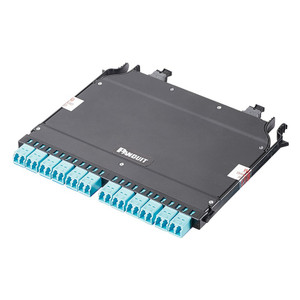
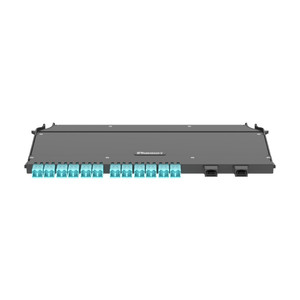
Panduit FDSZO-24-10R 24-Fiber OM4 LC Duplex FlexCore Fiber Cassette
The Panduit FDSZO-24-10R is a 24-fiber OM4 multimode splice cassette engineered for high-density optical distribution frame (ODF) and optical splice frame (OSF) deployments in datacenters and enterprise structured cabling environments. It delivers LC Duplex connectivity on the front panel with unterminated ribbon pigtails on the rear, enabling rapid mass-fusion splicing to incoming trunk cables while maintaining front-access serviceability. Optimized insertion loss specifications preserve link budgets on 40GBASE-SR4 and 100GBASE-SR4 parallel optics channels, where every tenth of a decibel matters over OM4's 100-150 meter reach. Built into Panduit's FlexCore platform, this cassette integrates with modular ODF chassis for scalable fiber management in spaces constrained by rack depth, U-count, or cable-access geometry.
Key Features
- 24-Fiber OM4 Capacity: Supports twelve LC duplex ports in a single cassette footprint, equivalent to 24 simplex fibers for 40G/100G SR4 parallel optics or twelve 10G duplex links.
- LC Duplex Front, Ribbon Pigtails Rear: Pre-terminated LC connectors face the front panel for patch-cord access; rear pigtails accept 12-fiber ribbon cables for mass fusion splicing, cutting per-fiber splice time by 90% versus single-fiber workflows.
- Optimized Insertion Loss: Factory-polished LC connectors and controlled pigtail routing minimize connector-pair IL, preserving margin on loss-sensitive 40/100GBASE-SR links where IEEE 802.3ba budgets leave little room for distribution-layer attenuation.
- FlexCore ODF/OSF Platform Integration: Mounts in Panduit FlexCore front-access enclosures, sharing the platform's tool-less cassette retention, integrated splice-tray management, and front-only service access—critical in back-to-back rack rows or wall-mount installations.
- Polycarbonate Housing, 11.7 mm Profile: Black polycarbonate shell withstands repeated cassette insertion/removal cycles; 11.7 mm height fits FlexCore's high-density stacking pitch, yielding 288+ fibers per 1U enclosure.
- 50 µm OM4 Laser-Optimized Fiber: OM4 multimode core supports 10 Gb/s to 400 m, 40 Gb/s to 150 m, and 100 Gb/s to 100 m over cost-effective VCSEL transceivers, avoiding single-mode's tighter loss budgets and higher transceiver costs for intra-building links.
- Standards Compliant: Meets ISO/IEC 11801, ANSI/TIA-568-C.3, TIA-604-5 (FOCIS-5 LC), TIA-604-10 (FOCIS-10 MPO/ribbon), IEEE 802.3ba (40/100G Ethernet), and ANSI T11.2 (Fibre Channel); RoHS 2002/95/EC compliant for EU installations.
- Unterminated Ribbon Pigtails: Installer splices incoming trunk to pigtails on-site, enabling polarity assignment per TIA-568 Method A/B/C or custom datacenter schemes without pre-ordering fixed-polarity variants.
- Carton Quantity 10: Sold in 10-cassette cartons for bulk ODF builds, reducing per-cassette packaging waste and freight cost on large-scale datacenter fit-outs.
Cassette Architecture and Splice Workflow: The FDSZO-24-10R's rear pigtails terminate in 12-fiber ribbon format, matching the industry-standard ribbon cable used in high-count trunk assemblies. During installation, the technician strips the incoming trunk's outer jacket, exposes the 12-fiber ribbon, cleaves it in a ribbon cleaver, and performs a single mass-fusion splice operation that bonds all twelve fibers simultaneously. This reduces splice time from approximately 10 minutes per fiber (144 splices for a 144-fiber trunk) to approximately 10 minutes per twelve-fiber ribbon (12 splice cycles for the same trunk), cutting labor cost and deployment time by an order of magnitude. The cassette's internal fiber routing guides pigtails from the splice tray to the LC duplex connectors, maintaining minimum bend radius (≥30 mm for OM4) and preventing fiber stress concentrations that degrade insertion loss or long-term reliability. Factory-polished LC connectors are tested to ≤0.25 dB typical IL and ≥50 dB return loss, ensuring repeatable performance across the cassette array. Installers verify each connector pair with an optical loss test set (OLTS) after splicing, comparing results against the IEEE 802.3ba channel loss budget: 1.9 dB for 40GBASE-SR4, 1.9 dB for 100GBASE-SR10. The optimized-IL designation means Panduit has tuned connector endface geometry, fiber alignment, and internal routing to consistently land below 0.2 dB per mated pair, leaving 1.5+ dB margin for cable attenuation, splice loss, and aging—critical when OM4 fiber attenuation is 3.0 dB/km and a 100 m link consumes 0.3 dB in fiber alone.
Deployment Context and ODF Migration Strategy: Datacenter operators adopt cassette-based ODF architectures to decouple trunk cabling (permanent, high-fiber-count, expensive to re-pull) from distribution cabling (flexible, lower-count, frequently reconfigured). The FDSZO-24-10R fits this model by accepting a 24-fiber or 48-fiber trunk cable spliced to multiple cassettes, then presenting LC duplex ports for structured patch-cord breakout to switches, servers, or storage arrays. A common deployment: 144-fiber OM4 trunk from the meet-me room to the top-of-rack ODF, spliced to six FDSZO-24-10R cassettes (6 × 24 = 144 fibers), yielding 72 LC duplex ports for 72 servers running dual 10G NICs or 36 servers running 40G QSFP+ breakout cables. When the facility upgrades to 100G switch uplinks, the operator swaps 10G SR transceivers for 100G SR4 transceivers without re-splicing trunks—only the patch cords and cassette selection change. Front-access design matters in hot-aisle/cold-aisle layouts where the ODF mounts on the cold-aisle side of a back-to-back rack row; rear-access enclosures would require the technician to reach into the hot aisle or depopulate adjacent racks to service splices. FlexCore's front-only access (patch cords, cassette insertion, splice trays) eliminates this conflict, reducing MTTR during adds/moves/changes. Cassette density also impacts U-count budgets: a 1U FlexCore enclosure holds up to twelve 24-fiber cassettes (288 fibers, 144 LC duplex ports) versus traditional fiber panels offering 24-48 ports per 1U. For a 1,000-port datacenter fabric, cassette-based ODF consumes approximately 7U versus 21-42U for legacy panels, freeing rack space for revenue-generating compute.
Compliance and Link-Budget Preservation: The FDSZO-24-10R meets ANSI/TIA-568-C.3 and ISO/IEC 11801 structured cabling standards, making it eligible for 25-year channel warranties when installed per manufacturer guidelines and tested to component-grade specifications. TIA-604-5 (FOCIS-5) governs LC connector physical dimensions and endface geometry; TIA-604-10 (FOCIS-10) covers MPO/ribbon connector tolerances—both critical for multi-vendor interoperability when mixing Panduit cassettes with third-party trunk cables or patch cords. IEEE 802.3ba compliance ensures the cassette's insertion loss and return loss fit within 40GBASE-SR4 and 100GBASE-SR10 channel budgets, verified by the factory's insertion-loss histogram showing 95% of connectors below 0.2 dB. This optimization reduces link-margin erosion on fully-loaded 100 m OM4 runs—where cable attenuation (0.3 dB), four connector pairs (4 × 0.2 dB = 0.8 dB), and two splice points (2 × 0.1 dB = 0.2 dB) sum to 1.3 dB against a 1.9 dB budget—leaving 0.6 dB safety margin for aging, contamination, or minor installation deviations. Lower-quality cassettes with 0.3-0.5 dB connectors would push the same link to 1.5-1.9 dB, risking intermittent bit errors or outright link failure under temperature swing or when transceivers age past their calibrated power range. For spine-leaf fabrics running 100GBASE-SR4 at line rate across hundreds of parallel links, this 0.1-0.3 dB difference separates a stable network from one plagued by forward-error-correction exhaustion and packet retransmits.