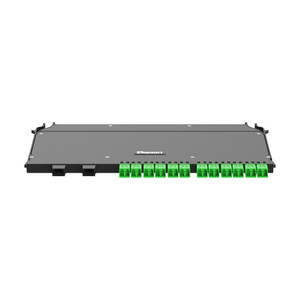
Panduit FDC9N-24-10URH FlexCore 24-Fiber Single-Mode Cassette
The Panduit FDC9N-24-10URH is a FlexCore front-access ODF cassette that bridges MPO trunk cables to LC duplex equipment ports in high-density datacenter and enterprise network installations. This 24-fiber single-mode (OS2) module converts two 12-fiber MPO-12 male connectors on the rear to twelve LC duplex ports on the front, delivering 24-strand breakout capacity in a compact 0.46-inch-tall form factor. Designed for universal polarity compatibility, this right-hand orientation cassette supports Method A, B, and C deployment architectures without adapter changes, streamlining migration from 10G to 40G/100G Ethernet and Fiber Channel infrastructures.
Key Features
- 24-Fiber Breakout Architecture: Two rear MPO-12 male connectors break out to twelve front-facing LC duplex ports, supporting 12 bidirectional links in a single cassette slot
- Universal Polarity Design: Field-configurable for Method A, Method B, or Method C polarity schemes without swapping adapters or cassettes, simplifying inventory and reducing deployment errors
- OS2 Single-Mode Performance: Engineered for 9/125µm single-mode fiber with standard insertion loss specs, supporting 10G/40G/100G Ethernet and 16G/32G Fiber Channel over extended distances
- FlexCore ODF Integration: Drop-in module for Panduit FlexCore front-access enclosures, enabling tool-free installation and hot-swappable reconfiguration without disrupting adjacent circuits
- High-Density 1U Profile: 0.46" (11.7mm) height allows up to 24 cassettes per standard 1U FlexCore panel, delivering 576-fiber capacity in a single rack unit
- Standards-Compliant Construction: Meets ISO/IEC 11801, ANSI/TIA-568-C.3, TIA-604-5 (FOCIS-5), TIA-604-10 (FOCIS-10), IEEE 802.3, and ANSI T11.2 Fiber Channel specifications
- Right-Hand Orientation: MPO key-up position on the right side of the cassette, matching infrastructure layouts that require directional cable routing for left-to-right patch management
- Polycarbonate Housing: Black UL94-rated polycarbonate enclosure provides mechanical protection and maintains minimum bend radius for internal fiber routing
MPO-to-LC cassettes have become the foundation of modern datacenter structured cabling because they decouple backbone infrastructure from active equipment migration cycles. When you install MPO trunk cables in cable trays and raceways during initial buildout, you create a permanent fiber highway that supports multiple technology generations without re-pulling cable. The FDC9N-24-10URH cassette acts as the translation layer: the rear MPO-12 connectors mate with pre-terminated trunk assemblies (typically 8-fiber or 12-fiber MPO cables), while the front LC duplex ports provide standard connectivity for switches, storage arrays, and servers. This architecture matters because LC remains the dominant duplex connector for 10GBASE-SR/LR, 25GBASE-SR, and even 100GBASE-SR4 breakout applications, while MPO handles the 40G/100G/400G parallel optics on the backbone side.
Universal polarity is this cassette's key differentiator for mixed deployments. TIA-568 defines three polarity methods: Method A (straight-through key-up-to-key-down), Method B (key-up-to-key-up with one fiber crossover), and Method C (array-to-array pairs flipped). Legacy installations often mixed methods as standards evolved, and troubleshooting polarity mismatches during 40G migrations costs hours of labor. The FDC9N-24-10URH uses a pinning design that works correctly regardless of which method your MPO trunks follow—flip the cassette orientation or swap the MPO connector key position, and the LC port mapping auto-adjusts. For integrators managing acquisitions or building expansions where documentation is incomplete, this removes the guesswork: plug in the cassette, verify link light, move on. The right-hand orientation specifically refers to the MPO key-up position being on the right side when viewing the cassette from the front, which aligns with FlexCore ODF layouts that route MPO trunks from the right-side cable management and LC patch cords from the left.
Insertion loss performance determines your link budget and maximum reach. This cassette uses standard insertion loss grade (as opposed to Panduit's ultra-low-loss UL variants), typically 0.5 dB or less per mated connector pair under TIA-604-5 test conditions. For single-mode OS2 fiber, that translates to support for 10GBASE-LR links beyond 10km, 40GBASE-LR4 beyond 10km, and 100GBASE-LR4 beyond 10km when combined with compliant optics and cleaned connectors. If your deployment involves very long campus links (over 30km) or you're chaining multiple cassette stages, Panduit offers UL (ultra-low) variants with sub-0.35 dB performance—but for typical datacenter and intra-building fiber runs under 2km, standard IL grade provides ample margin. The OS2 fiber specification supports wavelengths from 1260nm to 1625nm, covering CWDM and DWDM multiplexing if you later add dense wavelength division to increase capacity without pulling new fiber.
Installation into FlexCore ODF enclosures requires no tools: slide the cassette into the numbered slot, press until the latch clicks, then route the rear MPO connectors to their corresponding trunk positions in the enclosure's MPO adapter panel. The front LC ports remain accessible for patching while the rear stays locked behind the enclosure door, enforcing a clean separation between permanent infrastructure (MPO trunks) and movable patch cords (LC jumpers). This matters during adds/moves/changes—your tier-1 techs patch LC cords at the front without opening the rear enclosure and risking accidental MPO disconnects that would drop 12 or 24 circuits simultaneously. When you need to reconfigure port counts (say, moving from 24-fiber cassettes to 48-fiber units as switch density increases), the cassette pulls out in under 10 seconds and the new unit drops in without interrupting adjacent slots.
The 0.46-inch height is the critical dimension for density planning. Standard FlexCore 1U panels accept up to 24 of these cassettes side-by-side, yielding 288 LC duplex ports (576 fibers) in a single rack unit. For comparison, traditional LC duplex panels max out at 144 ports per 1U because each LC duplex connector requires rear-panel space for two individual fibers. MPO-based cassette systems double that density by consolidating twelve fibers into a single MPO footprint on the rear. In a 42U rack, if you dedicate 10U to fiber patching, you're looking at 2,880 LC ports—enough to support a fully-populated leaf-spine fabric with 96-port 100G switches broken out to 25G server connections. The width (11.53 inches / 292.8mm) fits FlexCore enclosure widths; these cassettes are not compatible with other vendors' ODF systems due to mechanical latch and MPO adapter positioning differences.
Standards compliance ensures interoperability and future-proofs your investment. TIA-568-C.3 is the North American structured cabling standard for optical fiber; ISO/IEC 11801 is the international equivalent. Both define performance classes, connector types, and polarity methods. TIA-604-5 (FOCIS-5) governs MPO connector mechanical and optical specs—ferrule geometry, endface radius, fiber protrusion—while TIA-604-10 (FOCIS-10) does the same for LC connectors. IEEE 802.3 (Ethernet) and ANSI T11.2 (Fiber Channel) define the physical media dependent sublayers for the actual data transmission. When a cassette lists all five standards, it means the insertion loss, return loss, connector endface quality, and fiber geometry have been tested to support both current and future protocols at those rated speeds. This cassette's compliance with IEEE 802.3 specifically covers 10GBASE-SR/LR, 40GBASE-SR4, and 100GBASE-SR4/LR4 over the appropriate fiber types and distances.
RoHS compliance (2002/95/EC) confirms lead-free solder and restricted hazardous substances, required for EU installations and increasingly specified by enterprise procurement even in non-EU regions. The polycarbonate housing carries UL94 flammability rating, important for plenum-adjacent rack installations where fire codes apply to all components, not just the cables. Panduit ships this cassette individually (package quantity 1) with a carton quantity of 10, meaning bulk orders arrive in 10-unit boxes—plan your staging if you're deploying a full panel's worth (24 cassettes) to avoid mid-install shortages.
This cassette integrates into Panduit's FlexCore ODF ecosystem, which includes wall-mount, rack-mount, and cabinet-mount enclosures in 1U, 2U, and 4U heights. The front-access design is the key attribute: older ODF systems required rear access to swap cassettes, forcing you to pull the entire enclosure out of the rack or walk behind the cabinet. FlexCore front-access enclosures keep the MPO trunk connections fixed in the rear cavity (accessed only during initial installation) while all cassette swaps, adds, and troubleshooting happen from the front. For datacenter hot-aisle/cold-aisle layouts where rear access means stepping into the hot aisle and disturbing airflow seals, front-access architecture reduces HVAC disruption and speeds Mean Time to Repair (MTTR) during outages. If your infrastructure was built with pre-terminated MPO trunks pulled overhead or under-floor, this cassette turns that backbone into a reconfigurable cross-connect without re-terminating a single fiber.
The FDC9N-24-10URH ships with factory-installed LC adapters and MPO connectors, pre-terminated and tested for insertion loss—no field polishing, no epoxy, no guesswork on fiber alignment. That's the economic argument for cassette-based systems: the labor cost to field-terminate and test 24 individual LC connectors (including re-do's for failures) typically exceeds the cost premium of the cassette itself, and you eliminate the variability of field tech skill levels. Panduit's factory testing includes automated insertion loss measurement on all 24 fibers, with per-unit test reports available on request for mission-critical deployments where you need documented proof of performance before going live.
Right-hand orientation matters when planning cable routing. In a FlexCore panel populated left-to-right with numbered slots, right-hand cassettes route their MPO connectors to the right side of the enclosure's rear adapter panel. If your MPO trunk cables enter the rack from the right-side vertical cable manager, right-hand cassettes minimize bend radius and cable crossing. Panduit also offers left-hand variants (LH suffix instead of RH) for mirrored layouts. Mixing orientations in the same enclosure works—each cassette is independent—but keeping consistent orientation across a panel simplifies documentation and troubleshooting. The numbering on the LC ports (1-12) corresponds to the fiber positions within the two MPO connectors: ports 1-6 map to the first MPO-12, ports 7-12 to the second MPO-12, following TIA-568-C.3 pair mapping rules.
When budgeting for a FlexCore deployment, the cassette cost is typically 15-20% of the total system cost—the rest goes to enclosures, MPO trunk cables, LC patch cords, and labor. But the cassette choice determines your migration path: a 24-fiber cassette gives you 12 duplex links today, but if you later need to support 100GBASE-SR4 (which uses 8 fibers in parallel), you'll need to swap to a different cassette pinout or add breakout modules. For most enterprise and datacenter environments standardizing on 10G/25G server connectivity with 40G/100G uplinks, the 24-fiber LC duplex cassette remains the workhorse—it maps cleanly to the way switches and storage present their ports (individual LC or LC duplex), and it preserves the flexibility to re-patch circuits without opening the rear enclosure. The standard insertion loss grade balances cost and performance for link lengths under 10km; if you're building a campus backbone connecting buildings 10-40km apart, budget for the UL (ultra-low) variants to preserve link margin.
The Panduit FDC9N-24-10URH delivers TIA-568-C.3 compliant 24-fiber breakout in a field-swappable cassette that integrates with FlexCore ODF front-access enclosures, providing universal polarity compatibility and right-hand MPO orientation for datacenter migrations from 10G to 100G Ethernet and 32G Fiber Channel. Its factory-terminated LC and MPO connectors eliminate field polishing labor while maintaining sub-0.5 dB insertion loss on OS2 single-mode fiber, and the 0.46-inch height enables 576-fiber capacity in a single 1U panel—making this cassette the structured cabling foundation for high-density leaf-spine fabrics where backbone permanence and equipment-side flexibility are both non-negotiable.