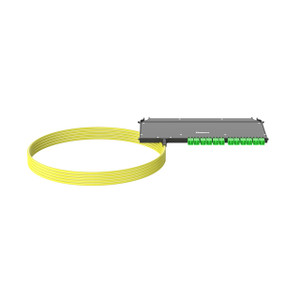
Panduit FDC9N-24-LAASRH FlexCore 24-Fiber OS2 Cassette with LC/APC to MPO-12 Connectivity
The Panduit FDC9N-24-LAASRH is a FlexCore front-access ODF fiber optic cassette engineered for high-density single-mode (OS2) trunk deployments in data centers and enterprise network cores. This 24-fiber module converts duplex LC/APC connections on the front panel to two 12-fiber MPO trunk connectors on the rear, using Method A straight-through polarity to simplify 40G/100G migration paths. Right-hand orientation, standard insertion loss, and black polycarbonate housing deliver field-proven reliability in space-constrained rack environments where every RU counts and polarity errors can halt entire switch fabric builds.
Key Features
- 24-fiber single-mode (OS2/OS1) capacity in a compact front-access cassette for 12 duplex LC circuits
- LC/APC duplex connectors on front panel deliver -60dB typical back-reflection for coherent optics and long-reach applications
- Two MPO-12 male trunk connectors with Method A polarity align with 40GBASE-LR4/100GBASE-LR4 parallel optics without crossover trunks
- Standard insertion loss (≤0.5dB typical) preserves link budgets for 10km+ OS2 reaches
- Right-hand fiber routing optimized for side-by-side cassette installations in high-density ODF panels
- Polycarbonate housing with 11.7mm height fits FlexCore ODF/OSF chassis in 1U and 2U configurations
- Factory-terminated and end-face inspected—zero field splices or field terminations required
- ISO/IEC 11801, ANSI/TIA-568-C.3, TIA-604-5 (FOCIS-5), TIA-604-10 (FOCIS-10) compliant for structured cabling deployments
- RoHS 2002/95/EC compliant for global data center footprints
- IEEE 802.3 and ANSI T11.2 (Fibre Channel) ready for converged Ethernet and storage networks
The FlexCore cassette architecture uses pre-terminated OS2 single-mode fiber with a 9µm core diameter, factory-spliced into a compact module and tested to guarantee insertion loss performance across all 24 strands before shipment. LC/APC (angled physical contact) connectors on the front panel reduce back-reflection to -60dB typical, a critical requirement for high-speed coherent optics, DWDM systems, and extended-reach applications where signal integrity cannot tolerate Fresnel reflection from flat-polished PC or UPC interfaces. The 8-degree angle polish on APC ferrules directs reflected light into the cladding rather than back toward the source, preventing interferometric noise in sensitive transceivers. The rear MPO-12 male connectors (one per 12-fiber ribbon) follow Method A pinout—straight key-up-to-key-down mapping—so position 1 on the LC side maps to position 1 on the MPO trunk, position 2 to position 2, and so forth without crossover. This polarity scheme aligns with 40GBASE-LR4 and 100GBASE-LR4 parallel optics (QSFP+ and QSFP28 modules) that expect a straight-through fiber path on each of the four or ten wavelength lanes. Installers avoid the Type-B and Type-C crossover trunk confusion that plagues mixed-polarity deployments, and MAC operations become paint-by-numbers—any cassette in the FlexCore family with Method A will interoperate without re-pinning or adapter flips. Standard insertion loss (typically ≤0.5dB across the entire cassette path, including both MPO interfaces and the internal ribbon) ensures link budgets remain viable for 10km OS2 reaches at 10G per lane, 2km at 25G per lane, and emerging 50G-PAM4 applications without mid-span amplification or dispersion compensation modules.
The 292.8mm-wide form factor matches standard FlexCore ODF enclosure widths, allowing up to 24 cassettes (576 LC duplex ports, 1,152 fibers) in a single 2U chassis when paired with Panduit's high-density ODF frames. The right-hand fiber routing steers bend-radius-managed cables toward the right side of the cassette when viewed from the front, a design detail that matters when installing multiple cassettes side-by-side in horizontal rows—each cassette's exit path aligns with the adjacent unit's entry path, creating a natural left-to-right or right-to-left cable flow that prevents crossover snarls in the vertical cable manager. The 11.7mm height leaves clearance for stacked installations in shallow-depth network cabinets common in telco central offices and colocation cages where rear access is limited to 12 inches. Because the cassette is a sealed, pre-tested assembly, there are no loose furcation legs, no breakout boots to manage, and no field-applied connectors that require cleaning and inspection before acceptance—every LC and MPO connector ships with a factory end-face report showing insertion loss, return loss, and geometry parameters (radius of curvature, apex offset, fiber height) measured on calibrated interferometric equipment. Installers can verify performance with an OTDR or light source/power meter, but the factory test data provides a baseline that eliminates "was it damaged in shipping or was it never right" debates during commissioning.
Data center operators migrating from 10GBASE-LR (duplex LC at 10Gb/s per fiber pair) to 40GBASE-LR4 (parallel optics at 4×10Gb/s over eight fibers) or 100GBASE-LR4 (parallel optics at 4×25Gb/s over eight fibers) face two persistent challenges: maintaining port density while preserving existing structured cabling infrastructure, and ensuring polarity consistency across hundreds of duplex links when transceivers switch from two-fiber to eight-fiber or twenty-fiber footprints. The FDC9N-24-LAASRH addresses both by consolidating 24 LC duplex ports (12 duplex circuits) into a single hot-swappable cassette that connects to pre-installed MPO-12 trunk cables in the overhead cable tray or underfloor conduit. This trunk-and-breakout topology reduces in-rack cabling complexity—installers pull a single 12-fiber or 24-fiber MPO trunk from the MDA (main distribution area) to the top-of-rack switch location, click the cassette into the front of the FlexCore ODF enclosure mounted in the rack, and break out to individual LC duplex patch cords at the switch faceplate. The result is 40–60% less cable volume in vertical managers compared to discrete duplex fiber runs, lower installation labor (one trunk pull versus twelve duplex pulls per cassette), and deterministic polarity (the trunk is pre-tested end-to-end, and the cassette polarity is fixed at manufacture). The front-access design allows cassette replacement, reconfiguration, or troubleshooting without disturbing rear trunk connections—critical in live production environments where pulling a trunk can drop an entire leaf-spine tier or storage fabric. The 11.7mm height enables 24-port duplex density in a single 1U ODF when paired with the appropriate FlexCore chassis, and the black housing with clear labeling windows (for inserting laser-printed circuit IDs or color-coded tags) simplifies MAC (move/add/change) operations under dim raised-floor lighting or in blacked-out secure facilities.
The cassette ships as a single pre-tested assembly with no field splices, no field terminations, and no loose components—every LC connector is factory-polished and inspected, every MPO connector is factory-pinned and tested, and the internal fiber ribbons are fusion-spliced in a controlled clean-room environment with automated splice loss verification. This eliminates the 70% of fiber commissioning time typically spent on connector cleaning, end-face inspection (pass/fail on scratch and contamination criteria per IEC 61300-3-35), rework of failed terminations, and OTDR troubleshooting of high-loss splices. For greenfield builds, the cassette-based approach cuts installation time by 60–70% compared to field-terminated breakout harnesses or individual duplex trunks, and for forklift upgrades (ripping out old copper or multimode fiber and replacing with OS2 single-mode), the pre-tested assembly de-risks the project by removing installer skill variability from the critical path. The Method A polarity is the TIA-568-C.0 Annex E recommended default for duplex-to-MPO applications, so the cassette integrates into mixed-vendor environments without requiring Panduit-specific adapters, crossover modules, or polarity-flipping patch panels. Installers can use off-the-shelf MPO trunk cables from any TIA-compliant supplier as long as the trunk follows Method A key-up-to-key-down pinout, and the LC duplex patch cords on the front can be generic OS2 LC/APC jumpers—no proprietary keying or latch modifications required.
Standard insertion loss performance (≤0.5dB typical per cassette, measured from MPO interface to LC interface including all internal splices and connectors) is suitable for the majority of data center and enterprise campus applications where link distances are under 10km and transceiver sensitivity margins are comfortable. For ultra-low-loss requirements (long-haul metro links, passive optical LAN architectures with 1:32 or 1:64 splitters, or high-split-count DWDM systems), Panduit offers low-insertion-loss variants of the FlexCore cassette with ≤0.35dB typical performance—consult the model suffix guide to identify the appropriate SKU, as loss grade is fixed at manufacture and cannot be field-adjusted. Similarly, for installations requiring left-hand fiber routing (to align with cable management channels on the left side of the rack) or alternative polarity methods (Method B for cross-connect applications, Method C for array connectors), the cassette family includes dedicated SKUs with the appropriate suffix codes. The FDC9N-24-LAASRH as specified here is right-hand, Method A, standard loss—attempting to reverse the hand orientation or re-pin the MPO connectors in the field will void the factory test certification and likely introduce unacceptable insertion loss or polarity errors.
Compliance with ISO/IEC 11801 (generic cabling for customer premises), ANSI/TIA-568-C.3 (optical fiber cabling components standard), and TIA-604-5 (FOCIS-5, the LC connector interface standard) plus TIA-604-10 (FOCIS-10, the MPO connector interface standard) ensures the FDC9N-24-LAASRH integrates into multinational data center footprints governed by mixed cabling specifications—ISO in EMEA and APAC regions, TIA in North America, and hybrid ISO/TIA in global enterprise networks. IEEE 802.3 readiness confirms compatibility with 10GBASE-LR, 40GBASE-LR4, and 100GBASE-LR4 Ethernet standards, while ANSI T11.2 (Fibre Channel) readiness ensures the cassette works in 16GFC, 32GFC, and emerging 64GFC storage fabrics where single-mode fiber is replacing multimode to extend reach beyond the 125m OM4 limit. The polycarbonate housing meets RoHS 2002/95/EC lead-free and hazardous-substance mandates, a requirement for equipment deployed in EU member states and increasingly adopted in corporate environmental procurement policies worldwide. Ships in cartons of 10 cassettes with a single-unit package quantity for inventory flexibility—data centers can stock a small quantity for spares without committing to full-case buys, and integrators can order mixed SKUs (different polarity methods, different loss grades, different hand orientations) in a single PO to cover a campus buildout with diverse rack layouts. Each cassette includes a printed label field for circuit ID documentation and a QR-code-compatible label area for integration with DCIM (data center infrastructure management) asset-tracking systems that use mobile scanners for inventory audits and MAC workflow verification.