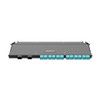
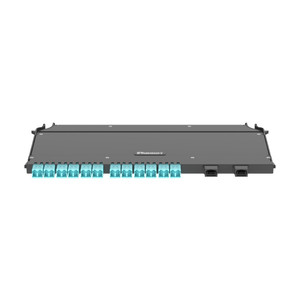
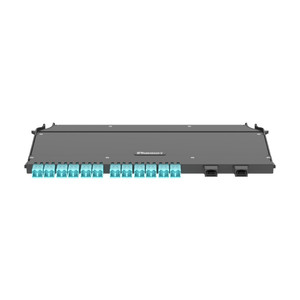
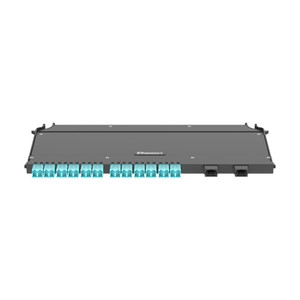
Panduit FDCZA-24-10ULH FlexCore 24-Fiber OM4 LC/MPO Cassette
The Panduit FDCZA-24-10ULH FlexCore cassette delivers high-density fiber breakout in a single-rack-unit footprint, bridging 24-strand OM4 multimode trunk cables to duplex LC patching in ODF and OSF frames. Engineered for left-hand polarity installations, this cassette terminates two 12-fiber MPO male connectors on the rear and provides twelve LC duplex ports on the front panel, enabling 40G/100G backbone migration without ripping out existing patch infrastructure. Data center and campus network installers use this module to future-proof vertical riser and horizontal distribution layers while maintaining TIA-568-C.3 polarity control across multi-building fiber plants.
Key Features
- 24-fiber OM4 (50/125 µm) capacity supports 100GBASE-SR4 and 40GBASE-SR4 applications up to 150 meters
- Front-access LC duplex connectors (12 ports) interface with existing patch panels and structured cabling
- Dual MPO-12 male rear connectors accept pre-terminated trunk assemblies for rapid deployment
- Left-hand (Method B) polarity orientation ensures transmit/receive alignment in TIA-568 architectures
- Ultra-low insertion loss variant delivers <0.35 dB typical performance per mated pair
- Single-RU height (11.7 mm / 0.46") fits FlexCore ODF and OSF enclosures without adapter panel modifications
- Black polycarbonate housing withstands repeated connector insertions and rack vibration
- Factory-terminated and tested—no field splicing or polishing required
- Universal cassette design accommodates both flush-mount and angled ODF frame configurations
- RoHS 2002/95/EC compliant for global deployment and e-waste regulations
Panduit's FlexCore cassette architecture solves the density problem every enterprise network faces when scaling beyond gigabit Ethernet. Traditional duplex LC infrastructure works well for 1G and 10G links, but 40G and 100G migration demands parallel optics—four or ten fiber pairs per port. Rather than abandon thousands of dollars in existing LC patch cords and panels, the FDCZA-24-10ULH drops into FlexCore ODF frames as a translation layer: MPO trunk cables run vertically between floors or horizontally to server rows, then break out to individual LC duplex connections at the distribution frame. This cassette maintains Method B (left-hand) polarity per TIA-568-C.3 Annex A, meaning transmit fibers on one end align with receive fibers on the opposite end without crossover adapters or custom pinouts. Installers working on multi-tier Clos fabrics or spine-leaf topologies appreciate the deterministic polarity—every cassette in a row follows the same pinout, and every trunk-to-patch transition behaves predictably under TIA and ISO/IEC 11801 rules. The ultra-low insertion loss designation matters when link budgets tighten: 100GBASE-SR4 over OM4 allows 2.6 dB total channel loss across 150 meters, leaving roughly 1 dB headroom after accounting for trunk cable attenuation (3.0 dB/km × 0.15 km = 0.45 dB) and connector aging. A cassette contributing 0.35 dB per mated pair preserves margin for future splices or additional interconnects, whereas economy cassettes at 0.75 dB can push borderline links into bit-error territory during temperature swings or after a few re-mates.
Field deployment starts at the building entrance or main distribution frame: pre-terminated 24-fiber MPO trunk assemblies land on the rear MPO-12 male ports (key-up orientation), and twelve duplex LC patch cords extend from the front panel to active equipment or secondary patch fields. Because the cassette ships factory-terminated with controlled geometry fiber and automated polishing, insertion loss remains consistent across all twelve duplex ports—no field variability from hand-polishing or cleave-angle errors. Installers serving healthcare campuses, financial data centers, and large-scale surveillance NVR deployments rely on this predictability when commissioning links that must pass OTDR certification on day one and remain within spec through five years of adds/moves/changes. The 292.8 mm width (11.53") spans a standard 19-inch rack opening with clearance for cable management fingers, and the 11.7 mm height allows stacking up to six cassettes in a single rack unit if the ODF frame supports that density. Left-hand polarity orientation (Method B) pairs naturally with Panduit's own pre-terminated MPO trunk assemblies and aligns with the majority of enterprise structured cabling standards, though integrators must verify polarity method during design—mixing Method A and Method B cassettes in the same frame creates transmit/receive mismatches that won't surface until link bring-up. The black polycarbonate housing resists UV degradation in telecom rooms with skylight exposure and provides enough rigidity to prevent connector misalignment when patch cords are pulled at an angle during overcrowded rack work.
This cassette meets ISO/IEC 11801, ANSI/TIA-568-C.3, TIA-604-5 (FOCIS-5 for LC), and TIA-604-10 (FOCIS-10 for MPO) physical-layer standards, ensuring interoperability with multi-vendor active equipment and structured cabling from any TIA-compliant manufacturer. IEEE 802.3 (Ethernet) and ANSI T11.2 (Fibre Channel) application compatibility extends deployment scope beyond IP networks into SAN fabrics and converged infrastructure. The ultra-low insertion loss specification and left-hand polarity orientation distinguish this unit from Panduit's standard-loss and right-hand variants—verify your architecture's polarity method and link budget before specifying, because swapping cassettes post-installation requires trunk re-termination or polarity-reversing patch cords that add cost and failure points.