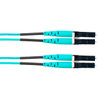
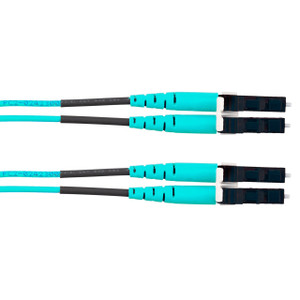
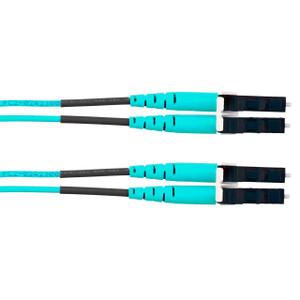
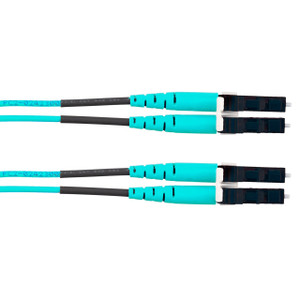
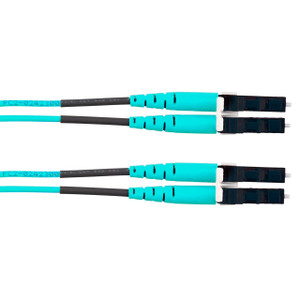
Panduit FX2ERLNLNSNM020 Opti-Core™ OM3 LC Duplex Fiber Patch Cord
The Panduit FX2ERLNLNSNM020 delivers enterprise-grade OM3 multimode connectivity for 10Gb Ethernet backbones, SAN interconnects, and high-density fiber distribution in telecommunications rooms and data centers. This 20-meter (65.6 ft) duplex LC patch cord addresses the specific challenge of medium-reach connections within or between equipment rows while maintaining the OFNR riser rating required for vertical pathway compliance—eliminating the need to spec separate plenum-rated cable for in-room risers or overhead distribution. The 1.6 mm cable jacket provides the durability needed for permanent installations while remaining flexible enough for tight-radius routing in high-density panels and zero-U cable managers.
Key Features
- OM3 50-micron multimode fiber supports 10GBASE-SR to 300 meters and 40/100GBASE-SR4 to 100 meters
- LC duplex connectors with standard insertion loss ensure compatibility with enterprise switches, storage arrays, and backbone infrastructure
- OFNR riser-rated jacket meets NEC Article 770 vertical pathway requirements without plenum upgrade costs
- 20-meter length spans equipment row-to-row connections, MDA-to-HDA links, or zone distribution in mid-size telecom rooms
- Aqua jacket color provides instant OM3 identification per TIA-598 cable color standards
- Pre-terminated factory assembly eliminates field termination labor and insertion loss variability
- 1.6 mm outer diameter maximizes airflow in high-density installations and fits shallow horizontal cable managers
OM3 laser-optimized multimode fiber is the workhorse specification for current-generation 10Gb Ethernet and emerging 40/100Gb migration paths in enterprise networks. The 50-micron core diameter and minimum 2000 MHz·km effective modal bandwidth at 850 nm enables 10GBASE-SR transmission up to 300 meters—sufficient for intra-building backbone links and equipment-row distribution in all but the largest campuses. This FX2ERLNLNSNM020 patch cord meets or exceeds TIA-568-C.3 OM3 specifications, ensuring full compatibility with multimode transceivers from Cisco, Arista, Juniper, Dell, HPE, and other enterprise networking vendors. The duplex LC connector interface matches the industry-standard form factor deployed in SFP+, QSFP+, and QSFP28 transceivers, providing seamless integration with existing infrastructure. Unlike singlemode fiber that requires precise laser alignment and expensive optics, OM3 multimode supports cost-effective VCSEL (vertical-cavity surface-emitting laser) transceivers while delivering the bandwidth headroom needed for 10G and 40G aggregation links.
The OFNR (Optical Fiber Nonconductive Riser) flame rating addresses a common specification gap in multi-floor installations. While horizontal cable runs typically require only general-purpose (OFN) or LSZH ratings, any cable entering a vertical shaft, penetrating a floor, or running between equipment on different levels triggers NEC 770.154 riser requirements. This patch cord ships with OFNR certification, allowing you to use a single SKU for horizontal distribution, vertical tie cables between stacked switches, and riser pathways connecting telecom rooms on adjacent floors—eliminating the need to stock separate plenum-rated (OFNP) jumpers for vertical applications and reducing inventory complexity. The all-dielectric construction (no metallic strength members) also simplifies grounding and bonding requirements compared to armored or metal-reinforced fiber assemblies. The 1.6 mm outer diameter strikes the optimal balance for permanent installations: robust enough to withstand repeated handling during adds/moves/changes and cable management adjustments, yet small enough to maximize airflow in high-density LC panels and comply with tight bend-radius constraints in 1U and 2U horizontal cable managers.
At 20 meters (65.6 feet), this patch cord length serves the middle tier of structured cabling deployments—too long for equipment-to-panel jumpers, but purpose-built for cross-connect applications that exceed the practical limit of 3-5 meter deskside cables. Common use cases include main distribution area (MDA) to horizontal distribution area (HDA) fiber trunks in multi-room facilities, SAN fabric connections between storage controllers and core switches separated by hot/cold aisle layouts, and backbone links spanning equipment rows in linear data center configurations. The factory-specified 20 m length also provides installation margin for overhead cable tray routing, drop-downs to rack-mounted equipment, and service loops at termination points—real-world considerations that often push a nominal 15-meter cable run into 18-20 meter territory once vertical drops, slack management for future re-termination, and pathway derating factors are accounted for. For integrators working in enterprise telecom rooms with distributed equipment layouts or data centers with row-based architectures, this 20-meter reach eliminates the signal budget and cost penalties of adding intermediate patch panels or fiber enclosures just to bridge distance gaps.
Panduit's Opti-Core manufacturing process delivers consistent insertion loss performance across the entire production run. Each LC connector undergoes factory polishing to achieve the endface geometry required for low back reflection and minimal insertion loss, then gets individually tested to verify compliance with TIA-604-3 (FOCIS-3) and TIA-604-10 (FOCIS-10) physical contact interface standards. This pre-terminated approach eliminates the variability introduced by field termination—no epoxy cure times, no hand-polishing inconsistencies, no risk of contamination during on-site assembly, and no question whether the installer's certification is current or their consumables are fresh. The result is predictable link budgets that don't require field testing to verify: you can calculate end-to-end loss based on published connector and cable specifications, then deploy with confidence that actual performance will match the design. The aqua jacket color provides instant visual identification in mixed-mode installations: OM3 multimode stands out immediately against yellow singlemode, orange OM1/OM2 multimode, or the violet/magenta jackets used for OM4/OM5 laser-optimized fiber, reducing the risk of mismatched connections during after-hours maintenance windows or emergency troubleshooting.
The duplex LC form factor dominates modern fiber optic networking for good reason: its small footprint allows 2x the port density of SC connectors in the same panel space, the push-pull tab mechanism enables single-handed insertion and removal in tight spaces, and the physical keying prevents reversed polarity connections that would break BiDi or parallel optics links. This FX2ERLNLNSNM020 assembly uses standard polarity (A-to-B mapping), making it compatible with straight-through duplex trunk cables and eliminating the need to stock Type-A, Type-B, and Type-C polarity variants for different segments of the same link. The LC interface also supports both traditional duplex transceivers (separate TX and RX fibers) and breakout to simplex connectors for BiDi or CWDM applications, providing deployment flexibility as network architectures evolve from 10G to 25G, 40G, or 100G over the cable plant's 15-20 year service life.
This patch cord meets ISO/IEC 11801 international structured cabling standards, TIA/EIA-568-C.3 North American fiber optic specifications, and RoHS environmental compliance requirements—ensuring deployments align with corporate procurement policies, building code inspections, AHJ (authority having jurisdiction) reviews, and international project specifications. The nonconductive construction eliminates concerns about inadvertent ground loops or differential voltage potentials when connecting equipment on separate electrical services or across buildings—a common issue in campus environments where fiber links cross between structures with independent utility feeds. For integrators managing fiber infrastructure across multiple sites or standardizing on a consistent bill of materials for template deployments, the Panduit part numbering system (FX2 = OM3 duplex, ER = riser, LNLN = LC-to-LC, SNM = standard loss, 020 = 20 meters) enables rapid identification and cross-site standardization without referencing spec sheets or vendor documentation.