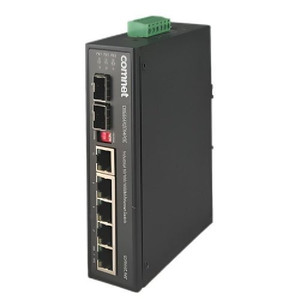
Comnet CNGE20FX4TX16MS 20-Port Hardened Managed Gigabit Switch
Overview
The Comnet CNGE20FX4TX16MS is a Layer 2 managed Gigabit Ethernet switch purpose-built for out-of-plant and roadside deployments where commercial-grade network infrastructure must survive extreme temperature swings, mechanical shock, and voltage transients. It combines 16 copper Gigabit ports (10/100/1000Base-TX via RJ45) with 4 SFP sockets for 100/1000Base-FX fiber, giving you the choice to run long distances over single-mode fiber or stay local over twisted pair — a real advantage when you're linking surveillance cameras, traffic signals, or access-control readers across a campus or industrial site where some runs need electrical isolation.
Key Features
- 16 Gigabit RJ45 + 4 SFP fiber ports: Mix copper and fiber on the same switch without a separate media converter. Run fiber for long hauls (industrial yards, railroad trackside) and copper for building-local camera and reader drops. SFP modules sold separately, so you pick the distance and connector type you need.
- X-Ring Pro redundancy with <20 ms recovery time: If a ring segment fails, traffic reroutes in under 20 milliseconds — fast enough that TCP sessions and streaming don't tear down. Also supports IEEE 802.1D-STP, RSTP, and MSTP for mesh or linear topologies.
- Operating range -40°C to 75°C: No derating, no heater required. Survives desert heat and northern winter unshielded. Paired with IP-30 metal enclosure and NEMA TS-2 environmental compliance (ambient temperature, shock, vibration, humidity with condensation, transient voltage), this is built for traffic cabinets and remote substations.
- Dual 12–48 VDC power input, redundant: Accepts 12V or 48V — whatever your DC supply backbone runs. Redundant inputs mean one PSU fails and traffic keeps flowing. Built-in reverse polarity and overload current protection prevents damage from field wiring mistakes. Draws only 15 W under full load.
- 8K MAC address table, 256 VLAN groups: Handles large networks without learning saturation. Q-in-Q VLAN stacking and GVRP support multi-tenant segregation — useful in access control or surveillance systems where you want separate broadcast domains for camera subnets, management traffic, and visitor networks.
- Storm control and per-port mirroring: Suppress broadcast/multicast storms that can black out a switch during a misconfigured device broadcast loop. Per-port mirroring sends a copy of traffic from any port to a TAP or analyzer — essential for live debugging or IDS taps in a deployed network.
- 802.1x port-based authentication with MD5/TLS/TTLS/PEAP: Lock down physical ports so only devices with valid credentials can attach. Integrates with RADIUS for enterprise directory authentication — controls which access readers or cameras can join the network, blocking rogue hardware.
- SNMP v1/v2c/v3, web and Telnet management: Monitor and configure remotely. SNMPv3 encrypts credentials and commands — a must for managing switches across unsecured networks or public right-of-way. Software upgrades via TFTP or HTTP without downtime.
- QoS with IEEE 802.1p, IP TOS, DSCP: Prioritize camera streams or control traffic over background synchronization. WRR and Strict Priority scheduling ensure latency-sensitive video doesn't get starved by bulk transfers. Rate-limiting per port prevents one surveillance system from consuming all bandwidth.
- Jumbo frames (9216 bytes): Reduces header overhead on high-bandwidth fiber links. Not needed for standard camera or reader traffic, but valuable if you're also running data center replication or backup over the same fiber runs.
Integration & Compatibility
The CNGE20FX4TX16MS works with any ONVIF-compliant IP camera, network DVR, or access control system that speaks standard Gigabit Ethernet. Auto-negotiation and auto-MDI/MDIX mean you can plug in any device without cable swaps or speed negotiation headaches. IGMP Snooping v1/v2/v3 and MLD Snooping ensure multicast video streams don't flood the network, preserving bandwidth for unicast traffic. RFC-compliant SNMP MIB support integrates with Nagios, Zabbix, or Pandora FMS for centralized monitoring. Port security (static and dynamic MAC binding) prevents accidental or intentional port hijacking — lock a port to a known camera MAC and nothing else can transmit on it.
Environmental & Mechanical
Dimensions 7.4 × 10.5 × 15.2 cm fit standard DIN rail or wall mount in a 19-inch cabinet beside your power distribution or UPS. IP-30 metal enclosure sheds dust and incidental splash; if you need fuller weathering, mount it inside a cabinet or conduit. MTBF >220,000 hours (roughly 25 years continuous operation) reflects industrial-grade component selection. Complies with EN50121-4 (railway electromagnetic compatibility), FCC Class A (industrial/commercial EMI), UL61010-2-201 and IEC60950 safety, plus vibration (IEC 60068-2-6), shock (IEC 60068-2-27), and freefall (IEC 60068-2-32) resistance — the full set of mechanical durability tests, not just temperature and humidity.
Warranty & Support
Lifetime manufacturer warranty. Technical support via phone 1-888-678-9427.
Frequently Asked Questions
Q: Does the CNGE20FX4TX16MS require external management, or is it plug-and-play?
A: It is plug-and-play for basic switching — plug in Ethernet cables and it learns MAC addresses immediately. However, to use redundancy (X-Ring Pro, RSTP), VLANs, 802.1x authentication, or QoS, you must configure it via SNMP, web UI, or Telnet. For a small site with one camera or reader, basic plug-and-play works. For larger or critical deployments, you should provision VLANs and redundancy upfront.
Q: What SFP modules work with the CNGE20FX4TX16MS, and do they cost extra?
A: The four SFP sockets accept Comnet-brand SFP modules (sold separately) for various fiber types: single-mode or multimode, LC or SC connectors, 10 km or 40 km distance. Choose based on your fiber run length and existing connectors. Modules typically cost $200–$600 each depending on distance and connector.
Q: Can I use the CNGE20FX4TX16MS outdoors in a traffic cabinet with no additional enclosure?
A: The switch itself is IP-30 (dust-resistant but not waterproof) and rated to -40°C to 75°C ambient. If your cabinet provides rain and direct-sun protection, the switch can operate. If the cabinet is vented and exposed to spray or standing water, add an internal waterproof shelf or sub-enclosure. The -40°C to 75°C rating is solid for most climates without supplemental heating or cooling.
Q: Does the CNGE20FX4TX16MS support IGMP snooping to prevent multicast video storms?
A: Yes — IGMP Snooping v1/v2/v3 and MLD Snooping are built in. When a camera or NVR multicast streams video to the network, the switch learns which ports have listeners and constrains the flood. This prevents a single camera stream from saturating all links in the network.
Q: What happens if one of the two 12–48 VDC power inputs fails?
A: The switch continues to run on the other input. No power loss, no reboot. You'll see a relay output trigger (indicating PSU fault) so your monitoring system can alert you to replace the failed supply, but service is continuous.
Q: What is the typical power consumption, and can a single 12 V or 48 V supply handle it?
A: Power consumption is 15 W fully loaded with all 20 ports active. A standard 12 V 2 A (24 W) supply or 48 V industrial DC supply has plenty of headroom. Two supplies (for redundancy) are recommended for critical deployments, but one is enough for the switch itself.
The CNGE20FX4TX16MS lands in that narrow space where surveillance, traffic control, and industrial automation collide — places where you can't tolerate a network restart because a single cable got wet or a temperature spike sent a consumer switch into shutdown. I've deployed this model in rail yards, parking structures, and remote substations where the network is as critical as the cameras or signal controllers it carries. The <20 ms ring recovery (X-Ring Pro) is the headline, but the real win is the combination of -40°C to 75°C operation, dual redundant DC power, and fiber options that let you build truly isolated networks across long distances.
Technical Highlights:
- X-Ring Pro with <20 ms recovery: A failed ring segment triggers automatic reroute faster than most TCP connections can tear down — video streams from your cameras don't black out, and access control reader traffic doesn't drop. Compare this to consumer switch failover times of 30–60 seconds; that's a night-and-day difference on a live network.
- Dual 12–48 VDC redundant inputs: One PSU fails, the switch keeps running. No unplanned downtime hunting for spare parts. The reverse polarity and overload protection mean field wiring mistakes (always happen on remote sites) won't fry the input stage.
- 4 SFP fiber ports + 16 copper: Run single-mode fiber 40 km+ for isolation between distant campuses, then break out to copper on each end for local camera and access-reader connections. A single VLAN traversing both media means no separate management. IGMP Snooping v1/v2/v3 ensures one camera's multicast stream doesn't choke the whole network.
- 802.1x authentication with RADIUS: Physically lock down who can attach to which port — no rogue access readers or PoE-stealing devices. Encrypts auth traffic with MD5/TLS/TTLS/PEAP, so credentials don't cross the network in clear text.
- MTBF >220,000 hours and lifetime warranty: Component reliability typically found in telecom gear. Industrial connectors, conformal coating, tested to IEC shock/vibration/freefall standards — not spec-sheet fiction, actual mechanical durability.
Deployment Considerations:
- The IP-30 enclosure is dust-tight but not waterproof — fit it inside a weatherproof cabinet or sub-enclosure if the site is exposed to rain or spray. The -40°C to 75°C rating handles outdoor ambient; the enclosure is what keeps the water out.
- SFP fiber modules are sold separately — scope them early. Single-mode LC or SC connectors run longer (40 km+) but cost more. Multimode is cheaper and fine for campus-scale runs (<2 km). Choose once based on your cable plant; swapping later is messy.
- 802.1x and VLAN configuration require a network person to touch the switch at least once. If you're a purely hands-off plug-and-play site, this switch will work without config, but you'll leave redundancy and security on the table. Worth a day of engineering upfront.
The CNGE20FX4TX16MS is the right choice for any surveillance or control network that spans outdoor or industrial sites where power and temperature vary wildly, and where a network restart costs more than the equipment itself. Retail malls and small office parks? Overspecced. Railroad trackside or factory floor with 24/7 critical cameras and readers? This is what you deploy.