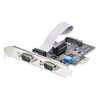
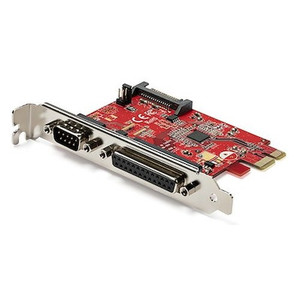
StarTech 2S232422485-PC-CARD Dual-Port PCIe to RS-232/422/485 Serial Adapter Card
Overview
The StarTech 2S232422485-PC-CARD is a two-port PCI Express serial adapter that adds a pair of RS-232, RS-422, or RS-485 DB9 serial ports to any desktop or server with an available PCIe 2.0 x1 slot. If you're integrating legacy access control panels, serial-based PTZ camera controllers, industrial automation PLCs, or point-of-sale peripherals into a modern PC platform, this card handles the physical layer translation without requiring a separate serial server or USB adapter chain. Built around the ASix AX99100 chipset, it delivers predictable, low-latency serial communication at baud rates up to 921.6 Kbps — fast enough for demanding industrial control loops and security system command buses alike. The 2S232422485-PC-CARD (often searched as 2S232422485 PC CARD) is a compact, half-height-compatible expansion card weighing just 2.0 oz, making it equally practical in tower workstations and 1U rack servers.
For integrators deploying StarTech connectivity solutions across mixed-protocol environments, this card covers all three common serial standards in a single SKU — no need to stock separate RS-422 and RS-485 variants.
Key Features
- Triple-protocol support (RS-232 / RS-422 / RS-485): Each port is individually configurable for RS-232 point-to-point, RS-422 balanced differential, or RS-485 multi-drop bus topologies. This matters in serial expansion cards for security deployments where PTZ controllers, door controllers, and intrusion panels often use different serial standards — one card covers all three instead of juggling multiple adapters.
- 921.6 Kbps maximum baud rate: Standard RS-232 tops out at 115.2 Kbps on most legacy hardware. This card pushes up to 921.6 Kbps, giving you roughly 8x the throughput headroom — relevant when polling multiple devices rapidly over RS-485 multi-drop or streaming continuous telemetry from industrial sensors.
- 256-byte hardware FIFO per port: The 256-byte FIFO buffers burst serial data at the hardware level, preventing character loss during CPU interrupt latency spikes. On a busy server handling multiple tasks alongside serial I/O, this buffer is what keeps your data intact when the CPU can't service the UART immediately.
- ASix AX99100 chipset with broad UART compatibility: The AX99100 emulates 16C450, 16C550, 16C650, 16C750, and 16C950 UARTs. Legacy serial software — including many access control and building automation platforms — expects specific UART behavior. This chipset's compatibility range means you're unlikely to hit driver-level incompatibilities with established serial applications.
- PCIe 2.0 x1 interface: PCIe 2.0 x1 delivers up to 500 MB/s of theoretical bandwidth — far beyond what two serial ports consume — and is backward compatible with PCIe 1.x slots. The card will seat and operate in any x1, x4, x8, or x16 slot that accepts PCIe cards, giving you flexibility in congested server backplanes.
- Per-port power output (12V / 5V at 1.5A): Each DB9 port can supply 12V at 1.5A or 5V at 1.5A to attached peripherals via the serial connector. This lets you power low-draw serial devices — some barcode scanners, smaller serial modems, or terminal adapters — directly from the card without separate power wiring to the device.
- ESD protection to +/-8kV contact / +/-15kV air / +/-15kV HBM: Serial ports are frequently connected to external cabling that runs across equipment rooms or between buildings, making them prime targets for electrostatic discharge events. The onboard ESD protection handles human body model strikes up to 15kV, which is meaningful protection for the card and the host system in environments with frequent hot-plug activity or long cable runs.
- Full data framing control (5–9 data bits, 5 parity modes, 3 stop-bit options): Some legacy protocols and proprietary serial devices use non-standard framing — 9-bit addressing in RS-485 multi-drop networks is a common example. The card's full framing flexibility ensures you can match whatever the attached device requires without protocol-level workarounds.
- Operating range 0°C to 70°C: This is the standard commercial temperature range. It's appropriate for equipment rooms and server closets but not for uncontrolled industrial enclosures or outdoor deployments. Plan accordingly if the host machine will be in a non-climate-controlled space.
Integration and Compatibility
The 2S232422485-PC-CARD integrates with Windows, Linux, and macOS systems via driver installation — the AX99100 chipset has broad OS driver support, and the UART compatibility list (16C550 through 16C950) covers the COM port expectations of most serial-aware software stacks. In security deployments, this card pairs cleanly with access control software, VMS platforms using serial PTZ protocols (Pelco-D, Pelco-P, Bosch BiCom, and similar), and building management systems that communicate over Modbus RTU on RS-485. For PCIe expansion card selection in multi-drop RS-485 installations, note that RS-485 allows up to 32 unit loads on a single bus segment — the card provides the host interface; bus termination and biasing resistors remain the integrator's responsibility at the cable level.
Consult our serial connectivity planning guide when sizing baud rates and FIFO requirements for your specific device polling cycles. For installations requiring isolated serial ports to break ground loops between equipment, consider pairing this card with an inline serial isolator — the card itself does not provide galvanic isolation.
Frequently Asked Questions
Q: Can each port on the 2S232422485-PC-CARD be independently set to RS-232, RS-422, or RS-485?
A: Yes. The card supports RS-232, RS-422, and RS-485 on each port, and the protocol can be configured per port — you are not locked into a single standard across both ports simultaneously.
Q: What is the maximum baud rate supported by the 2S232422485-PC-CARD?
A: The maximum baud rate is 921.6 Kbps per port, which is approximately 8x the typical 115.2 Kbps ceiling on legacy serial hardware.
Q: Does the 2S232422485-PC-CARD require a full-length PCIe slot?
A: No. It uses a PCIe 2.0 x1 interface and will fit and operate in any PCIe slot of x1 size or larger (x4, x8, x16), making it compatible with a wide range of desktop and server motherboards.
Q: What warranty is included with the 2S232422485-PC-CARD?
A: StarTech provides a 2-year manufacturer warranty on the 2S232422485-PC-CARD.
Q: Does the card provide galvanic isolation between ports or between the card and the host system?
A: No. The 2S232422485-PC-CARD does not include galvanic isolation. The onboard ESD protection (up to ±15kV air discharge) helps protect against electrostatic events, but if your installation requires ground loop isolation between equipment, you will need an external inline serial isolator.
Q: Is the 2S232422485-PC-CARD suitable for RS-485 multi-drop networks?
A: Yes. RS-485 multi-drop bus topology is a supported mode. The card handles the host interface side; bus termination resistors and line biasing at the cable level remain the installer's responsibility per RS-485 specification.
The 2S232422485-PC-CARD is one of those components that earns its place the moment your project hits a mixed-protocol serial requirement. The 256-byte hardware FIFO is the detail I keep coming back to — on a server that's also running VMS recording, access control event processing, and network polling simultaneously, that buffer depth is what prevents character overruns on the serial bus when the CPU is briefly tied up elsewhere. It's a spec that separates this card from cheaper adapters with 16-byte FIFOs that drop data under load.
Technical Highlights:
- AX99100 Chipset UART Emulation: Covers 16C450 through 16C950 — the range that matters for legacy access control and building automation platforms that hard-code UART type expectations in their serial drivers.
- 921.6 Kbps Max Baud Rate: Eight times the 115.2 Kbps ceiling of standard legacy hardware; gives you real headroom for fast RS-485 device polling across a multi-drop network without baud rate becoming a bottleneck.
- ±15kV ESD Protection (Air / HBM): Meaningful on any card whose DB9 ports connect to external cabling. One unprotected hot-plug event on a long cable run can take out a motherboard serial controller; this card absorbs it.
Deployment Considerations:
- RS-485 multi-drop installations: the card handles the host interface, but you are responsible for 120-ohm termination resistors at each bus end and fail-safe biasing resistors to define idle-line state — missing either will cause data corruption at higher baud rates.
- Operating temperature ceiling is 70°C — fine for a climate-controlled server room but watch this if the host machine is in a non-ventilated industrial enclosure or a rooftop equipment cabinet in a hot climate.
This card is the right fit for a physical security integration server that needs to simultaneously run Modbus RTU over RS-485 to a door controller network, Pelco-D PTZ commands over RS-232 to a camera dome, and has a single PCIe x1 slot available — two protocols, one card, no USB adapters to lose or reboot.