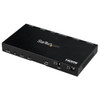
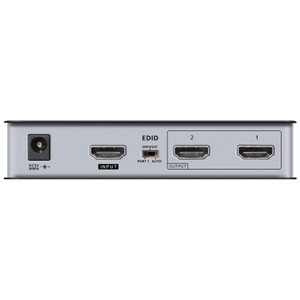
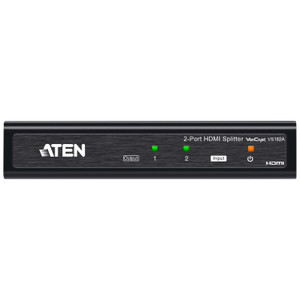
StarTech ST122HD20S 1x2 HDMI 2.0b Splitter with 4K Scaler
Overview
The StarTech ST122HD20S is a compact, single-input two-output HDMI splitter that handles 4K @ 60Hz on a full 18 Gbps HDMI 2.0b signal path — making it a practical tool for AV integrators and IT architects who need to drive two displays from a single source without dropping to a lower-bandwidth HDMI 1.4 connection. Where most budget splitters force both outputs to the lowest common denominator resolution, the ST122HD20S includes per-port scaling, so a 4K source can simultaneously feed a 4K monitor and a 1080p secondary display without any manual resolution switching at the source. For digital signage deployments, boardrooms, or security monitoring stations running mixed-generation display hardware, that scaler is the differentiating feature.
The unit measures just 4.7 x 2.5 x 0.4 inches in a steel enclosure, draws only 5W via its included AC adapter (100–240V universal input), and runs cool enough for confined AV rack shelves or behind-display installations. Operating range is 0°C to 40°C — suitable for indoor conditioned environments.
Key Features
- HDMI 2.0b at 18 Gbps full bandwidth: The full 18 Gbps throughput means 4K @ 60Hz with 4:4:4 chroma subsampling passes without compression artifacts. If you have been using older splitters that cap at 10.2 Gbps (HDMI 1.4), the difference in color accuracy on text-heavy content or color-critical signage is immediately visible.
- Built-in resolution scaler: Each output port can be assigned its own target resolution — 3840x2160 @ 60Hz, 3840x2160 @ 30Hz, 1080p, or 720p — without changing the source output. This means a single 4K media player or PC can simultaneously drive a 4K primary display and a 1080p overflow monitor, a common requirement in dual-zone signage and NOC environments.
- HDCP 2.2 compliance: Supports the current HDCP 2.2 content protection standard required for 4K streaming services and UHD Blu-ray players. Both output ports maintain HDCP 2.2 handshake, so protected content plays through without the black-screen errors common on non-compliant splitters.
- Discrete audio extraction — 3.5mm and SPDIF/Toslink outputs: The ST122HD20S breaks out audio independently via a 3.5mm analog jack and a Toslink optical output, supporting up to 7.1 surround sound. In a boardroom or control room where the amplifier or soundbar takes audio separately, this eliminates the need for an additional HDMI audio extractor in the signal chain.
- Auto and Copy EDID management: EDID handling is a common failure point in multi-display installations. The auto mode reads both connected displays and negotiates a compatible resolution automatically; copy mode clones the EDID from one display to the input port, which prevents source devices from losing video signal when a display is powered off or swapped. This is particularly relevant in 24/7 monitoring environments where display cycling cannot trigger a source re-negotiation.
- Up to 16.4 ft (5m) cable support: Specified for cable runs up to 16.4 feet on both input and output sides. For longer runs to secondary displays, pair with an active HDMI extender — passive cable extension beyond 5m at 4K 60Hz will introduce signal degradation.
- Universal AC input (100–240V): The included power adapter accepts any global mains voltage, which matters for multi-region deployments or procurement for international facilities without requiring a separate voltage converter.
- Steel enclosure: The metal chassis dissipates heat more effectively than plastic alternatives and provides basic RF shielding — relevant in rack environments where multiple signal cables run in close proximity.
Integration and Compatibility
The ST122HD20S fits into any signal chain where the source device outputs HDMI — including 4K media players, PC workstations, video walls fed from a single HDMI output, and security monitoring stations pairing a recorder HDMI output with both a local operator display and a secondary overview monitor. The 3.5mm and Toslink audio outputs integrate directly with most commercial AV receivers, soundbars, and PA system interfaces without an additional adapter.
For integrators building out video surveillance monitoring stations, the scaler functionality is particularly useful when pairing legacy 1080p operator monitors with newer 4K overview displays — both fed from the same NVR HDMI output. Explore the full StarTech AV and connectivity line for complementary signal distribution products. If you are planning a larger display matrix, review the HDMI extenders and splitters category for multi-output and long-run options. For AV-over-IP and enterprise-scale distribution, AV over IP encoders handle larger channel counts than a 1x2 splitter can address. When installing in a rack alongside PoE switches and NVRs, reference a network video recorder pairing guide to confirm HDMI output compatibility with your recorder model.
Frequently Asked Questions
Q: Can the ST122HD20S output different resolutions on each port simultaneously?
A: Yes. The built-in scaler allows each of the two HDMI output ports to be set to a different resolution — for example, 4K @ 60Hz on output 1 and 1080p on output 2 — while the source continues to output a single 4K signal. Supported output resolutions include 3840x2160 @ 60Hz, 3840x2160 @ 30Hz, 1080p, and 720p.
Q: Does the ST122HD20S support HDCP 2.2 protected content?
A: Yes. The unit supports HDCP 2.2 on both output ports, which is required for 4K UHD content from streaming services and UHD Blu-ray players. Both displays in the chain must also be HDCP 2.2 compliant for protected content to pass through.
Q: What audio formats does the ST122HD20S support, and how does audio extraction work?
A: The ST122HD20S supports up to 7.1 surround sound and provides two dedicated audio output connectors: a 3.5mm analog stereo jack and a Toslink SPDIF optical output. Audio can be extracted from the HDMI input signal and sent to an external amplifier or audio system without requiring a separate audio extractor device.
Q: What is the maximum HDMI cable length supported?
A: StarTech specifies a maximum cable length of 16.4 feet (5 meters) on both the input and output connections at 4K 60Hz. Passive cables beyond that length at full 4K bandwidth risk signal degradation; use an active HDMI extender for longer runs.
Q: What does EDID Copy mode do, and when should I use it?
A: EDID Copy mode clones the display capabilities (EDID data) from one connected display and presents that profile to the source device at the HDMI input. This is useful in installations where powering off one display would otherwise cause the source to re-negotiate resolution or lose signal — common in 24/7 monitoring stations where one display may be turned off during off-peak hours.
Q: What is the warranty on the ST122HD20S?
A: The ST122HD20S carries a 2-year manufacturer warranty.
The spec that most buyers overlook on the ST122HD20S is the EDID management — and it is the one that will save you the most troubleshooting time on a real installation. In monitoring and operations environments where the second display gets powered off between shifts, a splitter without EDID Copy will cause the source device to drop or re-negotiate its output every time that screen goes dark. The ST122HD20S handles that cleanly.
Technical Highlights:
- 18 Gbps HDMI 2.0b bandwidth: Full 4K @ 60Hz with 4:4:4 chroma subsampling — no bandwidth throttling that would push you to 4:2:0 on color-critical content or force 30Hz on a 60Hz-capable display.
- Per-port resolution scaling: Output 1 can run 3840x2160 @ 60Hz while output 2 runs 1080p simultaneously. This is the feature that makes the ST122HD20S genuinely useful in mixed-display environments rather than just a signal duplicator.
- Dual audio extraction (3.5mm + Toslink): 7.1 surround support with both analog and optical outputs means you can route audio to an existing AV system without adding another device to the rack. At 5W total draw, the power overhead is negligible.
Deployment Considerations:
- Cable runs are capped at 16.4 ft (5m) at 4K 60Hz — plan display placement accordingly or budget for active HDMI extenders on longer secondary runs before committing to mounting locations.
- Operating temperature is 0°C to 40°C, which is fine for conditioned server rooms and AV closets but rules out unconditioned utility spaces or outdoor enclosures — even with ventilation.
For a security operations center pairing a 4K NVR HDMI output with both a primary 4K operator workstation display and a 1080p overview screen on the wall, the ST122HD20S handles that exact scenario cleanly — no source reconfiguration, no resolution compromise, and no additional audio extractor required.