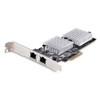
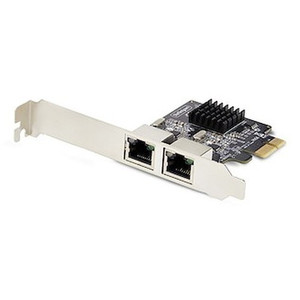
StarTech ST10GSPEXNDP2 Dual-Port 10GbE PCIe Network Adapter Card
Overview
The StarTech ST10GSPEXNDP2 is a dual-port 10 Gigabit Ethernet PCIe network adapter built for servers and workstations that need high-throughput, multi-speed copper connectivity without the cabling overhead of fiber. Powered by the Marvell AQC113CS chipset — one of the more capable silicon options for multi-gig copper — this card delivers two RJ45 ports on a single PCIe 3.0 x4 slot, making it a practical fit for network adapter upgrades in surveillance recording servers, NAS appliances, and edge compute nodes where 10GbE bandwidth is the bottleneck. Both a full-height and a low-profile bracket ship in the box, so it fits standard tower servers and 1U/2U rack chassis without a separate order.
Key Features
- Dual RJ45 Ports at Up to 10 Gbps Each: Two independent copper ports mean you can bond them for 20 Gbps aggregate throughput, split traffic across separate VLANs, or run one as a dedicated management link — all without adding a second card or consuming an additional PCIe slot.
- Multi-Speed Auto-Negotiation (10/5/2.5/1 Gbps and 100/10 Mbps): The card auto-negotiates down to whatever the connected switch supports. Plugging into an existing 1GbE switch works; upgrading to a 2.5GbE or 5GbE switch later requires no driver changes or hardware swap. This protects your investment when infrastructure upgrades happen in phases — common in phased network switch rollouts.
- Marvell AQC113CS Chipset: The AQC113CS is a proven multi-gig silicon used across commercial and server-grade adapters. It handles hardware offload functions (TCP/IP, checksum, segmentation) in silicon rather than burning CPU cycles — relevant when the host CPU is already loaded with video analytics or VMS processing tasks.
- PCIe 3.0 x4 Interface: A x4 Gen 3 slot delivers roughly 32 Gbps of theoretical bus bandwidth, which is well above the 20 Gbps combined ceiling of both ports running simultaneously. No bus bottleneck at full throughput — the limiting factor will always be your storage or network, not the slot.
- 16K Jumbo Frame Support: Jumbo frames up to 16K reduce CPU interrupt overhead and improve throughput efficiency on large sequential transfers — the kind of traffic pattern you see when multiple cameras are streaming to a central recorder over a dedicated network. Check that your switch and storage target also support jumbo frames before enabling; a mismatch silently caps performance.
- IEEE 1588 Precision Time Protocol (PTP): Hardware-level timestamping via the 1588 standard keeps clocks synchronized across network nodes to sub-microsecond accuracy. For multi-camera surveillance deployments where forensic timeline accuracy matters — or any IP-based system correlating events across devices — this is significantly more reliable than NTP alone.
- IEEE 802.3az Energy-Efficient Ethernet: The card supports EEE, which reduces power draw during low-utilization periods. In a 24/7 recording server context this isn't dramatic savings, but it does reduce heat output on the adapter during overnight low-traffic windows.
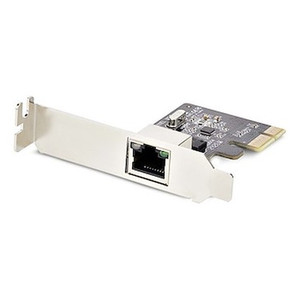
- Standard and Low-Profile Bracket Included: Both brackets ship in the box. Installing in a 1U rack server with a low-profile slot doesn't require a separate accessory order — a common gotcha on competing adapters that ship only one bracket style.
- Windows, Windows Server, and Linux Support: Driver support spans current Windows desktop and server editions plus Linux distributions, covering the majority of VMS server and NVR operating environments without hunting for third-party driver packages.
Integration and Compatibility
The ST10GSPEXNDP2 follows IEEE 802.3an (10GBASE-T), 802.3bz (2.5G/5GBASE-T), 802.3ab (1000BASE-T), and 802.3u (100BASE-TX) standards, which means it pairs with any standards-compliant managed or unmanaged switch that supports those speeds. For network video recorders and recording servers aggregating high-channel-count IP camera streams, the dual 10GbE ports eliminate the throughput ceiling that single-port 1GbE connections impose — particularly relevant when recording 30+ camera channels at high bitrates simultaneously.
Operating temperature is rated 5°C to 50°C, which covers standard server room environments but is worth noting for edge deployments in warmer enclosures — ensure chassis airflow keeps the PCIe slot zone within spec. Storage temperature tolerance is -10°C to 60°C. Humidity range is 20% to 80% RH non-condensing.
The card fits standard PCIe x4, x8, or x16 slots (x4 electrical minimum required). At 14.5 cm length, it clears most 1U chassis without obstruction, but verify slot clearance against your specific server chassis before ordering.
Frequently Asked Questions
Q: Does the ST10GSPEXNDP2 require a PCIe x4 slot specifically, or will it work in an x8 or x16 slot?
A: The card uses a PCIe x4 electrical interface. It will physically seat and function in any x4, x8, or x16 slot — the slot just needs to provide at least x4 electrical lanes. It will not function in an x1 slot.
Q: Can both ports run at 10 Gbps simultaneously without saturating the PCIe bus?
A: Yes. A PCIe 3.0 x4 slot provides approximately 32 Gbps of theoretical bandwidth, which comfortably exceeds the 20 Gbps combined maximum of both ports running full speed simultaneously. The PCIe bus is not the bottleneck.
Q: What operating systems are supported?
A: The ST10GSPEXNDP2 supports Windows, Windows Server, and Linux. Check the StarTech product page for the specific OS versions and driver packages available for your distribution.
Q: Does the card support link aggregation or NIC teaming?
A: The card provides two independent ports. Link aggregation (LACP/802.3ad) capability depends on your OS configuration and switch support — the physical ports themselves are separate interfaces that the OS or switch can present as a team. Confirm your VMS or OS supports the teaming mode you intend to use.
Q: What is the maximum jumbo frame size supported?
A: The ST10GSPEXNDP2 supports jumbo frames up to 16K. Your switch and storage target must also be configured to support jumbo frames at the same MTU for the feature to work end-to-end — a mismatch will cause fragmentation and may reduce rather than improve performance.
Q: Does the card fit in low-profile server chassis?
A: Yes. Both a full-height and a low-profile bracket are included in the box. No additional bracket purchase is needed for either chassis type.
When I spec server NICs for high-channel surveillance recording builds, the ST10GSPEXNDP2 stands out for one practical reason: the Marvell AQC113CS chipset handles TCP/IP offload in hardware, which keeps CPU headroom available for VMS processing and analytics rather than burning it on packet handling. On a 64-channel 4K recording server, that distinction matters more than most buyers realize until they're watching CPU utilization spike at 80% under load.
Technical Highlights:
- Multi-Gig Auto-Negotiation: Auto-steps from 100 Mbps through 10 Gbps across both ports independently — deploy it today against a 2.5GbE switch and it will run full 10GbE when you upgrade infrastructure, no driver or hardware change required.
- IEEE 1588 PTP Support: Hardware-level precision timestamping is rare at this price point. For forensic video correlation across multiple recording servers or synchronized event logging, this is meaningfully more accurate than software NTP and directly relevant to evidence-grade deployments.
- 16K Jumbo Frame Support: At 16K MTU, large sequential camera stream data moves in fewer, larger packets — reducing per-packet CPU interrupt load on the host. The benefit compounds as camera channel count grows.
Deployment Considerations:
- Operating temperature ceiling is 50°C — install in a chassis with adequate PCIe slot airflow. Edge deployments in warm enclosures without active cooling should verify ambient temperatures stay within spec before mounting.
- Jumbo frame performance gains only materialize if every hop in the path — switch ports, storage controller, NAS target — is also configured for the same MTU. Audit the full path before enabling 16K frames or you may see degraded rather than improved throughput.
This card is a strong fit for surveillance recording server builds running 32+ camera channels where a single 1GbE NIC is the documented throughput ceiling, particularly when the server also handles edge analytics and needs CPU headroom preserved for compute tasks rather than packet processing.