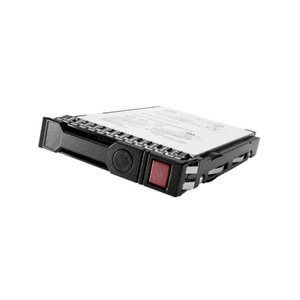
Lenovo 4XB7A83970 2.4TB 10K SAS 2.5" Enterprise Hard Drive
Overview
The Lenovo 4XB7A83970 is a 2.4TB, 2.5-inch SAS hard drive spinning at 10,000 RPM with a 12Gb/s interface — a purpose-built enterprise storage component for server and workstation environments where sustained throughput, high spindle speed, and SAS reliability are non-negotiable. If your storage architecture depends on a dual-port SAS backplane and you're evaluating capacity tiers for your Lenovo server platform, this drive lands in the sweet spot between raw capacity and per-drive performance.
Key Features
- 2.4TB Capacity at 2.5" Form Factor: Packing 2.4TB into a small-form-factor 2.5" drive means higher density per bay — relevant in 24-bay and 48-bay chassis where rack space and U-count are constrained. More capacity per slot reduces the number of drives needed to hit a target aggregate, which directly lowers power draw and heat output per terabyte.
- 10,000 RPM Rotational Speed: At 10K RPM, this drive delivers meaningfully lower seek latency than a 7.2K nearline unit. For transactional workloads — think OLTP databases, Lenovo ThinkSystem RAID arrays serving mixed read/write traffic — higher spindle speed translates to faster random I/O without the cost premium of an all-flash tier.
- 12Gb/s SAS Interface: The 12Gb/s SAS bus runs at twice the bandwidth of a 6Gb/s predecessor. In practice, a single 10K drive rarely saturates 12Gb/s, but the bandwidth headroom matters in multi-drive SAS expander topologies where aggregate throughput across multiple spindles is the constraint. It also positions the drive for compatibility with current-generation SAS HBAs and RAID controllers without a downgrade in signaling.
- 512E (512-byte Emulation) Sector Format: The 512E designation means the drive uses 4K physical sectors internally while presenting 512-byte logical sectors to the host. This is the compatibility format most enterprise operating systems and RAID controllers expect — you get the reliability benefits of 4K physical sectors (stronger error correction per sector) without requiring native 4K host-side alignment. Worth confirming your RAID controller supports 512E if you're mixing with 512n drives in the same array.
- SAS Protocol Reliability: SAS provides dual-port redundancy by design — if one port path fails, the drive remains accessible via the second. For mission-critical server storage where an HBA or expander fault should not cause data unavailability, this is a structural advantage over SATA, which is inherently single-port. SAS also supports command queuing depths far exceeding SATA, which smooths out high-concurrency I/O patterns.
- Server/Workstation Component Classification: This drive is rated and validated as a server/workstation component — not a desktop or surveillance-grade unit. Enterprise HDD qualification programs include vibration tolerance testing (RVFF), 24/7 duty cycle validation, and elevated MTBF targets that consumer and surveillance-class drives do not carry. Deploying a server-rated drive in a high-vibration multi-drive chassis is the correct call; substituting a consumer unit in the same slot is not.
Integration & Compatibility
The 4XB7A83970 is positioned as a Lenovo server component, making it a candidate for ThinkSystem and ThinkServer platforms with 2.5" SAS bays and 12Gb/s SAS backplanes. Before ordering, verify the target server's hardware compatibility list (HCL) — Lenovo publishes per-model compatibility data, and enterprise server vendors qualify drives at the firmware level. Mixing this drive into an existing array with different-capacity units is generally not recommended without consulting your RAID controller documentation, as capacity mismatches affect stripe geometry and usable array size. The 12Gb/s SAS interface is backward-compatible with 6Gb/s SAS controllers at reduced link speed, so it will enumerate in older chassis, but check whether the RAID controller firmware supports the 2.4TB capacity point — some older controllers have per-drive capacity ceilings below 2.4TB.
For deployments requiring the 4XB7A83970 as a hot-swap replacement or capacity expansion in an existing ThinkSystem chassis, confirm the drive bay type (2.5" SFF vs. 3.5" LFF with adapter) and whether the enclosure's backplane runs SAS or a mixed SAS/SATA topology. SAS drives will not operate in a SATA-only backplane regardless of adapter use — protocol compatibility at the backplane level is the governing constraint.
Frequently Asked Questions
Q: What servers is the Lenovo 4XB7A83970 compatible with?
A: The 4XB7A83970 is designed as a Lenovo server/workstation component for platforms with 2.5" SAS bays and 12Gb/s SAS backplanes, such as ThinkSystem servers. Always verify against Lenovo's official hardware compatibility list for your specific server model before purchasing.
Q: What does 512E mean on this drive, and does my RAID controller support it?
A: 512E (512-byte Emulation) means the drive uses 4K physical sectors but presents 512-byte logical sectors to the host. Most enterprise RAID controllers and operating systems handle 512E natively. However, if you're mixing 512E and native 512n drives in the same array, confirm your controller supports the mixed configuration — some older controllers require uniform sector format across an array.
Q: Can the 4XB7A83970 be used in a SATA backplane or NAS device?
A: No. This is a SAS drive and requires a SAS or SAS/SATA combo backplane. It will not operate in a SATA-only backplane or typical consumer/prosumer NAS devices, which use SATA interfaces exclusively.
Q: Is this drive suitable for 24/7 continuous operation?
A: Yes. Enterprise SAS HDDs at 10K RPM are qualified for continuous 24/7 server duty cycles, unlike desktop or entry-level surveillance drives that carry lower duty cycle ratings. This makes the drive appropriate for always-on server environments.
Q: What is the performance advantage of 10K RPM over a 7.2K nearline SAS drive at the same capacity?
A: A 10K RPM drive delivers lower rotational latency and faster seek times compared to a 7.2K nearline unit. For random I/O-heavy workloads such as database transactions or virtualization, this translates to measurably better response times — though for sequential bulk-throughput workloads, the gap narrows and a high-capacity nearline drive may be more cost-efficient per terabyte.
Q: Does backward compatibility with 6Gb/s SAS controllers affect performance?
A: The 4XB7A83970 will link-negotiate down to 6Gb/s if connected to a 6Gb/s SAS HBA or controller. At 10K RPM, the drive's sustained sequential throughput is well within what 6Gb/s SAS can handle, so real-world performance in most workloads will not be bottlenecked by the controller interface in a legacy chassis.
When I evaluate a drive like the 4XB7A83970 for a server storage refresh, the first number I look at is the interface transfer rate — 12Gb/s SAS here — because it tells me which generation of backplane and HBA I'm designing around. At 10K RPM in a 2.5" chassis, this drive is the right fit for workloads that need lower latency than a nearline 7.2K unit without paying the full premium of an NVMe or SAS SSD tier.
Technical Highlights:
- 10K RPM at 2.5" form factor: Higher spindle speed directly reduces rotational latency — relevant in OLTP or virtualization environments where queue depths are high and random 4K read/write latency shows up in application response time benchmarks.
- 12Gb/s SAS bus: Supports current-generation SAS controllers and expander topologies without a bandwidth ceiling at the interface level. The headroom matters in multi-drive SAS domains where aggregate spindle throughput can approach the expander's bandwidth budget.
- 512E sector format: Broadest controller compatibility in the enterprise SAS ecosystem — most ThinkSystem RAID controllers handle 512E without special configuration, which simplifies array provisioning compared to native 4K (4Kn) drives that require explicit host-side 4K alignment.
Deployment Considerations:
- Confirm the target ThinkSystem chassis HCL entry for this specific part number before provisioning — Lenovo qualifies drives at the firmware level, and an unqualified drive may enumerate but produce unexpected RAID controller behavior under load.
- If this drive is replacing a unit in an existing RAID set, verify that the replacement drive's capacity matches or exceeds the smallest drive in the array; the 2.4TB capacity point is non-standard and may not pair cleanly with legacy 1.8TB or 2.0TB drive populations in the same volume group.
This drive is well-positioned for a ThinkSystem SR650 or similar 2.5" SFF chassis running a SQL Server workload tier where the primary constraint is random I/O latency at enterprise duty cycle — not a fit for bulk cold storage, but the right spindle for a transactional hot tier that isn't ready to move fully to SSD.