Lenovo 4XB7B01233 2TB SAS 12Gb/s Hot-Swap 3.5-Inch Enterprise Hard Drive
The Lenovo 4XB7B01233 is a 2TB, 7200 RPM SAS 12Gb/s hard drive purpose-built for hot-swap deployment in Lenovo ThinkSystem servers. Formatted in 512e sector mode and housed in a standard 3.5-inch carrier, it slots directly into the ThinkSystem SR650 V3 without firmware gymnastics or compatibility guesswork. If you're provisioning direct-attached storage in a rack-dense environment where drive replacement can't mean server downtime, this is the form factor to spec.
Key Features
- 2TB Capacity at 7200 RPM: Spinning at 7,200 RPM, this drive delivers the sequential throughput that workloads like surveillance video archives, log aggregation, and bulk file storage actually need — without the per-gigabyte cost premium of SSDs where latency isn't the constraint. At 2TB per bay, a fully populated SR650 V3 can reach multi-hundred-terabyte raw capacity from a single chassis.
- SAS 12Gb/s Interface: SAS 12Gb/s provides twice the per-lane bandwidth of SATA 6Gb/s and, more importantly, dual-port connectivity — each drive presents two independent data paths. In a redundantly-cabled backplane, a single cable or HBA port failure doesn't take the drive offline. For any workload where drive availability is a system-availability dependency, that dual-porting is the real reason to choose SAS over SATA.
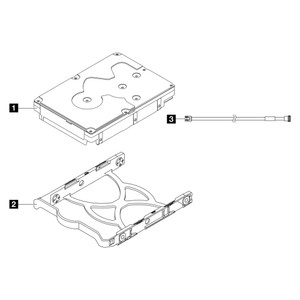
- Hot-Swap Ready: The drive ships in a hot-swap carrier designed for the ThinkSystem bay ecosystem. Failed drives can be pulled and replaced under power without scheduling a maintenance window, which matters significantly in 24/7 environments — surveillance recording arrays, always-on file servers, or storage nodes backing continuous-ingest pipelines.
- 512e Sector Format: The 512e (512-byte emulation) sector format maintains backward compatibility with operating systems, HBAs, and RAID controllers that were written to the original 512-byte sector standard, while the drive's internal physical sectors are 4K. This means the 4XB7B01233 works cleanly in existing ThinkSystem RAID configurations without requiring sector-alignment workarounds or updated firmware stacks in most deployed environments.
- 3.5-Inch Form Factor: The 3.5-inch large-form-factor (LFF) bay is the standard for high-capacity spinning media in rack servers. Compared to 2.5-inch SFF bays, LFF platters hold more data per spindle at lower cost-per-TB — a straightforward tradeoff when you're building out bulk storage rather than maximizing drive density.
- Validated for ThinkSystem SR650 V3: Lenovo validates drives against specific server platforms before including them in the Hardware Compatibility List (HCL). Running a drive on the HCL means the server's firmware, RAID controller, and management stack (XClarity) are tested against that exact drive model — reducing the risk of unexpected behavior under sustained I/O that only surfaces weeks after initial provisioning.
Integration & Compatibility
The 4XB7B01233 is confirmed compatible with the Lenovo ThinkSystem SR650 V3, a 2U dual-socket rack server commonly deployed in compute-dense enterprise and edge datacenter configurations. The SR650 V3's LFF bay complement supports direct integration of this drive into server storage configurations managed through Lenovo XClarity Administrator. For multi-drive arrays, pair with a Lenovo RAID adapter (530-series or 940-series, depending on your performance tier) to enable hardware RAID levels including RAID 5, 6, and 10.
SAS 12Gb/s requires a SAS-capable HBA or RAID controller — standard SATA-only controllers will not recognize this drive. Verify your SR650 V3's installed controller before ordering if the server was originally provisioned with SATA-only storage. In mixed-media environments, SAS and SATA drives can share the same expander backplane on the SR650 V3, but SAS and NVMe bays are physically and electrically distinct.
For deployments building out surveillance storage or bulk-write workloads, consider pairing multiple units across a NVR or server-based recording platform to distribute write load. The hot-swap carrier makes individual drive cycling straightforward in multi-bay configurations without disrupting the remaining array members.
Frequently Asked Questions
Q: Is the Lenovo 4XB7B01233 compatible with servers other than the ThinkSystem SR650 V3?
A: The 4XB7B01233 is validated by Lenovo specifically for the ThinkSystem SR650 V3. While SAS 12Gb/s drives are physically interchangeable across platforms with compatible backplanes, Lenovo's HCL validation applies only to the SR650 V3 for this part number. Use of this drive in other servers is possible but falls outside Lenovo's validated configuration support.
Q: Does the 4XB7B01233 require a special RAID controller or HBA?
A: Yes — this drive uses a SAS 12Gb/s interface and requires a SAS-capable HBA or RAID controller. Standard SATA-only controllers will not recognize or communicate with a SAS drive. Lenovo's 530-series or 940-series RAID adapters are compatible options for the ThinkSystem SR650 V3 platform.
Q: What does 512e sector format mean for my existing RAID configuration?
A: 512e (512-byte emulation) means the drive presents a logical 512-byte sector size to the operating system and controller, even though its physical sectors are 4K internally. This maintains compatibility with legacy software and firmware stacks that were written to the 512-byte sector standard. Most modern RAID controllers and OS environments handle 512e drives without any special configuration.
Q: Can this drive be replaced without shutting down the server?
A: Yes. The 4XB7B01233 ships in a hot-swap carrier compatible with the ThinkSystem SR650 V3 bay. Drives can be removed and inserted under power, enabling replacement of failed members in a RAID array without a maintenance window, provided the array has sufficient redundancy (RAID 1, 5, 6, or 10).
Q: Is this drive suitable for surveillance recording workloads?
A: The 4XB7B01233 is a general-purpose enterprise SAS drive. At 2TB and 7200 RPM with SAS 12Gb/s throughput, it handles the sustained sequential write patterns typical of multi-camera surveillance recording. For high-channel-count deployments, verify the total sustained write bandwidth requirement against the drive's SAS 12Gb/s interface ceiling and your controller's aggregate throughput spec.
When I look at the 4XB7B01233, the spec that matters most for enterprise deployment isn't the capacity — it's the dual-port SAS 12Gb/s interface. In a properly cabled SR650 V3 backplane, each drive maintains two independent data paths to the controller. That's the difference between a cable failure causing a degraded array versus a drive failure causing one. On a 24/7 recording server or a storage node backing a critical workload, that distinction shows up in your incident log eventually.
Technical Highlights:
- SAS 12Gb/s Dual-Port: Unlike SATA, SAS drives expose two independent ports — in a redundantly cabled backplane, path failure doesn't mean drive failure. On the SR650 V3, this enables multipath I/O configurations that eliminate the storage controller as a single point of failure.
- 7200 RPM Sustained Throughput: At full rotational speed, a 7200 RPM platter drive delivers the sequential read/write bandwidth that bulk-write workloads need without the cost-per-TB of flash. For surveillance archives or log storage where you're writing continuously but reading episodically, spinning media at this speed remains the correct economics.
- 512e Sector Emulation: The 512e format keeps this drive compatible with HBAs and RAID firmware that predate the 4K native sector transition. If your SR650 V3 is running an older RAID adapter firmware revision, 512e means you won't hit sector-alignment issues that can silently reduce write performance or cause controller rejection.
Deployment Considerations:
- Confirm your SR650 V3 is equipped with a SAS-capable RAID controller before provisioning — the server can ship with SATA-only or NVMe-only controller configurations depending on the original order, and a SAS drive will not enumerate on a SATA-only HBA regardless of backplane compatibility.
- Hot-swap operation requires RAID array redundancy to be meaningful — pulling this drive from a RAID 0 or a degraded RAID 5 with no spare will cause data loss or an offline array. Ensure your RAID level and spare policy are configured before relying on hot-swap replacement under production load.
The 4XB7B01233 is the right specification for SR650 V3 deployments that need validated, HCL-confirmed storage — particularly surveillance-adjacent server builds where the recording platform sits on a Lenovo ThinkSystem stack and the operator needs confidence that the drive, controller, and firmware have been tested together by the OEM.