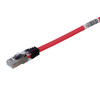
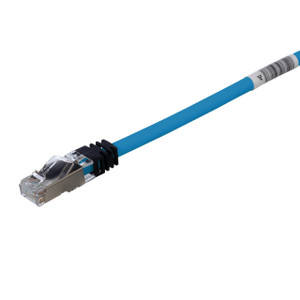
Panduit STP6X1MRD Cat 6A Shielded Patch Cord
High-density 10GBASE-T deployments demand patch cords that won't fail under sustained PoE load or EMI exposure. The Panduit STP6X1MRD delivers 500 MHz headroom in a 26 AWG S/FTP construction—shielded foiled twisted pair that blocks crosstalk in tightly packed racks while maintaining the slender 0.236" OD you need for airflow and cable management. The 1-meter length hits the sweet spot for top-of-rack switching, storage arrays, and KVM runs where slack creates clutter but shorter cords force layout compromises. RapidID barcoding eliminates the spreadsheet-and-toner chase during MACs; scan the pre-applied label, log the port in Panduit's mapping software, and move on. Tangle-free latches survive the hurried 3 a.m. troubleshooting pull without snagging neighboring cables or snapping off in your hand—a failure mode that turns a five-minute swap into a re-terminate job.
Key Features
- 500 MHz performance exceeds TIA-568.2-D Category 6A and ISO 11801 Class EA for 10GBASE-T Ethernet at full 100-meter channel reach
- S/FTP shielded construction (foil + braid) blocks EMI in high-density racks, industrial environments, and runs near fluorescent ballasts or VFDs
- 26 AWG stranded copper maintains 0.236" diameter for tight bend radius and 40%+ density improvement over 23 AWG solid-core jumpers
- Supports IEEE 802.3bt Type 3 (60W) and Type 4 (90W) PoE—no voltage drop failures on PTZ cameras, LED luminaires, or Wi-Fi 6E APs at full meter length
- RapidID pre-applied barcode integrates with Panduit port-mapping software for instant documentation during MACs—scan, log, done
- Tangle-free latch design prevents snags on adjacent cables during extraction; latch guard withstands 200+ insertion cycles without breakage
- CM/LSZH dual-rating: plenum-equivalent flame spread (UL 1863) + low smoke/zero halogen for international data centers and transportation hubs
- Slender strain relief boot fits 1U switch ports with 0.75" vertical clearance; no interference with stacked patch panels or horizontal cable managers
- Universal T568A/T568B pinout—works with either wiring scheme without adapter or crossover
- Red jacket for instant visual identification in mixed voice/data/storage networks or color-coded VLANs
The S/FTP construction combines individual foil shields on each twisted pair with an overall braid shield, then ties both to the plug's metal shell for 360° EMI rejection. This matters in three scenarios: (1) racks with 40+ cables where alien crosstalk from neighboring Cat 6A UTP cords degrades margin, (2) industrial facilities where VFD noise couples into unshielded copper and causes intermittent link flaps, and (3) healthcare or lab environments with RF equipment that generates continuous interference across the 1–500 MHz spectrum. Panduit's shield termination uses a compression-contact method—no solder cups or crimp ferrules—so the plug maintains <50 mΩ DC resistance to the cable's drain wire even after 200 mating cycles. The 26 AWG stranded conductors trade 0.4 dB insertion loss (compared to 23 AWG solid) for a 6 mm bend radius; you can loop this cord through a 2" D-ring without kinking the pairs or cracking the jacket. That's critical when dressing cables in Zero-U vertical managers or around the sides of blade chassis. ANSI/TIA-568.2-D specifies ≤37.1 dB NEXT at 500 MHz for Cat 6A; Panduit publishes 42+ dB typical on production samples, giving you 5 dB margin against manufacturing variance and field wear. The stranded copper also survives vibration—data center cleaning crews routinely bump rack fronts with vacuum hoses; solid-core conductors fatigue and fracture at the plug crimp point, while stranded wire flexes and recovers.
One-meter length serves top-of-rack leaf switches to server NICs (0.9–1.1 m typical in 42U layouts), storage controller redundant paths, or KVM-over-IP to blade management modules. It's short enough to avoid the 1.5 m sag that creates a cable curtain blocking airflow, but long enough to route around PDUs or reach the far side of a 23" rack without diagonal tension on the plug. The CM/LSZH rating meets NEC Article 800 for general-purpose telecommunications spaces (not plenum—use CMP-rated cords for air-handling ceilings) while adding the low-smoke/zero-halogen chemistry required by IEC 60332-3 and most European building codes. During combustion, PVC jackets release hydrochloric acid gas that corrodes electronics and obscures egress signage; LSZH compounds emit <0.5% halogen content and produce optically thin smoke, which is why airports, metro systems, and offshore platforms mandate it. Panduit's LSZH formulation also passes UL 1863's vertical flame test (CM rating), so a single part number covers both NEC compliance in the U.S. and IEC compliance abroad—no need to stock regional variants. The red jacket isn't cosmetic; integrators use color to denote function (red = storage iSCSI, blue = management, yellow = production data) or to flag PoE-capable links so junior techs don't accidentally backfeed power into SFP+ ports. RapidID barcoding solves the "which cable goes where" problem during after-hours MACs: the label survives 95°C operating temp and isopropyl wipes, and Panduit's free RapidID mobile app (iOS/Android) scans it into a searchable port map with switch name, VLAN, and install date. That eliminates the "follow the yellow cable" trace through a bundle of 80 identically colored cords.
Exceeds TIA-568.2-D and ISO 11801 Class EA across the full 1–500 MHz range, ensuring 10GBASE-T compliance at 100-meter channel distances when used with Panduit keystones and backbone cable. UL listed under E129886 for flammability and construction; RoHS compliant per EU Directive 2011/65/EU (lead-free solder, no hexavalent chromium). Supports IEEE 802.3bt Type 4 PoE at 90W continuous—sufficient for outdoor PTZ cameras with heater/blower assemblies or 802.11ax APs with 5 GHz high-power radios—without the voltage drop that causes brown-outs on marginally sized conductors. The tangle-free latch and slender boot aren't marketing features; they're the difference between a clean one-hour switch migration and a four-hour ordeal where half the clips break and you're re-terminating field plugs at midnight. Ships in cartons of 10 with individual polybags; UPC 07498371138 for inventory tracking.