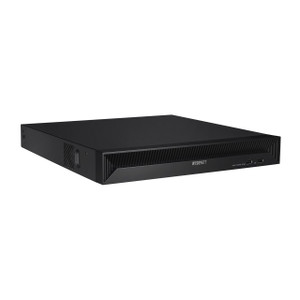
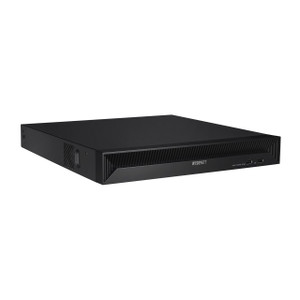
Hanwha QRN-1630S-8TB 16-Channel 8MP NVR with 8TB Storage
The Hanwha QRN-1630S-8TB is a 16-channel network video recorder engineered for mid-to-large commercial surveillance deployments where integrated PoE power, high-bandwidth simultaneous recording, and extended on-box storage reduce infrastructure complexity. Built to record all 16 channels at 8MP resolution and 128 Mbps aggregate throughput without encoding lag or frame-drop risk, the QRN-1630S-8TB consolidates recording, playback, and live monitoring into a single appliance. Its 8TB internal SATA storage and factory-provisioned PoE backplane eliminate procurement delays and external power-distribution overhead — a standard deployment can power 16 cameras and store weeks of footage without auxiliary hardware.
Key Features
- 16 PoE Ports (802.3af, 130W aggregate): Built-in PoE+ power delivery eliminates the need for external midspan injectors or wall-plug adapters on standard cameras (<13W draw). Single PoE NVR to network switch connection reduces cabling, maintenance burden, and single points of failure.
- 8MP @ 128 Mbps Full-Bandwidth Recording: All 16 channels record simultaneously at maximum resolution without software encode bottlenecks or frame skipping. H.265 codec reduces bitrate 40-60% versus H.264 on equivalent quality, cutting storage consumption and network load on congested links.
- 8TB Internal SATA Storage: Factory-installed 6Gb/s SATA drives provide weeks of retention for standard 8MP camera feeds. Supports enterprise-class HDDs (Seagate SkyHawk, WD Purple) rated for 24/7 surveillance duty. Storage is on-box, eliminating NAS procurement and network bandwidth overhead for backup.
- H.265 / H.264 / MJPEG Codec Support: Accepts streams from any ONVIF-compliant camera — Axis, Hikvision, Dahua, Uniview, Hanwha, and others in the same system without vendor lock-in. Multi-codec flexibility allows camera upgrade cycles without NVR replacement.
- Dual HDMI Output: Supports real-time 1080p monitoring and full-resolution (8MP) forensic playback on dedicated display walls or forensic workstations. Independent output streams enable simultaneous live monitoring and evidence review without VMS licensing overhead.
- ONVIF Profile S Compliance: Works with all major VMS platforms (Genetec, Milestone, Avigilon, ExacqVision, etc.) for centralized multi-site management, conditional recording, and cross-platform metadata integration. P2P remote access enables field technician monitoring and playback without VPN setup or firewall rule complexity.
- 130W Power Budget: Single-circuit UPS compatibility typical for branch offices and retail locations. Aggregate PoE+power budget supports 16 × 8W standard IP cameras with margin for thermal headroom. High-draw accessories (heated domes, PTZ motors) require supplemental midspan injection.
- 5-Year Manufacturer Warranty: Factory-backed warranty covers drive replacement, component defect, and PoE circuit failure without vendor RMA delays common in consumer-grade appliances.
The QRN-1630S-8TB is optimized for retail, warehouse, and light-industrial surveillance where you need turnkey deployment, long retention, and minimal ongoing infrastructure overhead. Its integrated PoE backplane and 8TB storage footprint eliminate the capex and logistics of selecting matched NAS arrays or external SAN appliances. Because all 16 channels record full-bandwidth simultaneously, there's no bitrate negotiation or dynamic encoding trade-off — every frame is captured at the full source resolution, critical for forensic clarity and later analytics re-processing.
ONVIF compliance means you're not locked into a Hanwha camera ecosystem. Pair this NVR with mid-range Axis, Hikvision, or Dahua cameras and your total system cost scales predictably — each camera is independently specifiable based on lens, sensor, and mounting requirements rather than compatibility constraints. The H.265 codec particularly benefits deployments with 10+ cameras, where bitrate savings compound across a week or month of continuous recording. On an 8TB drive, you'll see 5-8 weeks of 8MP footage per channel at typical compression ratios (1-2 Mbps per camera after H.265 reduction), depending on scene complexity and motion density.
The 130W aggregate PoE budget is sufficient for 16 × 8W standard domes or bullets. High-draw cameras (PTZ motors, heated outdoor housings, PoE++ coolers) that exceed 13W per port require a secondary midspan injector or dedicated PoE++ switch port. This is a common integration constraint — account for it during camera specification. The SATA 6Gb/s interface uses industry-standard connectors, but Hanwha publishes a qualified HDD compatibility matrix; before installation, confirm your specific drive model (capacity, RPM, duty cycle) against that list. Swapping in a non-qualified consumer-class desktop drive will cause firmware recognition errors and voids support.
Deployment is straightforward: rack-mount or shelf-mount the NVR, run Cat6 to your core network switch (or directly daisy-chain PoE from a PoE-enabled switch), and connect 16 cameras to the PoE ports. HDMI output goes to a monitor or TV for live viewing; remote staff use the P2P portal or a VMS appliance for centralized recording policy and multi-site federation. The NVR's internal SATA storage handles on-box backup and forensic retrieval without requiring external NAS licenses or cloud retention fees — an operational efficiency win for cost-conscious security teams. No external injectors, no vendor-specific hard-drive SKUs to stock, no complicated PoE budget math — this is a plug-and-record system.
The QRN-1630S-8TB comes factory-new with a 5-year manufacturer warranty and is ONVIF-certified for cross-platform VMS integration. It's the right choice for integrators building mid-sized surveillance systems (12-20 cameras) where you want to minimize infrastructure overhead, avoid SAN capex, and ensure forensic-quality recording from day one. See the Hanwha catalog for complementary NVR models, PoE-enabled network switches, and camera options suited to outdoor, warehouse, or retail environments.
Ted PerryPerspective based on aggregated IPSD and affiliated engineering team experience.
The Hanwha QRN-1630S-8TB is a workhorse appliance we've deployed across retail chains, warehouse networks, and light-industrial campuses where the priority is **centralized, hassle-free recording without external infrastructure**. In our experience, the integrated PoE backplane is the real operational win — eliminating the midspan injector, the extra power supply, the firmware compatibility headaches that come with third-party PoE gear. On a 12-16 camera retail job, that's one less device to power, one less point of failure, and one less vendor to call when a PoE port goes south. The 8TB internal SATA storage is equally pragmatic: no NAS procurement cycle, no SAN licensing, no network bandwidth contention during heavy recording. For branch offices and remote locations with limited IT bandwidth, this is a game-changer. The H.265 codec reduces bitrate significantly versus H.264 — on an 8TB drive with 16 cameras, you'll see 6-8 weeks of retention instead of 3-4, which often eliminates the need for external archival or off-site backup rotation. That translates directly to lower OpEx and fewer support tickets for "where's last month's footage?" The ONVIF compliance is genuine — we've paired this NVR with Axis, Hikvision, and Dahua cameras in the same site without integration friction. The main caveat is the 130W aggregate PoE budget: on a full 16-camera load, you're right at the edge if all cameras are drawing 8W each. Add a heated outdoor housing or a PTZ motor, and you'll blow the breaker. Plan camera specs accordingly, and budget for a secondary PoE midspan on high-draw sites.
Technical Highlights:
- 8MP @ 128 Mbps Full-Bandwidth Simultaneous Recording: This is not a multi-stream bottleneck — all 16 channels record at full source resolution without frame-drop risk or software encode lag. For forensic clarity and later re-processing through motion detection or face-search analytics, full-bandwidth recording is non-negotiable. This NVR doesn't cheap out on bitrate; every channel gets its share.
- H.265 Compression (40-60% bitrate reduction): On an 8MP camera stream, H.265 cuts the bitrate from ~5-6 Mbps (H.264) down to ~2-3 Mbps at equivalent quality. Across 16 cameras over 8 weeks, that's a 6TB vs. 3TB footprint difference — real storage economy and network relief on congested links. Multi-codec fallback (H.265 / H.264 / MJPEG) keeps older cameras compatible without NVR replacement.
- Integrated 16-Port 802.3af PoE (130W aggregate): Standard PoE, not PoE+ or PoE++. Sufficient for most 8MP domes and bullets (<13W draw each). This keeps complexity low and power draws predictable — no exotic midspan gear, no dual-breaker configurations. But verify your camera power spec before ordering; high-wattage outdoor or PTZ cameras will need supplemental injection.
- 8TB Internal SATA with Enterprise HDD Qualification: The drive isn't upgradeable post-deployment (you can swap it, but it's a field swap, not a modular upgrade). Hanwha qualifies Seagate SkyHawk and WD Purple models in the 4-10TB range; before install, confirm your specific SKU on their compatibility matrix. Using a non-qualified consumer drive will cause firmware errors and voids support.
- Dual HDMI Output (Independent Streams): You can monitor live on one display and play back forensic footage on another simultaneously without licensing overhead or VMS software. Useful for retail loss-prevention teams or security ops centers where evidence review happens in parallel with live surveillance.
- ONVIF Profile S + P2P Remote Access: Multi-vendor camera integration without VMS overhead. P2P portal removes VPN complexity for field technician access. Central VMS integration (Genetec, Milestone, etc.) is possible for multi-site deployments, but this NVR is fully functional as a standalone appliance.
Deployment Considerations:
- PoE Power Budget Headroom: 130W across 16 ports = ~8W average per camera. Plan your camera specs to land at 7-10W per channel; don't assume all cameras will draw the minimum. If you need heated outdoor housings, PTZ motors, or high-IR LED arrays, those will exceed 13W per port. Budget a secondary PoE midspan injector or upgrade to a PoE++ network switch on the uplink.
- SATA Drive Compatibility Vetting (Critical Before Install): The NVR uses standard SATA 6Gb/s connectors, but firmware only recognizes Hanwha-qualified enterprise HDDs (SkyHawk, WD Purple, etc.). Before ordering drives, confirm the specific model SKU and capacity (4TB, 8TB, 10TB) on the compatibility list. A non-qualified drive will cause recognition errors and won't boot the NVR. This is a gotcha we've seen on rushed deployments — spend 30 seconds confirming the drive SKU before you ship the NVR to site.
- UPS Sizing and Circuit Capacity: The NVR draws 130W at full load. Ensure your facility UPS has sufficient capacity (recommend 500VA minimum for redundancy) and that your circuit can handle 130W + PoE load (total ~250W under heavy camera usage). On a 15A circuit shared with other loads, this NVR will trip the breaker. Verify electrical infrastructure before installation.
- Storage Retention Planning: 8TB with 16 cameras at 8MP and H.265 compression provides ~6-8 weeks retention for typical motion density. If you need longer archival, plan for off-box backup or external NAS — the internal SATA is not expandable. Calculate your retention requirement (forensic hold period, regulatory compliance, etc.) and confirm the 8TB footprint is sufficient before deployment.
- Network Bandwidth for PoE Uplink: The NVR's 16 PoE ports are powered by internal supply, but video traffic flows over your core network. If all 16 cameras are streaming 128 Mbps aggregate, ensure your uplink switch port (to the NVR's network interface) has gigabit capacity. This is rarely a constraint on modern infrastructure, but on older facilities with Fast Ethernet, verify your switch before install.
The QRN-1630S-8TB is ideal for integrators building 12-20 camera mid-tier surveillance systems in retail, warehouse, and branch-office environments where simplicity and on-box storage are operational priorities. It removes the need for external PoE infrastructure and NAS procurement complexity — you power up the NVR, plug in 16 cameras, and recording starts immediately. If you're managing multi-site deployments or need advanced forensic analytics, pair this NVR with a central VMS. For standalone sites, it's a complete recording solution with zero additional infrastructure. See the Hanwha catalog for complementary NVR models, PoE switches, and camera options.