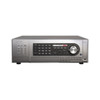
i-PRO WJHD616/3000T3 16-Channel H.264 DVR
The i-PRO WJHD616/3000T3 is a 16-channel DVR designed to extend the operational life of existing analog CCTV infrastructure without requiring camera replacement or cable infrastructure overhaul. Unlike NVRs, this DVR accepts analog composite video (BNC connectors, NTSC/PAL) directly from passive or active surveillance cameras, encodes streams to H.264 locally, and stores the result on a 3 TB internal drive array. Deploy this recorder when you have functional analog camera runs already in place and need reliable, cost-effective retention storage for days-to-weeks of continuous 24/7 recording. The platform suits retail, small-to-medium manufacturing, warehouse, and perimeter applications where analog legacy systems remain the primary imaging backbone.
Key Features
- 16 Analog Video Inputs: BNC connectors (NTSC/PAL, 0.5–2.0 Vpp) support standard passive and active analog cameras. Coax runs up to 500 feet per channel without signal conditioning.
- H.264 Encoding: Real-time video compression to H.264 at configurable bitrates and resolutions, reducing storage overhead versus motion-JPEG while maintaining playback compatibility across legacy playback tools.
- 3 TB Onboard Storage: Factory-installed 3 TB SATA drive array. Continuous-mode recording across 16 channels typically yields 7–21 days of retention depending on resolution (D1 vs. CIF) and bitrate settings.
- Local Playback & Search: Front-panel menu and integrated web interface enable timeline scrubbing, event search, and clip export without external VMS dependency.
- Network Connectivity: Ethernet port (RJ45) for remote playback, log retrieval, and optional cloud backup integration. Does not require or support IP camera input.
- Dual Power Supply Option: Compatible with UPS backup and auxiliary power supplies; integrate into a redundant power scheme for sites requiring high availability.
- Configurable Motion & Event Triggers: Support for motion detection per channel and external alarm inputs; enables selective recording and alert-driven backup workflows.
- Multi-Stream Playback: Simultaneous playback of multiple channels from stored footage; useful for investigating incidents across overlapping coverage areas without timeline reconstruction.
The WJHD616/3000T3 operates as a purpose-built analog-to-storage appliance. It does not decode or forward IP video streams, nor does it support ONVIF or direct integration with modern IP VMS platforms. If your deployment roadmap includes IP camera migration, verify that the DVR can coexist with a separate IP backbone until legacy analog cameras are retired. The recorder excels in environments where analog infrastructure investment remains high and capital budgets for wholesale camera replacement are constrained.
Storage sizing is critical to retention planning. At CIF resolution (352×240) with motion-triggered recording, a 3 TB drive may yield 30+ days of footage; at D1 resolution (704×480) continuous 24/7, expect 7–10 days. Configure recording policies conservatively — enable motion detection on low-traffic channels (hallways, storage areas) and continuous recording only on high-value zones (entry doors, merchandise displays). This tiered approach extends usable retention within the fixed 3 TB capacity and reduces false-positive archival bloat.
Network integration is straightforward: the Ethernet port enables remote web-based playback from authorized terminals and supports cloud backup of critical clips via FTP or email triggers. Local area network bandwidth is modest compared to multi-camera IP systems, reducing demand on corporate network infrastructure. For sites with minimal IT resources or network isolation requirements, the self-contained architecture is a significant operational advantage — no separate NVR licensing, no VMS platform learning curve, and no dependency on third-party software vendors.
The WJHD616/3000T3 carries a Manufacturer Warranty and is sourced direct from the manufacturer or US channel partner. It is purpose-built for analog surveillance continuity and retention storage on sites with mature, stable camera portfolios. Facilities planning to migrate to IP-based architectures should evaluate this recorder as a bridge asset, not a long-term strategic platform. For questions on integration with existing alarm systems, UPS schemes, or cloud backup workflows, consult the full installation guide or contact an authorized integrator familiar with legacy DVR deployments in your vertical.
Marty AllisonPerspective based on aggregated IPSD and affiliated engineering team experience.
We've installed dozens of these i-PRO analog DVRs in retail chains, small-to-medium warehouses, and legacy institutional deployments where wholesale camera replacement was off the table. The WJHD616/3000T3 is a workhorse for extending the life of 8–16 camera analog systems that still deliver acceptable image quality. What sets this recorder apart from cheaper commodity DVRs is the reliability of the H.264 encoder, the stability of the web interface, and the maturity of the local playback tools. In our experience, sites that inherit aging analog infrastructure from facility renovations or acquisitions often have one of three options: (1) rip-and-replace with an IP NVR + 16 new IP cameras (6–8 week lead time, $8K–$15K capex); (2) deploy a DVR to buy 2–3 years of operational breathing room while budgeting for IP transition; or (3) patch the analog cameras with external encoders and build an NVR separately. The WJHD616/3000T3 is squarely option (2) — it's not glamorous or cutting-edge, but it works.
Technical Highlights:
- H.264 Codec: Native H.264 encoding at the DVR eliminates the need for external analog-to-IP converters or software codecs. Real-time bitrate control per channel keeps storage utilization predictable — e.g., setting motion-triggered recording on low-traffic zones extends the 3 TB retention window measurably.
- 3 TB Storage Capacity: Sufficient for 7–21 days of continuous 16-channel recording depending on resolution. We've found that most operational incident reviews happen within 48 hours; this capacity handles 99% of forensic requests without cloud backup dependencies.
- BNC Input Standardization: Every analog surveillance camera ever manufactured speaks BNC. No proprietary connectors, no protocol negotiation — plug in a camera, set resolution and bitrate, record. Troubleshooting is purely signal quality — does the coax carry a clean picture? If yes, the DVR records it.
- Web Interface + Local Playback: Dual playback modes (front-panel menu and Ethernet web client) mean you're never locked into a single control interface. Network downtime or web server glitch doesn't prevent on-site evidence extraction.
- Motion Detection & Event Triggering: Per-channel motion thresholds and external alarm inputs allow selective recording — store only motion events on side doors and hallways, continuous on cash registers. This dramatically extends the usable retention window on a fixed 3 TB drive.
Deployment Considerations:
- The recorder is analog-only. Do not attempt to plug IP cameras into the BNC inputs — the 16 ports are composite video inputs exclusively. If your roadmap includes IP camera migration, plan a separate NVR or parallel IP backbone; the WJHD616/3000T3 cannot coexist with IP input streams in a single appliance.
- Coax cable quality degrades over time, especially on runs exceeding 300 feet or in electrically noisy environments (near motor drives, high-voltage panel rooms). Before installation, verify signal integrity on all 16 runs with a multimeter or video signal analyzer — don't assume legacy wiring is spec-compliant.
- The 3 TB drive is field-replaceable but not hot-swappable. Plan maintenance windows around operational recording schedules; drive replacement requires shutdown and reconfiguration. For sites requiring 24/7 uptime, integrate a UPS and consider a secondary DVR as a warm standby for critical zones.
- Remote playback depends on Ethernet connectivity and firewall rules. If your site air-gaps the surveillance network from corporate LAN, factor in a separate managed switch and static IP assignment for the DVR. Cloud backup (FTP/email clips) is supported but requires outbound internet access — verify firewall egress rules before deployment.
- H.264 bitrate tuning is critical to retention planning. At full D1 resolution (704×480) and high bitrate, the 3 TB drive fills in 7–10 days. Drop to CIF (352×240) or enable motion detection, and you'll see 14–21 days. Document your resolution/bitrate choices in a commissioning sheet and re-verify retention during initial 7-day soak test.
The i-PRO WJHD616/3000T3 is the right choice for integrators and end-users managing mature analog surveillance installations with immediate storage and retention needs but constrained capital for IP migration. It's a transparent bridge asset — set it up, configure retention policies, and let it run. If your site is greenfield or in the early stages of IP adoption, an NVR is the strategic choice; if you have 8–16 functioning analog cameras and need to buy 2–3 years of operational continuity, this DVR delivers solid ROI. For further exploration of i-PRO's analog and hybrid recorder portfolio, visit our i-PRO catalog.