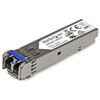
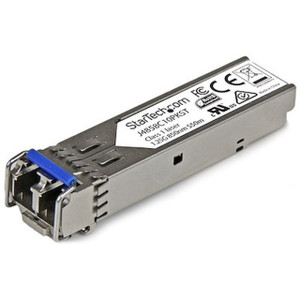
StarTech J4858C10PKST 10-Pack 1000BASE-SX SFP Transceiver Modules
Overview
The StarTech J4858C10PKST delivers ten HPE J4858C-compatible 1000BASE-SX SFP transceivers in a single purchase — the practical choice when you're upfitting a stack of HPE switches and need consistent, validated optics without sourcing individual modules one at a time. Each unit runs 1.25 Gbps over multimode fiber at 850 nm with a reach of up to 550 meters, covering virtually every within-building fiber run and most campus backbone segments. If you're managing a distributed IP camera deployment, a warehouse switching fabric, or a data center with HPE edge infrastructure, buying verified-compatible optics in bulk eliminates the trial-and-error of mixing transceiver brands across a managed switch stack.
Key Features
- 1.25 Gbps 1000BASE-SX Throughput: Each module sustains full-gigabit throughput at 1.25 Gbps — sufficient to handle high-density IP camera streams, VoIP, and data simultaneously on a single uplink port without creating a bottleneck between access and distribution layers.
- 550 m Reach on Multimode Fiber: At 850 nm over OM2 or better multimode fiber, the 550 m maximum reach covers inter-closet and inter-floor runs inside most commercial buildings and small campus environments. You won't need to swap to single-mode unless your run exceeds that distance.
- HPE J4858C Compatibility: Coded to HPE J4858C specification, these modules are designed to install and negotiate correctly in HPE ProCurve and Aruba-branded switches that accept SFP slots — no CLI overrides or unsupported-transceiver warnings to work around during commissioning.
- LC Duplex Connector: The industry-standard LC duplex interface means your existing multimode fiber patch cables work without adapters. LC is the dominant connector in structured cabling installed since the early 2000s, so there's typically no re-termination work involved at either end.
- Sub-1.3 W Power Draw: Each module consumes under 1.3 W, which matters when you're populating a 24- or 48-port switch. At scale, low per-port SFP power draw keeps your switch within its thermal and PoE budget — important on HPE switches where the total power envelope is shared across all ports and uplinks.
- 0°C to 70°C Operating Range: The commercial operating temperature window covers standard IDF closets, server rooms, and climate-controlled distribution spaces. Not rated for outdoor or industrial enclosures — keep that in mind if any of your termination points are in unconditioned spaces.
- 3,381,761-Hour MTBF: That figure translates to roughly 386 years of projected mean time between failures per unit — a reflection of the transceiver's passive optical design rather than a literal field-life guarantee, but it signals the component-level reliability margin built into the design.
- IEEE 802.3z Compliance: Full conformance to the 1000BASE-SX standard means interoperability isn't limited to HPE gear. These modules will negotiate correctly in any switch that accepts 802.3z-compliant SFPs — useful if your environment is multi-vendor or if HPE equipment is mixed with other brands in the same rack.
- 10-Pack Packaging: Buying ten modules as a single SKU (J4858C10PKST) simplifies procurement, reduces per-unit cost relative to individual purchases, and ensures all units in a deployment batch come from the same manufacturing lot — useful for consistency in managed environments where firmware and DOM data are tracked per module.
Integration & Compatibility
These modules are coded for HPE J4858C compatibility and conform to IEEE 802.3z 1000BASE-SX. They install into any SFP slot on HPE ProCurve or Aruba switches that accept J4858C-spec optics. The LC duplex interface pairs with standard 50/125 µm or 62.5/125 µm multimode fiber — OM3 or OM4 is recommended if you're approaching the 550 m distance limit to maintain adequate link margin. For network switches running structured fiber optic cabling in a surveillance or enterprise LAN context, the sub-1.3 W draw per module keeps aggregate uplink power consumption predictable across fully-populated switch chassis. These are not rated for single-mode fiber and will not function on OS1/OS2 runs — multimode plant only. For broader infrastructure planning in IP camera deployments, pairing these with PoE switches at the access layer and using SFP uplinks for distribution is a common and well-validated architecture. See the SFP transceiver catalog for single-mode and long-reach variants if your plant includes runs beyond 550 m. If you're speccing fiber connectivity as part of a camera infrastructure build, the network cabling guide covers fiber type selection and distance budgeting in detail.
Frequently Asked Questions
Q: Will the J4858C10PKST modules work in non-HPE switches that have SFP slots?
A: Yes, in most cases. These modules comply with IEEE 802.3z 1000BASE-SX, which is a vendor-neutral standard. They are coded for HPE J4858C compatibility, but most 802.3z-compliant SFP slots from other vendors will accept and negotiate them correctly. Some switches with strict MSA lock-out policies may require a CLI override — verify your specific switch model's transceiver acceptance policy before deploying at scale.
Q: What fiber type and connector do these modules require?
A: The J4858C10PKST uses LC duplex connectors and is designed for multimode fiber (50/125 µm or 62.5/125 µm). It operates at 850 nm and supports runs up to 550 meters. It is not compatible with single-mode fiber (OS1/OS2).
Q: What is the maximum cable run supported by these modules?
A: Up to 550 meters over multimode fiber. For runs approaching that limit, use OM3 or OM4 multimode fiber to maintain adequate optical link margin. Runs significantly shorter — typical in building riser or IDF-to-IDF segments — will have comfortable margin on standard OM2.
Q: How much power does each module consume, and does that affect my switch's PoE budget?
A: Each module draws under 1.3 W. SFP transceivers are powered from the switch's management/uplink power rail, not the PoE budget — they do not reduce the wattage available to PoE-powered devices like IP cameras. However, on thermally constrained switches, populating all SFP slots does add to overall chassis heat load, so verify your switch's thermal specs in high-density deployments.
Q: Can I use these modules in an outdoor or industrial enclosure?
A: The operating temperature range is 0°C to 70°C, which covers standard commercial-indoor environments. This range is not suitable for unconditioned outdoor enclosures or industrial settings with temperature excursions below freezing or above 70°C. Storage temperature extends to -40°C to 85°C, but that applies only when the module is unpowered.
Q: Why buy the 10-pack J4858C10PKST instead of individual modules?
A: If you're deploying or refreshing multiple HPE switches simultaneously, purchasing as a 10-pack simplifies procurement, reduces per-unit cost, and ensures all modules come from the same manufacturing lot — which is helpful for consistency in environments where transceiver DOM data (digital optical monitoring) is tracked or audited.
The J4858C10PKST is the module I recommend when a team is standing up or refreshing a multi-switch HPE environment and wants to close out the fiber uplink portion of the BOM in one line item. The 3,381,761-hour MTBF figure is the spec I point to first — not because it predicts individual unit life, but because it reflects the passive optical component quality and the conservatism of the thermal design. At under 1.3 W per module, you're not adding meaningful heat load even when all ten are populated across a dense switch stack.
Technical Highlights:
- 550 m MMF Reach at 850 nm: Covers the overwhelming majority of intra-building and inter-closet fiber runs. On OM3/OM4 plant you have comfortable margin at that distance; on legacy OM1 62.5 µm, derate to roughly 275 m to stay within link budget.
- Sub-1.3 W Power Draw: With ten modules active simultaneously, aggregate SFP power across a fully populated chassis stays under 13 W — negligible against a typical HPE switch's total power envelope and irrelevant to PoE port budgeting.
- IEEE 802.3z Compliance: Coding for HPE J4858C prevents unsupported-transceiver flags on HPE ProCurve and Aruba switch platforms, but the 802.3z conformance means the same modules can carry over to a multi-vendor environment without a separate part number.
Deployment Considerations:
- Verify fiber plant type before ordering: these are multimode-only (850 nm). If your existing runs are single-mode OS1/OS2, these modules will not establish a link — you need a 1310 nm single-mode SFP variant instead.
- The 0°C to 70°C operating range excludes unconditioned telecom rooms, outdoor cabinets, and industrial environments with freeze cycles. If any of your IDF or splice points are in unheated spaces, spec an extended-temperature variant rated to -40°C on the operating side.
For a campus security deployment with multiple HPE access-layer switches feeding a central NVR or VMS server over fiber backbone, the J4858C10PKST is a straightforward, low-risk choice — validated compatibility, predictable power, and enough reach to cover any single building's vertical riser without distance anxiety.