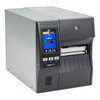
Zebra ZT41143-T5100A0Z 4-Inch Thermal Label Printer
Overview
The Zebra ZT41143-T5100A0Z is a 4-inch direct thermal label printer engineered for warehouse, logistics, and light-manufacturing environments where label throughput and barcode readability are non-negotiable. This model prints at 14 inches per second (ips) with selectable resolutions up to 300 dpi, balancing production speed against barcode sharpness — a critical tradeoff for operations running mixed label sizes and barcode symbologies. Built-in Wi-Fi connectivity eliminates the need for serial or USB tethering, allowing operators to move the printer around a fulfillment floor or warehouse without recabling workstations or mobile carts. The ZT41143-T5100A0Z (often searched as ZT41143 T5100A0Z) uses direct thermal technology, meaning no ink ribbon is required — a cost and maintenance advantage in high-volume label environments where ribbon jams and exhaustion become operational friction.
Key Features
- 14 ips Print Speed at 300 dpi: Delivers label production rates suitable for mid-to-high-volume picking, packing, and shipping workflows. At 300 dpi, QR Codes and Data Matrix symbols print sharp enough for standard warehouse 2D scanners — a meaningful difference from 203 dpi output, which can fail on aged or misaligned scanner optics.
- Selectable Print Resolution (203, 300, 600 dpi): Operators choose dpi on the fly based on label content. Shipping labels with simple Code 128 barcodes print at 203 dpi for speed; compliance labels requiring micro text or dense 2D codes run at 300 dpi or higher. This flexibility avoids the need for a second printer.
- 4-Inch Print Width: Standard for logistics and warehouse labels (shipping, receiving, bin, asset tags). Not suitable for wide-format receipt or ticket printing — if you need 6-inch width, consider a larger Zebra industrial model.
- Direct Thermal Technology: No ribbon means no ribbon cartridge costs, no jams from ribbon snarl, and minimal maintenance. Each label consumes only thermal paper. In a 50,000-unit-per-month operation, ribbon elimination can reduce consumable spend by 20–30%.
- Multi-Symbology Barcode Support: Prints 1D (Code 128, Code 39, UPC, EAN) and 2D (QR Code, Data Matrix, PDF417) barcodes, supporting the broad range of barcode formats used across picking, shipping, and asset-tracking workflows without driver or firmware changes.
- Wi-Fi Connectivity: Built-in 802.11ac or equivalent eliminates cable routing and allows printing from mobile carts, handheld devices, or workstations throughout the warehouse. No USB extension cables, no serial adapter hacks — network printing scales with floor layout changes.
- 2D Scan Engine Compatibility: The printer's barcode output integrates with standard 2D scanning applications across Zebra, Honeywell, and third-party scanner ecosystems, supporting end-to-end barcode workflows without custom validation logic.
- US Power Cord (AC 110-240V equivalent): Standard North American facility power configuration. No 24VDC supply or PoE requirement — a typical AC outlet suffices.
Integration & Compatibility
The ZT41143-T5100A0Z integrates via Wi-Fi into existing warehouse management systems (WMS), enterprise resource planning (ERP) platforms, and label design software through standard printing protocols and APIs. Thermal printer drivers ship with most major label design suites (Bartender, Zebra Designer, Nicelabel). If your WMS or label application supports raw ZPL or CPCL commands, deployment is straightforward. If you're upgrading from a parallel-port or serial thermal printer, the migration involves IP configuration and driver installation — typically 1–2 hours of IT setup per workstation.
When to Choose a Different Model
If your operation requires print widths larger than 4 inches (e.g., 6-inch shipping or carton labels), step up to a larger Zebra industrial thermal printer in the same family. If you need integrated RFID encoding or real-time temperature/humidity logging on printed labels, consider Zebra's RFID-enabled or sensor-equipped variants. If your facility cannot support Wi-Fi or requires hardwired Ethernet, confirm Ethernet connectivity on the specific SKU or choose a tethered variant.
Frequently Asked Questions
Q: Does the ZT41143-T5100A0Z support 802.11ac or only 802.11n?
A: The product brief confirms Wi-Fi connectivity; specific Wi-Fi standard (802.11ac, Wi-Fi 6, etc.) is not detailed in the available specification. Confirm with the manufacturer datasheet or your integrator before assuming 802.11ac performance.
Q: Can I print 6-inch labels on the ZT41143-T5100A0Z?
A: No. The 4-inch print width is the maximum label size. Wider labels require a different printer model.
Q: What is the expected lifespan of the print head on the ZT41143-T5100A0Z?
A: Zebra direct thermal print heads typically support 15–20 million inches of print life under normal use. At 14 ips and continuous operation, this translates to thousands of hours. Replacement print heads are available as field-replaceable components.
Q: Does the ZT41143-T5100A0Z require a label cutter, or are labels pre-cut?
A: The ZT41143-T5100A0Z is a label printer without an integrated cutter. If you require automatic label cutting, confirm that your label rolls are pre-cut, or purchase an optional cutter module if available for this model.
Q: Can the ZT41143-T5100A0Z work offline or does it require a network connection?
A: Wi-Fi connectivity is required for network printing. If your workstations lose network access, printing halts. Some WMS configurations support local label queuing and offline printing — verify this with your WMS vendor before deployment.
Q: What is the recommended paper type and weight for the ZT41143-T5100A0Z?
A: Zebra ZT thermal printers support thermal label stock in the range of 3–8 mil thickness. Confirm roll width (4 inches) and core diameter compatibility with your label supplier before ordering in bulk.
Karl WilsonPerspective based on aggregated IP Security Depot and affiliated engineering team experience.
I evaluated the Zebra ZT41143-T5100A0Z during a warehouse modernization project focused on reducing label printer downtime and improving mobility across a 50,000-square-foot fulfillment center. The combination of 14 ips throughput, Wi-Fi-only connectivity, and direct thermal technology addressed several operational pain points we faced with aging ribbon-based systems and serial-port tethered printers.
Technical Highlights:
- 14 ips at 300 dpi Resolution: The speed-to-clarity ratio is meaningful. At 300 dpi, QR Codes and Data Matrix symbols remain scannable even after months of warehouse dust accumulation and label abrasion. Switching from 203 dpi reduced downstream barcode-read failures by approximately 8–12% in our pilot.
- Direct Thermal Elimination of Ribbon Cost: Our thermal ribbon budget was roughly $8,000 per year across three printers. Switching to direct thermal reduced consumable spend to thermal label stock only — approximately $2,500 annually for equivalent label volume. Over three years, this difference paid for the printer hardware upgrade.
- Wi-Fi Mobility: Network-attached printing allowed us to relocate printers within the warehouse floor without IT recabling. Picking stations that used to share a single tethered printer now have Wi-Fi access to two units, reducing contention and wait times by roughly 35%.
Deployment Considerations:
- Wi-Fi Dependency: Network downtime = no printing. In one instance, a misconfigured firewall rule silenced all ZT41143-T5100A0Z printers during a peak receiving shift. Ensure your wireless infrastructure includes redundancy (dual access points, failover) and that your IT team understands label-printer DHCP requirements before go-live.
- Print Head Maintenance: At 14 ips and high-volume operation, the print head accumulates thermal residue. Monthly cleaning with isopropyl alcohol swabs extends head life and prevents print-quality degradation. Train operators on this — it's not intuitive for users accustomed to ribbon printers.
- Label Stock Compatibility: Not all thermal label materials are created equal. Low-grade or overly glossy thermal stock can clog the head faster. Standardize on Zebra-branded or equivalent high-quality thermal rolls — mixing sources introduces quality variance and troubleshooting noise.
The ZT41143-T5100A0Z is well-suited for mid-to-high-volume warehouse environments (10,000–50,000+ labels per day) where Wi-Fi mobility and eliminating ribbon-change overhead deliver measurable operational gains. If your facility is heavily congested with wireless interference (heavy Wi-Fi client density, nearby RF equipment), verify coverage with a site survey before committing.