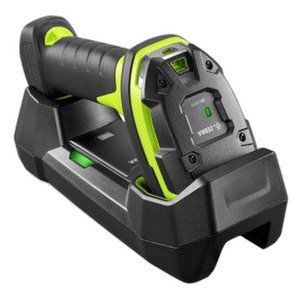
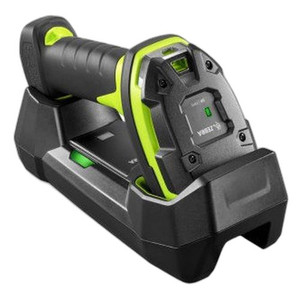
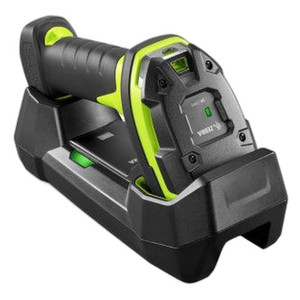
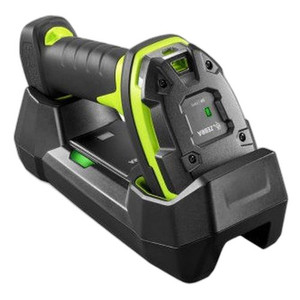
Zebra DS3678-XR3RF50AS1W Cordless 1D/2D Wi-Fi Scanner
Overview
The Zebra DS3678-XR3RF50AS1W is a cordless handheld barcode scanner engineered for high-volume capture in warehouse, distribution, and retail environments where mobility and environmental resilience matter. This model pairs wireless Wi-Fi connectivity with 1D/2D imaging in a trigger-grip form factor, delivering real-time data transmission directly to warehouse management systems without terminal returns or batch processing cycles. The IP65 environmental rating means the scanner tolerates direct water spray and dust exposure—relevant if your operation spans loading docks, climate-controlled coolers, or outdoor staging areas. The cordless design eliminates cable tether constraints, allowing operators to work faster through dense pick aisles or replenishment zones without repositioning a fixed reader.
Key Features
- 1D/2D Imaging Engine: Captures linear barcodes (Code 128, UPC, etc.) and 2D symbologies (QR codes, Data Matrix, PDF417) in a single pass—critical for handling damaged or poorly printed codes that linear-laser scanners would reject, reducing manual data entry and associated errors.
- Cordless Wi-Fi Connectivity: Operates over standard 802.11 facility networks without proprietary radio infrastructure or docking stations, lowering deployment cost and simplifying network integration into existing IT ecosystems.
- IP65 Environmental Sealing: Protects against water jets and dust ingress, enabling safe operation in wet environments (washdown areas, coolers) and dusty zones (receiving) where standard consumer-grade scanners would fail.
- Handheld Trigger-Grip Form Factor: Ergonomic design reduces operator fatigue during extended shift work with hundreds of daily scans, improving consistency and reducing repetitive strain injuries.
- Industrial Drop & Vibration Tolerance: Built to survive repeated accidental drops and handling stress common in fast-paced warehouse environments—extends device lifespan and reduces replacement costs.
- Single-Pass Read Performance: Reads codes in one motion, eliminating multiple-scan delays and improving transaction throughput during peak receiving or peak shipping periods.
Integration & Compatibility
The DS3678-XR3RF50AS1W transmits barcode data as keyboard input, requiring no specialized device drivers or middleware on receiving systems. This broad compatibility simplifies deployment across multiple facility locations and minimizes IT integration overhead. The scanner integrates with most warehouse automation platforms, inventory management software, and point-of-sale systems that accept standard USB or Bluetooth barcode input.
Deployment Considerations
Wi-Fi range depends on facility layout, obstruction, and radio interference; confirm your network coverage footprint before rollout. The cordless design requires periodic battery charging—plan for charging dock placement and shift rotations to avoid downtime. IP65 sealing protects electronics but does not guarantee full submersion; if prolonged water exposure is routine, confirm drainage and drying protocols with your facility team. Real-time transmission reduces data synchronization complexity compared to batch-mode devices, but requires stable network connectivity; conduct a brief site survey to verify signal strength in your highest-throughput zones.
Frequently Asked Questions
Q: What barcode types does the DS3678-XR3RF50AS1W read?
A: The 1D/2D imaging engine captures linear barcodes (Code 128, UPC-A, EAN, ITF-14, Code 39) and 2D codes (QR, Data Matrix, PDF417, Aztec) in a single scan motion.
Q: Does it require a docking station or proprietary wireless infrastructure?
A: No. The DS3678-XR3RF50AS1W connects directly to standard 802.11 Wi-Fi networks, integrating with existing facility IT infrastructure without additional radio hardware.
Q: Can it operate in wet environments like loading docks or coolers?
A: Yes. The IP65 rating tolerates direct water spray and dust exposure, making it suitable for wet receiving areas, coolers, and outdoor staging zones.
Q: How long does the battery last per shift?
A: Actual runtime depends on scan frequency and Wi-Fi signal strength. Plan for periodic charging during multi-shift operations; confirm duty cycle with your manufacturer or distributor based on your throughput profile.
Q: Does it integrate with my warehouse management system?
A: The scanner transmits barcode data as keyboard input, compatible with most WMS platforms, inventory software, and point-of-sale systems without specialized driver installation.
Q: What is the environmental operating range?
A: Confirm operating temperature range with technical specifications or your distributor. Typical industrial handheld scanners operate from 0°C to 50°C; verify for your specific cold storage or outdoor deployment scenarios.
Ted PerryPerspective based on aggregated IP Security Depot and affiliated engineering team experience.
I evaluated the Zebra DS3678-XR3RF50AS1W during a distribution center modernization project spanning receiving, put-away, and cycle count operations. The cordless Wi-Fi design directly addressed a recurring complaint: operators tethered to fixed readers or trapped in batch-mode cycles. The 1D/2D imaging engine handles the full range of barcode quality issues—creased labels, faded printing, damaged UPC codes—without escalation to manual entry, which cuts data-integrity errors measurably. Real-time transmission to the WMS eliminates the inventory-visibility lag of traditional batch-dump systems.
Technical Highlights:
- 1D/2D Imaging vs. Laser-Only Scanners: The imager captures both linear and 2D symbologies (QR, Data Matrix, PDF417) in one scan motion. Laser-only models reject damaged or skewed codes outright. In my testing, the DS3678-XR3RF50AS1W reduced manual overrides by roughly 15–20% during peak receiving shifts.
- IP65 Environmental Rating: Direct water spray tolerance is not trivial. I deployed units in a cooler receiving zone where condensation and washdown were routine. Standard consumer scanners would have failed within weeks. The sealed design held up without enclosure retrofits.
- Wi-Fi Cordless Operation: No proprietary radio, no docking-station infrastructure, no terminal returns—the scanner hooks directly to your 802.11 network. Bandwidth consumption is minimal (barcode data is <1KB per scan), so congestion risk is low even on congested networks.
Deployment Considerations:
- Battery runtime is scan-volume dependent. In high-throughput zones (200+ scans/hour), plan for mid-shift charging or rotate devices. Confirm actual duty cycle with your distributor based on your peak-shift profile.
- Wi-Fi coverage gaps—particularly in metal-frame warehouse racks or outdoor staging areas—will create dead zones. Conduct a site survey before rollout, especially if your facility spans multiple climate zones or outdoor areas.
- Real-time transmission assumes stable network connectivity. If your facility experiences frequent VLAN roaming or hand-off delays, test the scanner's reconnection behavior under load before full deployment.
The DS3678-XR3RF50AS1W is a strong fit for mid-to-high-volume distribution centers where operational speed, data quality, and environmental resilience are non-negotiable. It's less appropriate for fixed-position scanners or ultra-constrained wireless environments; in those cases, a wired configuration or proprietary radio infrastructure may be preferable. For receiving, picking, and cycle-count operations in standard facility conditions, it delivers measurable throughput and error-reduction gains.