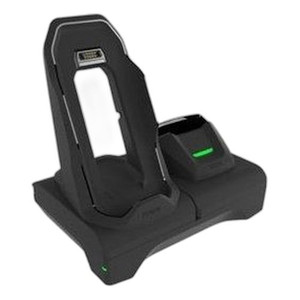
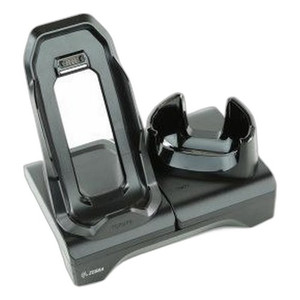
Zebra CRD-TC7X-CVCD1-01 TC7X Vehicle Cradle Charge Only
Overview
The CRD-TC7X-CVCD1-01 is a wired vehicle cradle engineered for Zebra TC7X mobile computers deployed in warehouse, logistics, and last-mile delivery operations. This cradle is charge-only, meaning it supplies power to the device during in-vehicle operation but does not synchronize data—a deliberate design choice that simplifies wiring and reduces integration complexity in fleet vehicles where data transfer happens at the depot, not roadside.
Key Features
- Wired connectivity: No Bluetooth pairing overhead or wireless dropout risk. Hardwired connection ensures consistent power delivery to the TC7X regardless of cabin RF environment—important when your vehicles are moving through industrial areas with heavy radio traffic.
- 12VDC, 4.16A output: Draws from the vehicle's 12V auxiliary circuit (via the supplied country-specific AC line cord adapter). 4.16A at 12V equals ~50W, enough to charge and power the TC7X and its peripherals simultaneously without stressing the vehicle's electrical bus. Calculate this into your vehicle power budget if you're adding multiple cradles or high-draw equipment.
- 100-240 VAC input: The external AC adapter accepts both US and international line voltages, and the package includes a country-specific three-wire grounded AC cord. This matters if your fleet operates across multiple regions or if depot charging stations serve mixed-voltage environments.
- Charge-only design: No data sync means no USB protocol negotiation, no ActiveSync delays, and no dependency on the vehicle's compute infrastructure for device management. If your workflows require real-time sync during deliveries, this is not the right cradle—you'll need a data-capable variant.
- Integrated mechanical retention: The cradle holds the TC7X securely during acceleration, braking, and cornering. Vibration on rough warehouse floors or delivery routes won't dislodge the device.
- Compact footprint: Vehicle cargo areas have limited space. The cradle is dimensionally optimized for dashboard, headrest, or cargo-area mounting without obstructing sightlines or occupant safety systems.
Integration and Compatibility
The CRD-TC7X-CVCD1-01 (often searched as CRD TC7X CVCD1 01) is exclusive to the Zebra TC7X series. It will not cradle TC2X, TC5X, or non-Zebra devices. If your fleet is mixed-device, you'll need to source cradles for each model type. Verify your TC7X firmware revision supports the vehicle power profile (contact Zebra support if unsure—some older TC7X lots shipped with firmware requiring desktop chargers). The country-specific cord is non-replaceable in the field; order the correct region variant upfront. If you need a backup or cross-regional deployment, order spares now.
What's in the Box
- Vehicle cradle assembly (charge-only)
- Country-specific AC line cord (three-wire grounded)
Frequently Asked Questions
Q: Does the CRD-TC7X-CVCD1-01 sync data to a backend system?
A: No. This is a charge-only cradle. Data synchronization must occur via docking stations at the depot or via wireless connectivity (Wi-Fi/LTE) on the TC7X itself. This design simplifies installation and eliminates vehicle-side compute overhead.
Q: Can I use this cradle in a non-Zebra vehicle or in a static warehouse environment?
A: Yes, the cradle is mechanical and electrical agnostic—it doesn't detect vehicle motion. If you have 12VDC available and space for the form factor, it will function in a stationary setting (e.g., warehouse dispatch counter). However, it is designed and tested for vehicular vibration environments.
Q: What happens if I pull a TC7X from the cradle while it's in use?
A: The device loses power immediately if no battery is present. A fully charged TC7X battery provides backup runtime. Verify battery health and charge status before field deployment.
Q: Is the country-specific AC cord replaceable?
A: No. The cord is integrated into the power supply assembly. If you require operation in multiple regions, order the correct regional variant upfront. Cross-regional field substitution is not supported.
Q: What is the typical charge time from 0% to full on a TC7X battery?
A: The CRD-TC7X-CVCD1-01 datasheet does not specify charge time. Consult the TC7X mobile computer documentation for battery capacity (mAh) and calculate expected runtime based on the 4.16A supply current.
Ted PerryPerspective based on aggregated IP Security Depot and affiliated engineering team experience.
The CRD-TC7X-CVCD1-01 is a straightforward vehicle power solution for TC7X deployments in last-mile and warehouse environments. The key differentiator is the charge-only architecture—no data sync overhead means simpler wiring, fewer integration gotchas, and lower vehicle electrical complexity. At 12VDC, 4.16A output, this cradle delivers roughly 50W continuous, which is adequate for charging and running the TC7X and a single peripheral simultaneously.
Technical Highlights:
- 12VDC, 4.16A output: Sufficient to power and charge the TC7X without stalling the vehicle auxiliary circuit. Calculate cumulative draw if you're deploying multiple cradles or adding high-draw scanners or printers.
- 100-240 VAC input with country-specific cord: The external AC adapter accepts international voltages, but the line cord is region-locked. Order the correct variant—there's no field substitution path.
- Charge-only design: Eliminates USB protocol negotiation and ActiveSync delays. If your workflows require real-time backend sync during runs, this is a liability, not an asset.
Deployment Considerations:
- Verify the cradle form factor fits your vehicle's dash, headrest, or cargo mounting point before purchase. Vehicle interiors are not standardized, and a poor fit wastes time and money.
- The country-specific AC cord is non-replaceable. If your depot or fleet operations span multiple regions, stock the correct cord variant for each region. Cross-regional sharing isn't feasible.
- This cradle will not work with TC2X, TC5X, or any non-Zebra device. Mixed-device fleets require multiple cradle SKUs.
The CRD-TC7X-CVCD1-01 is the right choice for logistics operations where devices charge and power during delivery runs, and all data sync happens at the depot via docking or wireless. If your workflow requires constant backend connectivity during the route, consider a data-capable cradle variant or rely on Wi-Fi/LTE instead.