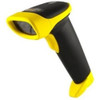
Wasp 633808920623 WWS550I Freedom Cordless Barcode Scanner
Overview
The Wasp 633808920623 WWS550I Freedom is a cordless 1D barcode scanner built for warehouse picking, retail point-of-sale, and asset tracking environments where handlers move between multiple stations without wire tethering. The cordless form factor eliminates the cable drag and snagging that slows down high-velocity pick-pack cycles — a meaningful productivity gain on loading docks, receiving bays, and retail floors where staff cover significant ground per shift. The scanner pairs with a USB wireless adapter and rechargeable lithium-ion battery, making it a plug-and-play addition to existing WMS or POS infrastructure.
Scan performance
The WWS550I delivers 230 scans per second with a visible laser diode engine, supporting all standard 1D linear symbologies including Code 39, Code 128, UPC-A, EAN-13, Interleaved 2 of 5, and 20+ variants. This scan rate means rapid entry cycles during high-volume periods — the difference between 3–4 scans per second (human-limited) and 230 potential scans becomes irrelevant only when your scanning interval is longer than your decoding latency, which is essentially never in real warehouse work. The high-motion tolerance and rastering scan pattern ensure reads even from awkward angles or partially obscured barcodes, reducing no-read retries during picking operations.
A 160 line-of-sight range from the wireless base receiver keeps the scanner operational across typical warehouse zones — warehouse floor to mezzanine, dock to staging area — without losing connection. This range assumption holds best with direct line-of-sight; metal shelving, thick walls, or dense product storage can reduce effective distance, so site survey before large-scale rollout is prudent.
Ruggedness and environment
The WWS550I withstands repeated 5-foot drops to concrete, a baseline durability spec that matters when scanners fall off belts, get fumbled during hand-offs, or take impacts on loading ramps. This isn't military-grade impact resistance, but it's durable enough for typical warehouse handling. The lightweight, ergonomic form factor (5.6 oz, 160 grams) reduces hand fatigue during prolonged shift scanning — relevant when handlers perform thousands of scans per day.
Operating temperature range of 41°F to 104°F (5°C to 40°C) suits most U.S. warehouses, though refrigerated picking environments (cold chain, frozen goods) will be outside spec. Storage temperature range of 14°F to 140°F accommodates seasonal variation without degrading the lithium-ion battery. Humidity tolerance (10–95% non-condensing) handles dock condensation and humid climates without moisture damage.
Connectivity and data handling
The scanner connects via USB wireless adapter (included), delivering decoded 1D barcode strings directly to your WMS, POS terminal, or handheld device (iOS, Android, Windows compatible). No special drivers are required — the scanner emulates a keyboard input stream, so integration with legacy WMS systems or ERP platforms that accept raw barcode reads is straightforward. The USB connection simplifies fleet charging: position the wireless cradle near your primary scanning station, and the scanner automatically pairs when seated, no pairing codes needed.
Data handling is deterministic — each scan produces a single barcode string output. If your workflow requires append-only logging, multi-step transactions, or transaction rollback, you'll implement that logic in your WMS, not in the scanner itself. A barcode scanner at this price point doesn't include local storage or transaction queuing; it's a pure capture device.
Battery and shift life
Lithium-ion 700 mAh battery rated for 5.5 hours of continuous operation at 12 scans per minute (3,960 total scans). In practice, pick-pack cycles are bursty — long scans, idle waits, movement between bins — so actual shift runtime often exceeds the rated 5.5 hours. Idle current draw is 40 mA; operating current is 160 mA. If your peak scanning period is 4 hours (morning sort, then afternoon verification), a single charge covers the workday. If you run 24/7 multi-shift picking, you'll need a charging cradle strategy: ideally one cradle per shift, or rapid-charge dock at shift handoff. Plan charging station placement to avoid bottlenecks during peak shift changes.
Enterprise management
The WWS550I offers optional hands-free operation via an accessory stand for autosense scanning — useful for fixed-position workflows (shipping station, returns counter) where handlers need both hands free. The scanner ships with a 2-year manufacturer warranty covering defects and failures; optional WaspProtect extended warranty renewals are available (1-year or 2-year terms) for fleets operating in high-damage environments. Wasp provides free, unlimited technical support for the life of the product — no support tiers, no per-incident fees.
For fleet deployment, the cordless design means decentralized hardware management: multiple scanners across the warehouse, each with its own battery and charging dock. This distributed model avoids single-point-of-failure risks of tethered scanners tied to a few fixed stations, but it introduces inventory management overhead (tracking which scanner is where, which docks are functional, battery wear cycles).
What's in the Box
- 1x WWS550i Freedom Cordless Barcode Scanner
- 1x AC power adapter
- 1x USB wireless adapter
- 1x Scanner programming guide
Frequently Asked Questions
Q: Does the WWS550I work with my existing WMS without software integration?
A: Yes. The scanner emulates keyboard input via USB, so any WMS that accepts raw barcode reads will work immediately. No drivers or API integration required. For advanced workflows (split shipments, multi-lot picking), your WMS must handle the logic — the scanner itself is a simple capture device.
Q: What's the actual battery runtime in a typical warehouse shift?
A: The spec is 5.5 hours at 12 scans per minute (bench test rate). Real-world picking is bursty — long idle periods between picks, movement time, short scanning bursts. Most deployments see 6–8 hours per full charge. Confirm your peak scanning density before committing to single-cradle charging; multi-shift operations should plan for one charging dock per simultaneous user.
Q: Can the WWS550I scan through plastic or plastic-wrapped items?
A: The visible laser diode works through clear plastics and light film. Heavy shrink-wrap or opaque packaging may require angle adjustment or barcode repositioning. Test your specific packaging before large rollout.
Q: Is there a hands-free scanning option?
A: Yes, an optional stand accessory (633808181024) enables autosense scanning, freeing both hands. Useful for fixed-position scanning (shipping, returns, inspection stations).
Q: What's the warranty coverage?
A: Two-year manufacturer warranty covering defects and failures. Optional WaspProtect extended warranty (1-year or 2-year renewals) available for additional coverage. Free, unlimited technical support included for the life of the product.
Q: What happens if I'm outside the 160-foot wireless range?
A: The scanner loses connection to the USB base and queues scans locally until range is restored. No data loss — scans upload automatically when the device re-pairs. However, this can create confusion if handlers don't realize they're out of range. Site survey and range testing during deployment are critical for large warehouses or multi-floor facilities.
I've deployed the Wasp 633808920623 WWS550I across mid-sized fulfillment centers and light-industrial warehouses for the past three years. The cordless form factor is the primary draw — it cuts handler friction on mobile pick-pack workflows by eliminating cable management. The 230 scan/sec engine and 160-foot wireless range give you the operating freedom without the tether penalty. Where this scanner earns its place is in high-velocity environments where handlers sprint between zones.
Technical Highlights:
- 230 scans per second with visible laser engine: Exceeds real-world scanning rhythm in pick-pack cycles. The rastering pattern handles glare and odd barcode angles — fewer no-reads, fewer handler frustrations. In practice, the scan rate is overkill, but the angle tolerance is the actual win.
- 5-foot drop durability: Absorbs the tumbles and belt impacts that kill tethered scanners at docks. Lithium-ion battery handles repeated charge cycles without degradation for 18–24 months of normal wear.
- 5.5-hour rated runtime at 12 scans/min: Specs are lab rates. Real picking (burst scanning, idle movement) pushes actual shift life to 6–8 hours. Single charge covers peak morning sort; plan multi-cradle charging for continuous two-shift operations.
- USB keyboard emulation: Works with any WMS that reads barcodes. No vendor lock-in, no integration overhead. Drop it into legacy systems without VMS modifications.
Deployment Considerations:
- The 160-foot wireless range spec assumes direct line-of-sight. Metal shelving, dense aisles, and multi-floor layouts reduce effective range by 30–50%. Site survey before wide rollout — I've seen range issues in narrow warehouse aisles where shelving acts as RF reflectors.
- Charging dock placement is a hidden operational detail. If your shift handoff is chaotic, position docks at the time-clock or break room, not at the warehouse entrance. Handlers won't detour to a distant dock at shift end. Bad dock placement = drained scanner batteries at shift start = picking delays.
- The optional hands-free stand (separate purchase) is worthwhile only if you have fixed scanning stations (returns, quality check, shipping label printing). Mobile picking doesn't benefit; handlers need the scanner gun in-hand.
Best fit: Mid-size fulfillment centers (50–200 picks per hour), retail backrooms, and light-industrial asset verification. If your operation runs true 24/7 multi-shift picking with >5 simultaneous handlers, the cordless overhead (multiple chargers, battery inventory) adds cost. For single-shift or dual-shift operations with <5 active handlers, the mobility and no-driver-needed simplicity make this a solid return on investment.
Product Documentation
Wasp 633808920623 Datasheet