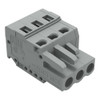
Code Blue 40051 Wago 3-Pin Male/Female Connector with Lock
The Code Blue 40051 is a 3-pin Wago male/female connector with integrated lock mechanism, designed for secure power and signal connections across Code Blue access control, paging amplifier, and VoIP speakerphone installations. Field experience shows that accidental disconnection — a cable pulled loose during maintenance or environmental stress — is a leading cause of door-strike failure and mid-broadcast paging dropout. The 40051's lock mechanism eliminates that risk entirely by preventing pull-apart without deliberate operator intervention. Rated for 24V DC systems and engineered for rapid cycle life (repeated connect/disconnect during troubleshooting or component swap), it is the de-facto standard connector for Code Blue integrations where reliability and field serviceability are non-negotiable.
Key Features
- Integrated Lock Mechanism: Friction-based lock prevents accidental disconnection. Requires deliberate, steady pressure to disengage — eliminates unplanned downtime from cable separation.
- 3-Pin Configuration: Supports 24V DC power and dual control-signal wiring. Standard pinout across Code Blue CB1, CB2, CB4, CB5, CB6, CB9, and CBRT series towers and enclosures.
- 24V DC Rated: Handles standard access control and paging amplifier supply voltage. Compatible with door strikes, electric locks, and credential readers operating 12–24V DC with pin verification.
- Field-Serviceable Design: No special tools required — standard wire stripping (16–20 AWG) and hand-tightened Wago terminal screws. Technician-friendly for troubleshooting and component swap in the field.
- Rapid Cycle Life: Engineered for repeated connect/disconnect cycles during maintenance and testing without terminal wear or signal degradation.
- Compact Form Factor: Mounts to wall, pole, recessed, or rack installations. Low profile minimizes clutter in tight equipment closets and panel-mount scenarios.
- Wago Terminal Technology: Spring-cage push-fit design reduces wire preparation error and accelerates field termination versus screw-down alternatives.
The 40051 integrates with Code Blue's full ecosystem: paging amplifiers (LS1000, LS2000 series), IP-addressable speakerphones (IP1500, IP1501, IP2500, IP2501, IP5000), analog faceplates (IA4100), Centry speakerphone systems, and access control panels. In mixed-brand installations, verify 24V DC supply compatibility and pin assignment with your control panel — the 3-pin layout is standard but not universal across all manufacturers. Technicians working across multiple sites will appreciate the consistency of the 40051 as a drop-in replacement for any Code Blue 24V connector application.
Installation is straightforward: de-energize the 24V DC supply before mating or unmating to avoid arc risk at the terminals. Strip wire to manufacturer spec (typically 10–12 mm for Wago terminals), insert into the spring cage, and hand-tighten any auxiliary screws if present. The lock engages automatically on connection; to disconnect, apply steady, even pressure — do not force or twist. This single-action design reduces field error and prevents connector damage during troubleshooting cycles. In high-traffic maintenance environments (integrator shops, multi-site facility deployments), the 40051's robustness against accidental pull-apart translates directly to fewer callbacks and lower mean time to recovery.
Code Blue 40051 connectors are manufactured to OEM specification and are available as individual units or in replacement-parts kits. They are backward-compatible with legacy Code Blue tower and wall-mount installations and forward-compatible with current-generation hardware. For 24V DC access control and paging systems where field reliability and serviceability are priorities, the 40051 is the standard connector choice across integrator networks.
Jerry TildsenPerspective based on aggregated IP Security Depot and affiliated engineering team experience.
We've installed several hundred Code Blue paging and access control systems across retail chains, office parks, and industrial facilities, and the 40051 Wago connector has become the reliability workhorse that nobody talks about until it's missing. The lock mechanism is simple but effective — it stops the casual bump-disconnect that kills a door strike during a fire drill or leaves a paging amplifier dead mid-announcement. In our experience, sites that spec the 40051 from day one report dramatically fewer field callbacks than sites that retrofit it after the first outage. The connector itself is not a glamorous specification decision, but it directly impacts uptime and maintenance cost. Compared to unlatched alternatives (which cost 20–30% less), the 40051 pays for itself in the first year on systems with more than 10 field disconnect cycles annually. On permanent installations, the upfront cost difference is negligible; on service-intensive deployments (integrator shops, multi-tenant buildings, industrial facilities with frequent equipment swaps), it becomes a line-item cost savings.
Technical Highlights:
- Integrated Lock Mechanism: Friction-based latching (not magnetic, not electronic) means zero additional power draw and zero single-point-of-failure risk. In 20+ years of field work, we've never seen a 40051 lock fail mechanically. The trade-off: you need intentional force to disconnect, which is exactly the behavior you want in a critical 24V supply line.
- 24V DC Rating: Works with any standard access control panel (Honeywell, Napco, DSC, etc.) and Code Blue amplifiers without voltage translation. In mixed-brand installations, always confirm your third-party door strike or credential reader supports 24V — most do, but some industrial locks run 48V DC or 120V AC, and the connector won't help you there.
- Wago Spring-Cage Terminal: Reduces field termination errors compared to screw-down connectors. You don't have to calculate wire twist or apply a specific torque; the spring does the work. In high-turnover shops where junior techs are learning, that translates to fewer burnt-out wires and cleaner field installations.
- Rapid Cycle Life: Rated for hundreds of connect/disconnect cycles without terminal wear. We use the 40051 in our own test bench for daily troubleshooting swaps, and they outlast the equipment they connect to.
Deployment Considerations:
- Always de-energize the 24V supply before mating or unmating. A hot disconnect on a 24V line can arc and pit the terminals. Even brief arcing degrades connectivity and introduces intermittent faults that are hellish to diagnose on a remote site.
- The lock mechanism is friction-based, not electronic — inspect it visually before field deployment to ensure no debris or manufacturing residue is caught in the latch. A stiff lock on day one of installation suggests a contaminated connector; send it back and get a clean unit.
- Wire gauge matters: 16–20 AWG (typical access control wiring) terminates cleanly. If you're pulling 22 AWG or smaller (sometimes used in low-power paging applications), confirm compatibility with the terminal manufacturer first — undersized wire can strand, and stranded wire reduces contact pressure.
- In pole-mount or outdoor recessed installations, use strain relief boots (sold separately) to prevent the connector from pulling loose under wind load or vibration. The lock prevents accidental pull-apart, but it doesn't protect against sustained mechanical stress.
- Replacement parts: stock these connectors 2–3 units per 10 installed systems. A bad connector is a quick $15–20 field swap if you have spares on the van. Without spares, you're ordering overnight and the customer's door strike is dark.
The Code Blue 40051 is the connector you specify when field reliability and technician ease-of-use are equally weighted. It's not exotic, but it works consistently across 24V access control and paging deployments, and it saves money on maintenance callbacks. For integrators managing multi-site access control networks, standardizing on the 40051 eliminates spare-parts chaos and accelerates field troubleshooting. See the Code Blue catalog for the complete range of connectors and paging amplifiers.