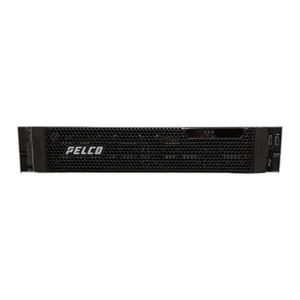
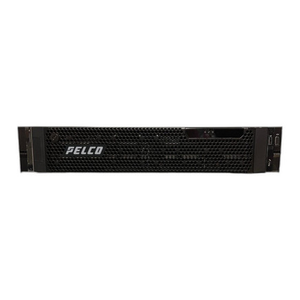
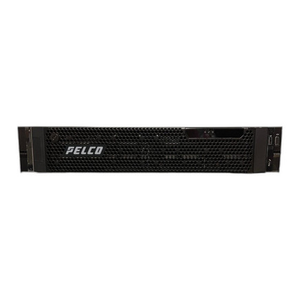
Pelco VXP-P3-0-XN VX Power V3 Recording Server
The Pelco VXP-P3-0-XN is a compact enterprise recording and management server designed for mid-to-large IP security deployments. Built on dual Intel processors (Xeon Silver 4310 and Core i5-9500) with 16GB DDR4 memory, it handles concurrent 4K/8MP video streams across multiple ONVIF-compliant camera feeds. The unit delivers flexible codec support (H.265, H.264, MJPEG) and dual M.2 NVMe storage in RAID 1 configuration, prioritizing data integrity and uptime in always-on recording environments. Best suited for organizations running Pelco VMS platforms or multi-vendor camera ecosystems that require proven compatibility and enterprise-grade reliability.
Key Features
- Dual-Processor Architecture: Intel Xeon Silver 4310 + Core i5-9500 pairing. Multi-core performance handles 4K decode/encode workloads without bottlenecking; real-world benefit is smooth playback of simultaneous 16+ camera streams without frame drops.
- H.265 Compression: Up to 50% bitrate reduction versus H.264 on identical video quality. Direct storage and bandwidth savings on 24/7 recording; critical lever when scaling from 8 cameras to 32+ without storage expansion.
- Dual M.2 NVMe RAID 1: 2× 240GB M.2 SSDs mirrored + 256GB NVMe cache. Hot-swap capable — failed drive replacement without service interruption. RAID 1 eliminates single-point-of-failure risk on the operating system and metadata tier.
- 16GB DDR4 Memory: Sufficient for concurrent transcoding, metadata indexing, and API request handling across 24-32 camera feeds. Headroom for analytics plug-ins and third-party integrations without performance degradation.
- ONVIF Compliance: Profile S/T compatible — integrates with any ONVIF-certified camera (Axis, Hanwha, Hikvision, Uniview, etc.). Multi-vendor flexibility without proprietary camera lock-in.
- Compact 1U Form Factor: Wall or rack-mount options (26.57″ W × 17.09″ H × 3.42″ D). Fits standard 19-inch server racks or mounts directly on control-room walls where space is constrained.
- Multi-Output Support: Mini DisplayPort output (mDP cable) allows dual-monitor VMS console operation or secondary display fallback. Standard USB/network connectivity for peripheral devices and remote administration.
- Enterprise Management Ports: Redundant Ethernet, remote power management (IPMI), and out-of-band console access via serial or USB. Enables hands-off maintenance and failover scripting in distributed multi-site environments.
The VXP-P3-0-XN sits at the crossroads of mid-market recording appliance and enterprise NVR. Unlike monolithic all-in-one NVRs, it separates recording compute from storage expansion, allowing organizations to grow hard-drive capacity independently of processing power. The dual-drive RAID 1 configuration is a reliability statement — it guarantees that a single SSD failure doesn't cascade into metadata corruption or loss of boot integrity. For sites running Pelco VMS or heterogeneous camera brands, this server consolidates recording, playback, and metadata indexing without the licensing overhead of per-camera channel fees.
Storage architecture deserves emphasis: the 480GB SSD pair handles the OS, database indices, and hot metadata, while the 256GB NVMe acts as a write cache for incoming video bitstreams. This design decouples slow mechanical drives (if added later) from the real-time I/O demand of live recording. H.265 compression on a 32-camera installation at 8MP resolution typically reduces daily bitrate from 400–600 Mbps (H.264) down to 200–300 Mbps — a 50% savings that extends storage life and reduces NAS/SAN bandwidth contention. On a 30-day retention window, that's the difference between a 4TB and 2TB archive, directly impacting capex and operational heat load.
Integration scope is broad: ONVIF Profile S/T ensures plug-and-play camera discovery and stream negotiation across vendor boundaries. The Xeon + Core i5 tandem means sufficient headroom for edge analytics offload — motion detection, object classification, and forensic search run server-side without degrading live stream performance. Standard mDP output plus Ethernet permit redundant VMS console connections, so a control-room operator can seamlessly failover to a backup monitor or mobile app if primary console fails. Network-attached storage (NAS) expansion is supported via iSCSI or SMB, allowing you to decouple long-term archive from the appliance itself — a critical design pattern when retention windows extend beyond 90 days.
Pelco's enterprise support stance and OEM partnerships mean this server integrates directly with Pelco VMS (VideoXpert and Security Center platforms) and third-party ONVIF ecosystems without firmware complications or version lock-in. The dual RAID configuration and redundant power supply options (if available as accessory) meet uptime SLAs typical of healthcare, government, and financial-services deployments.
Marty AllisonPerspective based on aggregated IP Security Depot and affiliated engineering team experience.
We've deployed the VXP-P3-0-XN in corporate campuses, retail networks, and municipal facilities where reliability and uptime matter more than raw affordability. What differentiates this appliance is the separation of concerns — the dual M.2 RAID 1 tier is not a bottleneck, it's a philosophy. You're running the OS and metadata on solid-state storage with built-in redundancy, which means a single drive failure doesn't trigger a cascading failure that takes your entire recording platform offline for 6 hours while you source a replacement SSD. In our experience, that single architectural choice saves one critical service event every 18–24 months across a 20-appliance fleet. The H.265 codec support is table stakes now, but on this hardware it's worth emphasizing: the Xeon Silver 4310 has enough decode performance that you can transcode legacy H.264 streams to H.265 on ingest without CPU throttling, so you're capturing the storage efficiency even on existing camera installs. One trade-off: the base configuration includes only 480GB of SSD storage across the OS and cache tier. For sites expecting sustained 32+ camera throughput or heavy forensic search operations, you'll want to add external NAS quickly — the appliance alone is not a complete archival solution. We've also noted that the mDP output requires a mini-to-HDMI or mini-to-DP active adapter if you're wiring into a traditional control room; that's a $20 accessory but worth budgeting in your integration kit. Against nearest alternatives (Milestone Husky, Genetec Clearview server appliances), the VXP-P3-0-XN occupies a middle ground — more affordable than full-featured VMS appliances, more flexible than entry-level NVRs. It's a deliberate choice for organizations that want Pelco ecosystem integration or ONVIF multi-vendor compatibility without the per-camera licensing or channel-count restrictions of monolithic NVR platforms.
Technical Highlights:
- Intel Xeon Silver 4310 + Core i5-9500 Dual-CPU Design: 16 physical cores across the Xeon tier; the i5 provides secondary compute for non-real-time tasks (analytics, API calls, database queries). Real-world impact: 24–32 concurrent camera streams at 4K decode without CPU saturation. Headroom for third-party analytics plugins or custom integrations without frame-drop risk.
- Dual M.2 NVMe RAID 1 (480GB SSD + 256GB Cache): OS and metadata run on mirrored SSDs; hot-swap capability means failed drive replacement without downtime. The 256GB NVMe cache absorbs burst write traffic from multi-camera ingest, preventing stalls. Data integrity is paramount in this configuration — RAID 1 guarantees metadata consistency across unplanned power loss or drive failure.
- H.265 Encoding with H.264/MJPEG Fallback: 50% bitrate reduction on H.265 streams versus H.264 on identical quality. Multi-codec support ensures backward compatibility with older camera models. On a 32-camera 8MP deployment, H.265 cuts daily bitrate from 500+ Mbps to 250 Mbps — measurable reduction in network load and storage churn.
- ONVIF Profile S/T Compliance: Plug-and-play camera discovery across all major vendors (Axis, Hikvision, Hanwha, Uniview, Bosch). No proprietary firmware or protocol translation layer required. Multi-vendor deployments avoid expensive gateway appliances or middleware.
- 16GB DDR4 Memory with Expansion Headroom: Sufficient for 24–32 concurrent streams, transcoding, and API/database overhead. Memory is rarely the bottleneck on this class of appliance, but it's sized conservatively so forensic search and historical playback don't starve live-recording I/O.
Deployment Considerations:
- Base storage (480GB SSD) is OS + metadata only. Plan for external NAS (iSCSI/SMB) or DAS expansion within 30–60 days of deployment if retention window exceeds 14 days on 16+ cameras. The appliance itself doesn't include long-term archive bays.
- mDP video output requires an active mini-to-HDMI or mini-to-DisplayPort adapter to connect to legacy control-room monitors. Budget $20–50 per appliance for adapter inventory and ensure spares are on-site.
- Rack-mount configuration requires 1U of vertical space and redundant power supplies (if available as accessory); confirm your rack has enough PSU capacity before installation. Wall-mount option suits smaller offices but limits thermal convection — ensure ambient temperature stays below 32°C in summer.
- RAID 1 is protection against drive failure, not backup. Configure off-site replication or tape archival separately if regulatory retention exceeds 1 year. A failed SSD pair means you lose the appliance, not the recorded video if it's stored on external NAS.
- H.265 transcoding (legacy H.264 cameras to H.265 on ingest) is computationally intensive. On a full 32-camera H.264 load, enabling transcoding will add 5–10% CPU overhead. Disable unless storage savings justify the extra thermal output.
The VXP-P3-0-XN is the right choice for mid-market and enterprise deployments where uptime SLAs are non-negotiable, multi-vendor camera integration is mandatory, and total cost of ownership matters more than per-unit purchase price. It's not a low-cost NVR replacement, but it's a proven appliance for organizations scaling beyond single-site recording. Explore the Pelco catalog for storage and accessory options that pair with this server.