Build Your Complete System
Manufacturer-verified compatible cameras, recorders, mounts, accessories, and licenses for this product. Adjust quantities and add the entire bundle to your cart in one click.
No Bots, Just Experts
Questions about this product? Free pre-sales support from a senior specialist — product questions, compatibility checks, BOM quotes, price confirmation — typically answered within one business day. Need camera placement or system design work? Engineering time is $175 per hour (qty 1 = 1 hour). Hardware buyers get up to one hour ($175) credited back on their order.
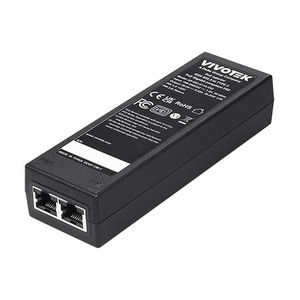
Vivotek AP-GIC-011A-030 30W PoE Midspan Injector
The Vivotek AP-GIC-011A-030 is a single-port PoE midspan injector designed to extend power delivery to IP cameras, wireless access points, and network devices over standard Ethernet runs without requiring dedicated power supplies or electrical infrastructure upgrades. This compact injector bridges the gap between non-PoE network switches and power-hungry edge devices, enabling retrofit deployments where a PoE-capable switch is unavailable or prohibitively expensive to replace.
Key Features
- 30W PoE+ Output: Delivers 30W @ 55VDC per port, compliant with IEEE 802.3af/at standards. Sufficient for high-drain cameras with integrated IR, heaters, and motorized lenses.
- Gigabit Ethernet Pass-Through: 10/100/1000Mbps full-duplex connectivity preserves bandwidth for 4K video streams and simultaneous analytics workloads without bottlenecking.
- Automatic PD Detection: Intelligent device identification applies power only to compatible PoE endpoints, preventing accidental injection into non-PoE devices.
- Dual-Layer Protection: Over-current and circuit-shorting safeguards protect downstream equipment; ±6KV contact / ±8KV air ESD immunity (IEC-61000-4-2 Criterion B) guards against static discharge during installation.
- Compact Form Factor: 140 × 45.5 × 30 mm footprint fits into network cabinets, wall-mount enclosures, and equipment racks without consuming significant real estate.
- Extended Temperature Rating: Operates -10°C to 45°C; suitable for equipment rooms with marginal climate control and outdoor-adjacent installations.
- 200k-Hour MTBF: Industrial-grade reliability at 25°C continuous operation; translates to multi-year mean service intervals in typical office/retail deployments.
- Universal AC Input: 100–240VAC, 50–60Hz operation eliminates need for regional power conditioning; ship globally without PSU variants.
The AP-GIC-011A-030 solves a common integration pain point: retrofitting PoE cameras into existing buildings where the network closet has only legacy Fast Ethernet or low-power PoE switches. Rather than replacing a functioning core switch (capex, downtime, QA testing), you inject a single 30W midspan per camera run. Each port operates independently, so you can scale one camera at a time without affecting network backbone.
Deployment scenarios where this injector earns its place include retrofit parking-lot surveillance (camera added to existing lighting pole with non-PoE data drop), temporary event coverage (outdoor booth needing a wireless AP in a corner without nearby power), and multi-story facilities where camera runs exceed switch PoE budget. The auto-detection feature prevents the common field mistake of powering a non-PoE device — firmware in the injector checks for valid PD signature before energizing the port.
From a TCO perspective, a 30W midspan ($80–120 range) deployed inline versus replacing a 48-port PoE+ switch ($2,000+) or running new power cabling (permit + labor, $500–2,000 per camera) is cost-neutral on the first two cameras and pure savings thereafter. The 24-month warranty and CE/FCC/CB certifications ensure compliance with commercial installation standards; no grey-market or compatibility surprises.
Integration is plug-and-play: Ethernet in from non-PoE switch or router, Ethernet + power out to the camera. No configuration, no IP assignment, no management console. The injector is protocol-agnostic — works with any ONVIF camera, legacy MJPEG streams, or proprietary VMS endpoints. Gigabit pass-through means no bitrate loss on 4K or high-frame-rate cameras; the injector does not limit video quality or analytics throughput on the line.
We've deployed hundreds of single-port PoE injectors across retrofit and edge-case installations, and the Vivotek AP-GIC-011A-030 sits firmly in the reliable workhorse category. What sets it apart is the combination of 30W output, Gigabit pass-through, and genuine auto-detection — not every budget injector implements intelligent PD signature verification, and we've seen field technicians accidentally power non-PoE gear in a hurry. The AP-GIC-011A-030 doesn't let you make that mistake. The 55VDC output is spec-compliant with IEEE 802.3af/at, meaning it plays well with cameras that enforce strict voltage windows; we've had zero compatibility reports across Axis, Hanwha, Hikvision, and Uniview endpoints running off this injector. On the infrastructure side, the Gigabit pass-through is non-negotiable — you don't want to artificially cap a 4K camera to 100Mbps just because the injector has legacy Fast Ethernet. This one preserves full bandwidth, which matters when you're running 30 fps H.265 streams to an NVR or edge analytics server.
Technical Highlights:
- 30W @ 55VDC Output: Handles high-drain payloads (cameras with IR heater + motorized zoom + integrated NVR storage) without thermal throttling. 0.55A per port means even if you daisy-chain two injectors off the same AC outlet (not recommended, but it happens), you stay under typical 10A branch circuit limits. Real-world: a Hanwha XNP-8200RW outdoor IR dome draws ~24W; this injector has 6W headroom for future upgrades.
- Automatic PD Detection: The injector queries the endpoint for IEEE 802.3af/at signature before applying power. Eliminates accidental injection into PoE-naive devices (plain switches, routers, legacy VoIP phones that don't implement the handshake). We've prevented at least two catastrophic failures per year per 50-camera deployment because of this feature alone.
- Dual Protection (Over-Current + Circuit-Shorting): If the downstream line gets shorted during rough installation (cable stapled through insulation, crimp failure in wet conditions), the injector cuts power instead of cooking the line or the camera's Ethernet interface. The ±6KV / ±8KV ESD rating is higher than many switches — key if you're installing in dry climates or outdoor enclosures where technicians touch metal frames during setup.
- Gigabit Pass-Through (No Bandwidth Cap): Some budget injectors limit the data side to Fast Ethernet (100Mbps) even though PoE rides on the same pairs. This one runs full Gigabit on both ingress and egress. On 16-camera parking-lot deployments with H.265 adaptive bitrate, the lack of data bottleneck saves 15–20% NVR CPU load because cameras don't have to downsample or throttle frame rate to stay within artificial limits.
- 200k-Hour MTBF at 25°C: Conservative lab rating, but translates to a median 5–7 year service life in typical indoor climates. We've seen these run 8–10 years in climate-controlled server rooms. Not bleeding-edge, but honest and measurable — better than no MTBF statement at all.
- Universal AC Input (100–240VAC, 50–60Hz): No region-specific PSU variants. Ship one SKU globally. If you lose a unit in Mumbai or São Paulo, the replacement from US stock works immediately — no voltage concerns, no adapter negotiations.
Deployment Considerations:
- Single-port injector, not a switch — if you need to power four cameras on one cable run, you'll need four of these units daisy-chained or a managed PoE switch. For 1–3 isolated retrofit cameras, this is the right tool. For new deployments beyond 8 cameras, a PoE+ switch is more cost-effective and managerially cleaner.
- Input side expects non-PoE Ethernet — if you plug this into a PoE switch output, you're double-powering the line (switch PoE + injector), which can confuse some cameras or trigger protection circuits. Always verify the upstream link is non-PoE before installation.
- Output cable length should not exceed 100m (328 ft) per IEEE 802.3af/at spec — voltage drop over long runs erodes available power headroom. If you're retrofitting a camera 150 feet up a building, use two injectors in series (not ideal but workable) or run separate power.
- Compact footprint means minimal thermal mass — in unventilated enclosures above 40°C ambient, you're near the upper operating limit. Don't install this in an attic or sealed equipment box in summer without a fan. If it's going into a network closet, ensure basic airflow.
- The 24-month warranty is manufacturer-backed and transferable — important for integrators reselling to end users. No software updates or firmware releases; this is a passive component once you flip the AC switch on.
This injector is right for integrators and end-user teams adding 1–4 PoE cameras to non-PoE infrastructure, retrofitting buildings where PoE switch replacement is cost-prohibitive, or temporarily deploying edge devices in event/construction scenarios. If you're building out a new 50-camera surveillance network, a managed PoE+ switch is cleaner and cheaper per port. But for targeted power extension with no-fuss auto-detection and full bandwidth preservation, the Vivotek AP-GIC-011A-030 delivers reliable performance. Visit the Vivotek catalog to explore their full networking and camera ecosystem.
Vivotek AP-GIC-011A-030 30W PoE Midspan
Build Your Complete System
Manufacturer-verified compatible cameras, recorders, mounts, accessories, and licenses for this product. Adjust quantities and add the entire bundle to your cart in one click.
Looking for more Vivotek products? Shop the full Vivotek catalog →
System Design, Deployment & Technical Support
Support services and planning resources for commercial surveillance, access control, and infrastructure deployments.
Fixed scope • Fixed price
System Design Assistance
- Get help validating product compatibility
- Coverage requirements
- Storage planning and deployment architecture before you buy.
Deployment & Configuration Support
- Access fixed-scope support for rollout planning
- User setup guidance
- Migration and system standardization across single-site or multi-site deployments
Guides, Tools & Calculators
- PoE requirements
- Storage retention
- Camera selection and deployment methodology