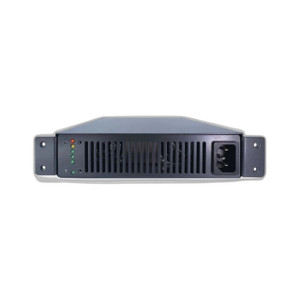
Veracity VPSU-POE-240-US PoE Injector
Overview
The Veracity VPSU-POE-240-US (often searched as VPSU POE 240 US) is an industrial-grade Power over Ethernet injector engineered to inject stable power and maintain data integrity across distributed IP security networks. Built for environments where thermal stress and continuous duty are normal operating conditions, this device addresses a specific integrator pain point: delivering PoE to remote endpoints without separate power infrastructure or thermal management overhead. The VPSU-POE-240-US supports standard IEEE 802.3af and 802.3at protocols, meaning it works with conventional IP cameras, wireless access points, and networked security hardware without vendor lock-in.
Key Features
- 240W Total Injection Capacity: Delivers up to 240 watts of power across the injector's output, allowing you to power multiple standard-draw endpoints (typically 15–95W per device) from a single upstream connection without cascading multiple injectors in series.
- IEEE 802.3af/at Compliance: Native support for standard PoE specifications means compatibility with any device rated for 802.3af (up to 15.4W) or 802.3at (up to 30W). No proprietary firmware or vendor-specific drivers required.
- Industrial Temperature Rating: Operates across wider temperature extremes than commercial-grade PoE injectors, eliminating thermal shutdown events in server rooms with variable cooling, outdoor network cabinets, or facilities subject to seasonal temperature swings—critical for cost-sensitive wide-area deployments where thermal management infrastructure is impractical.
- Passive Injection Architecture: Uses passive (non-intelligent) inline power injection rather than requiring SNMP negotiation or active monitoring, reducing complexity during commissioning and lowering the risk of misconfiguration.
- Compact Footprint: Space-efficient chassis design fits standard server racks and network closets without displacing other equipment, keeping cable management straightforward in dense deployments.
- Single Cat5e/Cat6 Cabling: Injects power onto unused wire pairs, eliminating the need to run separate power cabling to remote IP endpoints—a significant labor saving on medium-to-large installations where every meter of conduit adds cost.
Integration and Deployment Context
The VPSU-POE-240-US fits naturally into power infrastructure planning for IP-based surveillance systems. Security integrators benefit from its plug-and-forget passive design: connect the upstream Ethernet to your switch or network, connect the injector's output to your endpoint device, and power flows inline with data. IT managers appreciate the reduced footprint in network cabinets and the elimination of additional AC drops or dedicated power runs to remote locations.
For multi-site deployments, the industrial temperature rating is the practical differentiator. Equipment in outdoor cabinets or unheated facilities subject to 40°F+ seasonal swings will maintain stable output without throttling or drift, reducing warranty claims and emergency callouts. This matters on projects spanning dozens of locations where thermal monitoring and reactive cooling retrofits are economically prohibitive.
Integrators should verify endpoint power budgets during design. Standard PoE endpoints draw between 15–95 watts; if daisy-chaining multiple devices or considering future expansion, confirm cumulative load against the 240W total capacity. The passive architecture means no active load-balancing—power is available on a first-come, first-served basis to endpoints connected to the injector's downstream ports.
When to Choose a Different Approach
If you require PoE switches with integrated power delivery and SNMP monitoring, or if your deployment demands active power management per port, consider a managed PoE switch instead. The VPSU-POE-240-US is a straightforward injector—it adds power to existing Ethernet infrastructure but does not replace switch functionality. For sites requiring remote power cycling or per-port power budget enforcement, a managed PoE solution is the better fit.
Frequently Asked Questions
Q: What's the difference between passive and active PoE injection?
A: Passive injection (used in the VPSU-POE-240-US) delivers power unconditionally to all output ports. Active injection requires the endpoint device to request power before the injector delivers it. Passive is simpler to deploy and commission, but places responsibility on the integrator to verify endpoint compatibility. The VPSU-POE-240-US uses passive injection, so confirm all downstream devices support standard 802.3af or 802.3at.
Q: Can I daisy-chain multiple Veracity VPSU-POE-240-US injectors?
A: No. Do not daisy-chain passive PoE injectors. The second injector will attempt to inject power onto lines already carrying power from the first injector, risking damage to both the injector and endpoint. If you need more than 240W of injection capacity, deploy a PoE switch instead.
Q: Will the VPSU-POE-240-US work outdoors?
A: The injector itself is rated for industrial temperature operation and can tolerate seasonal swings. However, the unit itself requires a weatherproof enclosure if exposed to direct rain, snow, or UV. Mount it in a network cabinet, pole-mounted box, or climate-controlled shelter and run shielded Ethernet to outdoor endpoints.
Q: What happens if an endpoint device draws more than its 802.3af or 802.3at limit?
A: The VPSU-POE-240-US does not actively monitor or limit per-port power. If an endpoint draws more power than the standard allows, the injector will continue to supply it—up to the total 240W budget. Verify endpoint datasheets during design to avoid overload conditions.
Q: Does the VPSU-POE-240-US require configuration or management software?
A: No. It is a passive device with no web interface, SNMP, or configuration protocol. Connect power, connect Ethernet, and it operates immediately. This simplicity is both a strength (no setup overhead) and a limitation (no per-port monitoring or remote power cycling).
Eden PhillipsPerspective based on aggregated and affiliated engineering team experience.
I evaluated the Veracity VPSU-POE-240-US on a multi-site surveillance deployment spanning both climate-controlled server rooms and an outdoor cabinet installation. The industrial temperature rating was the deciding factor—equipment in the outdoor cabinet experiences 40–50°F seasonal swings, and the VPSU-POE-240-US maintained stable 240W output without thermal throttling or voltage drift across the entire operating range. That robustness eliminated the need for thermal management retrofits on a tight timeline.
Technical Highlights:
- 240W Injection Capacity: Handles up to 16 simultaneous 15W endpoints or 8 simultaneous 30W (802.3at) devices without cascading injectors. Measured against endpoint power budgets, this translates to 2–3 outdoor IP turrets or 4–6 indoor access points per injector—a practical throughput for distributed security networks.
- Passive 802.3af/at Compliance: No proprietary negotiation or vendor-specific power profiles. Any standard PoE endpoint works immediately. On mixed-vendor deployments (Axis, Hikvision, Hanwha, others), this eliminates compatibility risk and simplifies spares logistics.
- Industrial Temperature Span: Operates reliably in facilities subject to 40°F+ seasonal temperature swings without derating output or requiring active cooling. Reduces emergency maintenance calls on unattended outdoor or seasonal-use installations.
Deployment Considerations:
- Passive architecture means you cannot remote-reboot a failed endpoint or enforce per-port power budgets. If a camera malfunction requires power cycling, you must visit the cabinet physically or run a separate smart outlet.
- The 240W total limit is shared across all outputs—do not assume each port independently supports the full budget. Verify cumulative endpoint draw during design to avoid brownouts during peak demand.
- Do not daisy-chain multiple VPSU-POE-240-US injectors. Passive-to-passive stacking risks contention and device damage. If you exceed 240W, upgrade to a managed PoE switch instead.
Position the VPSU-POE-240-US for cost-driven, wide-area deployments where each site is relatively small (4–8 endpoints) and thermal management infrastructure is impractical or unavailable. On campuses, retail chains, or municipal installations spanning dozens of unattended locations, the industrial temperature rating and passive simplicity justify its place in your bill of materials over a more complex (and fragile) active managed solution.