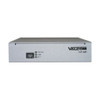
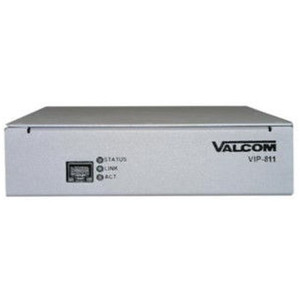
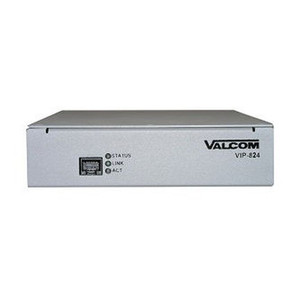
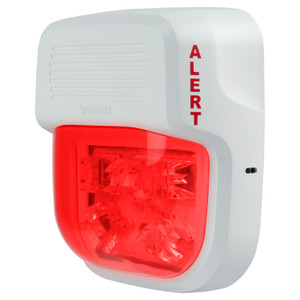
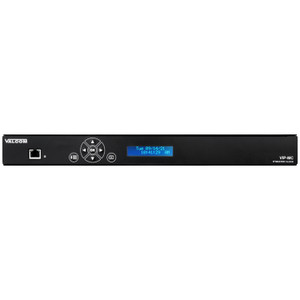
Valcom VIP-821A IP Gateway FXO Port
Overview
The Valcom VIP-821A is a single-port FXO gateway engineered to integrate legacy loop start trunk lines into modern IP telephony networks. Organizations with hybrid voice infrastructure—where analog PSTN trunks still terminate on-site but IP PBX systems handle routing—use the VIP-821A to bridge that gap without wholesale system replacement. The device converts incoming analog signals to SIP-compliant IP packets, making it compatible with standard IP PBX platforms, cloud calling services, and managed Ethernet networks. Powered entirely by PoE (802.3af), the VIP-821A requires no separate power infrastructure, reducing installation complexity and eliminating dedicated circuit requirements.
Key Features
- Single FXO Port: Accepts one loop start trunk connection from a traditional PSTN line or legacy PBX extension. This one-to-one port mapping means you can integrate exactly as many trunks as you need by deploying multiple units—useful if you have 2–3 legacy lines you want to retain rather than migrating all trunks at once.
- SIP Protocol Support: Native SIP connectivity eliminates proprietary gateway translation layers. Your IP PBX sees the VIP-821A as a standard SIP trunk endpoint, making provisioning straightforward and reducing vendor lock-in complexity.
- PoE (802.3af) Power Delivery: Draws power directly from standard Ethernet cabling. The 802.3af budget (15.4W maximum, but this device uses well under that) means it won't consume a disproportionate share of your switch's power allocation—critical when deploying dozens of networked devices across a facility.
- Wall or Rack-Mount Form Factors: Choose wall mounting for branch locations or equipment rooms where shelf space is tight, or rack mounting for data center consolidation. Both options simplify cable routing and reduce clutter in telecommunications closets.
- Audio Input Capability: Integrated audio inputs enable two-way communication workflows, allowing the gateway to both receive and transmit audio signals. Useful for environments where monitored announcement systems or intercoms need to originate from the same IP network as voice trunks.
- Managed Network Integration: Designed for deployment on controlled IP LANs and WANs. QoS tagging and VLAN support (via standard Ethernet infrastructure) ensure voice traffic stays prioritized even during peak data usage.
Integration & Compatibility
The VIP-821A excels in phased migration scenarios. If you're moving a branch office from a legacy PBX to a cloud-based IP system but can't port the existing analog trunk immediately, deploy a VIP-821A to keep that trunk active on the new IP infrastructure. SIP compatibility means most modern IP PBX systems—Avaya, Cisco, Asterisk derivatives, and vendor-agnostic platforms—recognize it as a standard trunk endpoint. Configuring dial plans, call routing, and failover logic uses your existing IP PBX workflows; no proprietary gateways or gateway-specific software layers required.
In multi-site deployments, the VIP-821A (often searched as VIP 821A) supports both LAN and WAN configurations. Remote offices with a single legacy trunk can deploy one unit on the local network, with SIP traffic tunneling back to the central IP PBX over your WAN connection. No additional hardware or SIP proxies needed—standard managed Ethernet handles the transport.
Deployment Scenarios
Branch Office Integration: A satellite location has one incoming analog line serving a small department. Rather than provisioning a new SIP trunk (which may incur recurring carrier costs), mount the VIP-821A in the branch closet, connect it to the local Ethernet infrastructure, and point its SIP registration to the central IP PBX. Existing calls continue on the legacy trunk; the gateway handles the protocol translation transparently.
Selective Trunk Retention: Your organization is migrating most trunks to SIP but has one or two specialized lines (e.g., a dedicated fax/modem line) that must remain on the analog PSTN. Deploy a VIP-821A for each legacy line, keeping them active on the IP network without forcing them to SIP trunks.
Monitored System Extension: Security or emergency systems using hardwired analog lines can integrate with the IP network via the VIP-821A's audio input capability, enabling centralized monitoring and logging of announcement systems while keeping them on managed network infrastructure.
Frequently Asked Questions
Q: Does the VIP-821A support call waiting and caller ID signaling?
A: Yes. The VIP-821A accepts standard loop start signaling, including on-hook/off-hook transitions and DTMF digits, converting them to SIP signaling. Caller ID passes through as CNAM/ANI headers in the SIP INVITE message, so your IP PBX displays calling party information normally.
Q: How many VIP-821A units can I stack on a single PoE switch?
A: Each unit draws under 13W via 802.3af PoE. A standard 48-port PoE+ switch budgets 370–740W total, so you can power 25–50 units depending on your switch's total power allocation and how many other devices share the budget. Plan your switch capacity as part of your deployment—one unit is trivial; a dozen requires attention to PoE headroom.
Q: What happens if the Ethernet connection drops?
A: The VIP-821A loses power and SIP connectivity. Calls in progress terminate. If you need resilience, deploy a redundant gateway or ensure your Ethernet plant has failover (dual uplinks from the branch closet). This is a limitation of PoE-only power—if the line must stay up during network events, you'll need either a backup power source or traditional AC-powered gateway.
Q: Is the VIP-821A NDAA-compliant or subject to tariffs?
A: Verify NDAA Section 889 and tariff status directly with the manufacturer or your integrator. This product's compliance posture may vary based on component sourcing and assembly location.
Q: Can I use this with a cloud-based IP PBX service?
A: Yes, if your cloud PBX provider offers a SIP trunk integration option. The VIP-821A registers to the cloud provider's SIP proxy using standard credentials, forwarding inbound PSTN calls and handling outbound routing the same way a SIP trunk would. Check your provider's gateway compatibility list to confirm.
Ted PerryPerspective based on aggregated IP Security Depot and affiliated engineering team experience.
I've deployed the Valcom VIP-821A in environments where analog PSTN trunk lines had to coexist with IP PBX infrastructure, and it solves a real problem: you don't always have the luxury of migrating every trunk on day one. The VIP-821A lets you integrate selectively, keeping legacy lines operational while your IP system handles the heavy lifting. It's particularly valuable in branch office scenarios where that one analog trunk has been there for years and cutting it over to a SIP trunk incurs carrier reconfiguration costs or delays.
Technical Highlights:
- PoE (802.3af) Power: Single Ethernet cable supplies both power and data—no separate AC outlet or power supply required. Typical draw is under 13W, leaving headroom on standard PoE switches. Matters when you're already maxed out on closet infrastructure; you avoid installing new power circuits.
- Single FXO Port Architecture: One port means one trunk per unit. If you have three legacy lines to integrate, you deploy three units. This modular approach is actually an advantage—you scale incrementally without overprovisioning a large gateway for lines you may retire soon.
- Native SIP Signaling: No proprietary gateway software or vendor-specific extensions. Your IP PBX sees it as a standard SIP trunk endpoint. Configuration lives in your existing dial-plan provisioning—no separate gateway management console required.
Deployment Considerations:
- Power Dependency: The VIP-821A has no internal battery or backup power. If your Ethernet uplink fails, the gateway loses power immediately and all calls drop. If branch resilience is critical, plan for either redundant Ethernet uplinks or a backup power solution (PoE injector with UPS, for example).
- Single Trunk Scaling: For environments with 10+ legacy trunks, deploying one unit per trunk can create cable clutter and management overhead. If you have that many analog lines, consider whether a larger gateway or trunk migration timeline makes more sense economically.
- PoE Budget Planning: Before deploying a dozen VIP-821A units across a site, verify your switch has adequate power allocation. A single unit is invisible; a fleet of them can consume 130W+ and strain a switch's power supply.
The VIP-821A is best suited to phased modernization projects in branch offices, small satellite locations, or environments with one or two specialized analog lines you need to retain for legacy system support. It's not a solution for wholesale trunk migration, but it's a pragmatic way to buy time during IP PBX deployments without forcing immediate carrier changes.