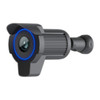
Ubiquiti UVC-AI-LPR-B UniFi AI License Plate Recognition Camera
Overview
The Ubiquiti UVC-AI-LPR-B is a 4MP bullet-form AI camera purpose-built for license plate recognition and vehicle identification in enterprise outdoor deployments. This model integrates into the UniFi Protect ecosystem, running edge-based AI analytics locally on the camera rather than relying on cloud processing or centralized compute resources. Powered by PoE++ at 90W via standard Ethernet, the UVC-AI-LPR-B eliminates the need for separate power infrastructure at the camera location, streamlining both installation and ongoing network management. The camera is designed specifically for access control points, parking lot perimeter monitoring, and vehicle-focused surveillance where plate capture accuracy and vehicle classification are primary objectives.
Key Features
- 4MP resolution with AI-optimized sensor: Captures sufficient detail for plate legibility across typical recognition distances; the sensor is tuned for vehicle detection rather than general scene capture, meaning performance will be sharper for moving vehicles than for wide-area crowd surveillance.
- License plate recognition at the edge: Processes plate detection and character recognition locally on the camera, reducing latency and bandwidth compared to cloud-based LPR systems. Results are streamed to UniFi Protect for centralized logging and audit.
- Vehicle classification and object detection: Identifies vehicle type, color, and direction of travel without sending raw video to external processors, maintaining privacy and reducing WAN congestion.
- PoE++ power (90W): Requires a PoE++ injector or compatible switch port (IEEE 802.3bt Class 4 or higher). Single Ethernet drop simplifies rough-in and reduces installation time compared to dual-power designs. Verify your switch supports 90W per port; older PoE+ infrastructure maxes out at 30W.
- Bullet form factor with 3.3 lb housing: Mounts to poles, walls, or corner installations without requiring a ceiling cavity. Compact profile suits areas where dome or turret cameras would be visually obtrusive or mechanically difficult to secure.
- H.264/H.265 codec support: H.265 encoding reduces storage footprint by roughly 40–60% versus H.264 at equivalent quality, a meaningful difference when recording 24/7 across a multi-camera parking lot deployment. Stream selection is configurable via UniFi Protect.
- Centralized management through UniFi Protect web GUI: Firmware updates, analytics configuration, user access, and video retention policies are managed from a single pane of glass. No separate NVR software or third-party management layer required for basic operations.
- Network streaming over 1000Base-T Ethernet: Gigabit connectivity ensures sustained video delivery without network choking, even when multiple cameras stream simultaneously into a single NVR or cloud instance.
- Night vision with optimized IR illumination: Built-in infrared delivers usable plate recognition in low-light and total-darkness scenarios. Performance in extreme backlight (sunset against a plate) or reflective surfaces should be validated in your specific site conditions before deployment.
- RTSP compatibility: Outputs RTSP-compatible streams, allowing third-party VMS platforms (Milestone XProtect, Genetec, etc.) to ingest video if you wish to integrate beyond the UniFi Protect ecosystem.
- Outdoor-rated housing: Built for weather exposure. Confirm IP and temperature ratings against your climate zone and mounting method in the manufacturer datasheet.
When This Is the Right Choice
Deploy the UVC-AI-LPR-B when license plate recognition or vehicle classification is a core security objective—parking lot enforcement, gated-facility access logging, perimeter intrusion monitoring of vehicle approach vectors, or toll/gate automation. Organizations with distributed sites benefit from UniFi Protect's centralized multi-site dashboard, eliminating the need to manage separate NVRs at each location. If you already operate UniFi Protect at your organization, adding an LPR camera extends the same administrative model without introducing a separate management domain.
When to Consider Alternatives
If your primary need is panoramic coverage (e.g., wide parking lot with minimal zoom), a higher-resolution fixed or panoramic IP camera may deliver better economics. For indoor-only low-risk environments (lobbies, retail floors without vehicle access), standard fixed cameras will cost less and perform adequately. If your site lacks sufficient PoE++ infrastructure and adding 90W-capable switch ports is expensive, a lower-power camera model may be more practical. Should your deployment require extremely high frame rates or specialty lens configurations not available in the Ubiquiti line, evaluate other outdoor IP camera vendors against your technical specifications.
Integration and Ecosystem
The UVC-AI-LPR-B (often searched as UVC AI LPR B) is a native UniFi Protect device, meaning it pairs instantly with an existing UniFi Dream Machine or UniFi Protect NVR without additional drivers or integrations. RTSP export allows centralized video storage and management in external platforms if required. Role-based access control within UniFi Protect enforces audit trails for footage review, supporting compliance and forensics workflows. The camera supports standard network security—VLAN isolation, firewall rules, and certificate-based authentication are all configurable within the broader UniFi network stack.
Deployment Considerations
Confirm PoE++ switch availability before ordering—many existing deployments use PoE+ (30W max) and will require a new switch port or dedicated injector. License plate recognition accuracy is angle-dependent: oblique approaches degrade character legibility, so position the camera to intersect travel vectors at 30–60 degrees where possible. Test IR illumination range in your specific mounting height and ambient light conditions before finalizing placement. Store PoE power planning documentation for future network upgrades.
What's in the Box
Confirm exact contents with your vendor, as Ubiquiti packaging may vary by region and sales channel. Standard shipments typically include the camera unit and a basic wall-mount bracket. Mounting hardware, weatherproofing sealant, and extended warranties are usually ordered separately.
Frequently Asked Questions
Q: What is the effective range for license plate recognition on the UVC-AI-LPR-B?
A: Effective recognition distance depends on mounting height, angle, vehicle speed, and plate condition. Most deployments achieve reliable plate capture at 15–35 feet with the camera positioned at 45–60 degrees to traffic flow. Test in your specific environment before finalizing the placement.
Q: Can I integrate the UVC-AI-LPR-B with a non-Ubiquiti NVR?
A: Yes, via RTSP. The camera outputs standard RTSP streams compatible with Milestone XProtect, Genetec, and most ONVIF-capable platforms. However, license plate recognition analytics will only be available within UniFi Protect; third-party systems will receive raw video only.
Q: Does the UVC-AI-LPR-B require a PoE++ switch, or can I use an injector?
A: Either works. A PoE++ (802.3bt Class 4) switch port or a standalone PoE++ injector will supply the 90W required. Standard PoE+ equipment (30W max) is insufficient and will not power the camera.
Q: What happens to license plate data if the UniFi Protect controller goes offline?
A: The camera continues to perform local analytics and record video to local storage (microSD if equipped, or to a local cache). Once the controller is reachable, data syncs and events are logged in the central archive. Confirm local storage configuration with your deployment plan.
Q: Is the UVC-AI-LPR-B suitable for high-speed highway or toll-lane environments?
A: At typical highway speeds (55+ mph), capture quality degrades significantly. The UVC-AI-LPR-B is optimized for parking lots, gated entries, and low-speed perimeter points (1–15 mph). High-speed toll or freeway applications typically require specialized high-shutter-speed LPR cameras.
Q: What codec settings should I use to balance storage and recognition accuracy?
A: H.265 at 4MP, 15–20 fps is a practical baseline for LPR workloads, reducing storage by ~50% versus H.264. Increase frame rate to 30 fps only if vehicle speeds exceed 20 mph or if you need sub-second event capture for high-volume access points.
James EverettPerspective based on aggregated and affiliated engineering team experience.
The UVC-AI-LPR-B is a solid pick if your deployment sits at the intersection of UniFi ecosystem standardization and vehicle-centric access control. The 90W PoE++ power requirement is the real gating factor—it means you're either buying a new switch with 802.3bt ports or deploying injectors, which adds cost and cable runs. But if you clear that hurdle, edge-based license plate recognition at 4MP is a genuine time-saver compared to cloud-dependent LPR services that charge per-event or per-plate. The H.265 codec support is also worth noting: 24/7 LPR recording across a 20-camera lot can fill traditional H.264 storage in weeks; H.265 cuts that roughly in half, which matters for sites with limited local NVR capacity.
Technical Highlights:
- 90W PoE++ power draw: Far heavier than standard PoE+ cameras (15–30W typical), so don't assume your existing switch can handle it. A single misconfiguration—plugging into a non-PoE++ port—will leave you with a non-responsive camera and a site visit to troubleshoot.
- 4MP sensor tuned for vehicle recognition: Good enough for plate legibility at 20–30 feet depending on angle, but not a multi-purpose high-resolution sensor. If you need both tight facial detail (lobby entrances) and plate recognition on the same camera, this isn't your tool.
- H.265 + local edge processing: Reduces both storage footprint (40–60% savings vs H.264) and bandwidth demand—a two-fer that scales well across multi-site deployments. The camera does the heavy lifting; UniFi Protect simply logs and archives the metadata and flagged frames.
- UniFi Protect integration only for full analytics: RTSP export to third-party VMS works, but plate recognition and vehicle classification stay on the camera—third-party systems see raw video only. If you're mixing Ubiquiti and Genetec (or Milestone), you lose the AI value outside UniFi Protect.
Deployment Considerations:
- Test the camera's field of view and IR illumination at your actual mounting height and angle before ordering a fleet. License plate recognition is angle-dependent; too steep or too shallow and you'll miss characters.
- Budget for PoE++ infrastructure. If you don't already have 802.3bt ports on your core switch, injectors and extended cabling are non-trivial additions. Calculate total cost of ownership, not just camera price.
- Local analytics mean the camera processes every frame, which can struggle if you're capturing vehicles at highway speeds (55+ mph). This is a parking lot and gated-entry tool, not a toll-plaza solution.
- Confirm microSD or local cache availability if your deployment requires offline recording during controller downtime. The camera can buffer analytics locally, but you need storage configured.
The UVC-AI-LPR-B shines in parking enforcement, gated-facility vehicle logging, and perimeter intrusion workflows where UniFi Protect is already the operational baseline. If you're standardized on UniFi and PoE++ infrastructure exists, it's a straightforward add. If you're retrofitting PoE++ into a PoE+ network, or if you need multi-vendor analytics, look at your total installed cost and timeline before committing.