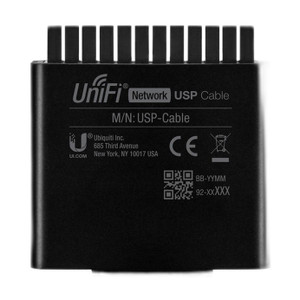
Ubiquiti USP-RPS Redundant Power Supply
The Ubiquiti USP-RPS is a dedicated redundant power supply purpose-built for UniFi switching infrastructure in medium-to-large deployments. This 1U rack-mounted unit converts standard AC mains (100–240V universal input) into dual voltage outputs—645W at 54V DC or 350W at 12V DC—eliminating the need to source separate power supplies for heterogeneous device inventories. Maximum input draw is 995W, allowing deployment in standard office-grade electrical circuits without dedicated power circuits.
Key Features
- Dual Voltage Output: Choose 645W at 54V or 350W at 12V depending on your connected device load. This eliminates forklift upgrades if you're running both high-power PoE gear (like access points drawing 60W+) and legacy 12V devices on the same infrastructure—a real cost-saver in mixed-age deployments.
- Redundant AC Input: Wire primary and secondary AC feeds to the same or separate circuits. If the primary feed fails, the unit continues supplying DC without interruption—critical in environments where even brief PoE loss triggers network failover costs or device reboot cascades.
- Compact Footprint: Measures 442.4 × 325.6 × 43.7 mm (17.4 × 12.8 × 1.7 inches) and weighs 5.5 kg. Fits standard 19-inch racks with minimal depth, leaving room for cable routing in crowded cabinet environments. Can also wall-mount in confined telco closets or outdoor network cabinets.
- ESD Protection: Rated ±16kV air discharge and ±12kV contact ESD, protecting connected PoE switches from transient voltage spikes caused by nearby lightning strikes or static discharge events—especially valuable in facilities with overhead cabling or frequent equipment swaps.
- Management via Gigabit Ethernet: Single RJ45 port integrates into Ubiquiti network control systems, displaying the unit in controller topology views and enabling real-time monitoring of voltage, current draw, and load distribution from a central management console. No serial port or dedicated management interface required.
- Firmware Updates & Factory Reset: Receive periodic firmware patches via the controller interface; on-unit factory reset button allows field-level recovery without requiring management console access or serial console skills.
- Wide Operating Range: Operates reliably from -5°C to 45°C, supporting both climate-controlled data centers and unheated outdoor cabinets in temperate regions. No active cooling fans, reducing maintenance overhead in remote or dusty sites.
- NDAA & Certifications: Carries CE, FCC, and IC certifications. NDAA Section 889 compliant for U.S. government and institutional procurement—a requirement if you're bidding on state/federal contracts or selling into DoD-adjacent organizations.
Integration & Compatibility
The USP-RPS integrates seamlessly with UniFi switching architecture via its Ethernet management port. Once connected to your PoE switches or controller infrastructure, the unit appears in the UniFi Dashboard topology, displaying real-time load metrics, output voltage stability, and alert status. Alerts can forward to syslog or trigger email notifications, giving your NOC visibility into power delivery health alongside network device status.
Terminal block connectors on the unit require proper cable gauging—Ubiquiti provides sizing guidance in the datasheet. Plan for voltage drop on long cable runs to distant rack-mounted or outdoor PoE devices; undersized cable will degrade output voltage and reduce available power at the endpoint. Terminal blocks are rated for their respective voltage and current capacity, so validate breaker/fuse sizing against your total connected load before installation.
Deployment Scenarios
The USP-RPS is essential in multi-switch UniFi campuses where a single power failure would cascade outages across dozens of access points or edge switches. Typical wins include medium-to-large offices with multiple wiring closets, education campuses spanning multiple buildings, and retail chains where branch-level PoE outage triggers point-of-sale downtime. Heterogeneous device inventories—mixing newer 54V PoE devices with legacy 12V equipment—avoid the complexity and cost of parallel power distribution.