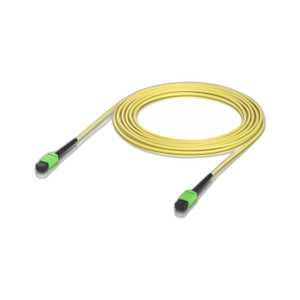
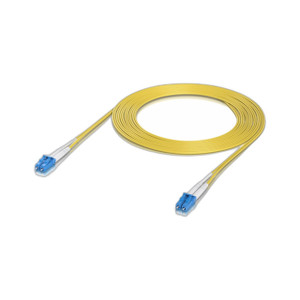
Ubiquiti UACC-OFC-SM-PATCH-UPC-APC Single-Mode Fiber Patch Cable
The Ubiquiti UACC-OFC-SM-PATCH-UPC-APC is a single-mode fiber patch cable engineered for infrastructure deployments requiring bridging between UPC and APC connector types. This cable addresses a specific integration challenge: mixing network equipment and security systems where one side uses polished UPC (Ultra Polished Connector) and the other uses angled APC (Angled Physical Contact). Rather than requiring adapter boxes or rewiring, this single cable handles the mismatch directly.
Key Features
- Mixed Connector Configuration (SC/UPC to SC/APC): One end terminates in SC/UPC; the other in SC/APC. This eliminates the need for separate adapter modules in rack installations, saving rack space and reducing failure points in fiber chains.
- Single-Mode Fiber Construction: Single-mode fiber supports long-distance signal transmission with minimal attenuation — critical for campus-scale deployments or multi-building fiber runs where distance exceeds 300 meters. Multimode alternatives lose signal quality over longer runs.
- Compact Form Factor: Weighs 0.100 lb, designed for tight rack-mounted installations and fiber termination panels. Its low weight means installation is straightforward without special support hardware.
- SC-Type Connectors: SC connectors (push-pull design) are standard across enterprise networking and security equipment. They are more robust than LC connectors in high-vibration or outdoor rack environments and offer reliable keyed insertion to prevent cross-mating.
- Enterprise-Grade Manufacturing: Manufactured to standard quality requirements for mission-critical fiber infrastructure. Suitable for point-to-point fiber links between network switches, security appliances, and fiber termination points.
- Compatible with Ubiquiti Equipment: Integrates directly with Ubiquiti networking products and other systems using SC-type connectors, simplifying inventory and reducing vendor fragmentation in mixed-brand environments.
Integration & Compatibility
Deploy this cable in scenarios where your primary network infrastructure uses UPC connectors (common in carrier-grade equipment and many enterprise switches) but your security or microwave backhaul system uses APC connectors. APC connectors have a 8-degree angle that reduces back-reflection, which is why some long-distance or high-sensitivity applications specify them. Rather than installing separate fiber equipment at both ends, this patch cable bridges the mismatch at the interconnection point.
The cable integrates into standard fiber racks, patch panel installations, and device-to-switch connections. SC connectors are keyed to prevent accidental mismatches, and the single-mode core ensures signal integrity across distances where multimode fiber would introduce modal dispersion and signal loss. This is particularly valuable in warehouse automation, campus surveillance systems, and remote site connectivity where fiber distance can easily exceed 500 meters.
When to Choose a Different Model
If both ends of your link already use matching connector types (SC/UPC to SC/UPC, or SC/APC to SC/APC), a standard homogeneous patch cable will cost less and eliminate one connector interface. If your application requires multimode fiber for short-distance connections under 300 meters, multimode patch cables are more economical. If you need a ruggedized outdoor-rated fiber assembly, verify that this standard patch cable meets the environmental rating required for your installation; some deployments may need jacketed or armored variants not represented by this SKU.
Frequently Asked Questions
Q: What is the difference between SC/UPC and SC/APC connectors?
A: UPC (Ultra Polished Connector) has a flat, perpendicular endface and is standard in most enterprise networks. APC (Angled Physical Contact) has an 8-degree angle that reduces back-reflection, making it preferred for long-distance or high-sensitivity applications. The UACC-OFC-SM-PATCH-UPC-APC bridges these two types on a single cable.
Q: Is this cable suitable for long-distance outdoor deployments?
A: The cable is single-mode and supports long-distance transmission. However, standard patch cables are not rated for direct outdoor exposure (temperature extremes, UV, physical abrasion). For outdoor runs, verify that environmental conditions fall within the cable's operating specifications or use an armored or conduit-protected variant.
Q: Can I use this cable with non-Ubiquiti equipment?
A: Yes. SC-type connectors are an industry standard. Any network or security equipment with SC/UPC input on one end and SC/APC input on the other will work with this cable. However, verify connector type compatibility before ordering to avoid mismatches.
Q: What is the maximum distance this cable supports?
A: Single-mode fiber supports distances well beyond 10 kilometers with minimal attenuation. For typical enterprise campus deployments (under 5 km), attenuation is negligible. Exact distance limits depend on your equipment's optical budget and acceptable power margins.
Q: Does Ubiquiti provide a warranty on this patch cable?
A: Warranty information is not specified in the published product data. Contact the manufacturer directly for details on defect coverage and warranty terms.
Ted PerryPerspective based on aggregated IP Security Depot and affiliated engineering team experience.
The Ubiquiti UACC-OFC-SM-PATCH-UPC-APC is a solution to a real field problem: you've specified single-mode fiber for your backbone run, but your upstream carrier or existing equipment uses UPC connectors while your security appliance expects APC. Rather than reconfiguring equipment at both ends, this patch cable bridges the mismatch at the rack — saving time and eliminating unnecessary re-termination.
Technical Highlights:
- Single-Mode Core: Sustains signal quality across distances where multimode fiber (common in shorter-range deployments) introduces modal dispersion. For campus backbone and remote-site fiber links, this is non-negotiable.
- SC Connectors with Keyed Design: Push-pull keyed connectors are far more robust in production rack environments than smaller LC connectors. They resist accidental cross-mating and handle repeated insertions without performance degradation.
- UPC-to-APC Configuration: Addresses the specific connector mismatch without requiring intermediate adapter boxes or patch panels. Fewer interfaces mean fewer potential failure points in your fiber chain.
Deployment Considerations:
- Verify that your equipment supports both UPC and APC on the respective ends before ordering. A mismatched cable order creates a costly rework cycle.
- Standard patch cables like this one are not rated for outdoor temperature swings, UV exposure, or physical abuse. If your run crosses outdoor rooftops or high-vibration mechanical areas, specify an armored or rugged variant instead.
- Back-reflection at the UPC-APC interface will be higher than a matched pair of connectors. For very-long-distance links (over 5 km) or high-sensitivity receiver equipment, this may introduce measurable signal loss. Test in the lab before committing to production.
Deploy this in warehouse fiber backbone work, multi-building campus security deployments, or carrier-facing installations where you must bridge legacy UPC infrastructure to newer APC security appliances. It solves a connector incompatibility without inventory bloat.