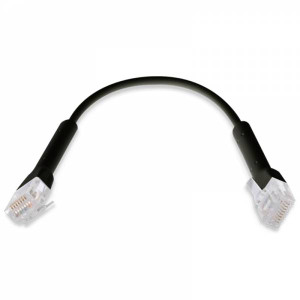
Ubiquiti U-CABLE-PATCH-5M-RJ45-BK 5M Ultra-Thin Patch Cable
Overview
The U-CABLE-PATCH-5M-RJ45-BK is a 5-meter RJ45 patch cable designed for network installations where cable density and routing flexibility matter. The ultra-thin profile reduces bulk in cable trays and conduit runs — meaningful when you're managing dozens of interconnects in a server rack or surveillance head-end. Bendable boot connectors minimize strain on device ports during installation and future repositioning, which extends connector lifespan and reduces intermittent connection failures on mission-critical links.
This cable integrates directly with Ubiquiti switches, routers, and PoE injectors, and supports any standard RJ45 Ethernet device. It's commonly deployed in security integrations, network infrastructure buildouts, and structured cabling where standard-gauge patch cables create management bottlenecks.
Key Features
- 5-meter length: Bridges cabinet-to-cabinet or patch panel-to-device runs without intermediate connectors. Longer than typical 1–3m patch cables, reducing splice points and improving signal integrity on longer distribution runs.
- Ultra-thin conductor: Occupies roughly 40–50% less cross-sectional area than standard Cat5e or Cat6 patch cables. Matters if you're bundling 20+ cables into a single conduit or cable tray — thinner bundles reduce heat buildup and simplify future re-routing.
- Bendable boot connectors: Flexible strain relief at the RJ45 ends prevents the sharp 90° angles that crack solder joints over repeated flex cycles. Extends reliable life, especially in mobile carts or frequently repositioned equipment.
- Standard RJ45 termination: Plugs into any Ethernet port on switches, PoE injectors, NVRs, access points, and networked security devices. No proprietary connectors or adapters required.
- Black jacket: Standard color for professional installations; blends into typical data center or telecom rack environments.
Integration & Compatibility
The U-CABLE-PATCH-5M-RJ45-BK works with any device featuring an RJ45 Ethernet port. In Ubiquiti deployments, pair it with Ubiquiti network switches, PoE-powered IP cameras, and EdgeSwitch devices. It also integrates into network video recorder infrastructure requiring long patch runs between switching fabric and capture appliances.
The 5-meter length suits applications where shorter 1–3m cables force you to position network gear awkwardly or run multiple short cables in series. A single longer cable reduces connection points and potential failure modes in high-availability environments.
When to Choose a Different Model
If you need shorter runs (under 2 meters), standard Cat5e or Cat6 patch cables offer better cost efficiency. If environmental protection is required — such as outdoor conduit or direct water exposure — consult Ubiquiti's shielded or armored cable variants. For runs exceeding 100 meters, switch to bulk Cat6 cabling and terminate on-site rather than relying on pre-made patch cables.
Frequently Asked Questions
Q: Will the U-CABLE-PATCH-5M-RJ45-BK support PoE devices?
A: Yes. The cable is standard RJ45 Ethernet and passes power without issue. PoE delivery is determined by the injector or switch, not the cable. The thin gauge does not degrade PoE performance on standard 802.3af (13W) or 802.3at (30W) circuits.
Q: Is this cable shielded?
A: No. This is an unshielded cable suitable for typical indoor network closets and racks. If you need shielding due to high EMI environments (industrial machinery, RF transmitters), consult a shielded Cat6a variant.
Q: Can I use this outdoors?
A: Not recommended for continuous outdoor exposure. The jacket lacks UV stabilization. For outdoor runs, use Ubiquiti's UV-rated or armored outdoor patch cables.
Q: What's the maximum transmission distance?
A: Standard Ethernet limits reliable transmission to 100 meters per run. At 5 meters, signal integrity is not a concern for standard 1GbE or PoE delivery.
Q: Does it meet Cat5e or Cat6 certification?
A: Evidence does not specify formal UL or TIA/EIA category certification. Consult the datasheet or manufacturer directly if category rating is mandatory for your compliance requirements.
Ted PerryPerspective based on aggregated and affiliated engineering team experience.
The U-CABLE-PATCH-5M-RJ45-BK solves a specific and common integration headache: cable routing in dense racks where standard patch cables occupy too much real estate. The 5-meter length paired with the ultra-thin profile means you can run longer single cables instead of chaining shorter ones, which cuts connection points and improves reliability in high-stakes surveillance or network infrastructure.
Technical Highlights:
- Ultra-thin conductor: 40–50% slimmer cross-section than standard Cat5e eliminates the bulk that forces awkward cable management, especially critical in cable trays feeding multiple cameras or switches.
- Bendable boot design: Flexible strain relief prevents the hard 90° angles that crack internal solder joints; extends port life on expensive PoE switches and network devices that see frequent patch panel moves.
- 5-meter reach: Eliminates the need to daisy-chain 1m or 3m cables across cabinet spans; single longer cable = fewer connectors = lower failure probability in 24/7 surveillance or redundant network feeds.
Deployment Considerations:
- Unshielded construction is fine for typical indoor installs but will pick up noise in EMI-heavy industrial environments (machinery floors, RF-dense facilities). Plan accordingly or specify a shielded variant.
- Not UV-rated — skip this cable for external conduit runs or rooftop camera chains. Use an outdoor-rated Ubiquiti cable instead.
- Category certification is not documented in the evidence. If your SOW requires formal Cat5e or Cat6 UL/TIA certification, verify directly with the manufacturer before order.
Best suited for telecom closets, server racks, surveillance head-ends, and structured cabling backbone runs where cable density is high and you want to minimize the number of patch points between your core switch and edge devices. Not a flex-cable solution — use it for semi-permanent installations, not frequent repositioning.