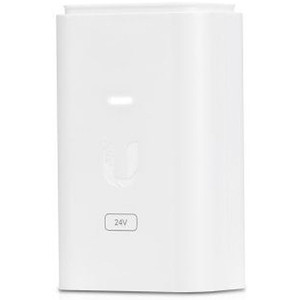
Ubiquiti POE-24-12W-G-WH 24V PoE Adapter
Overview
The Ubiquiti POE-24-12W-G-WH is a passive 24V DC PoE injector designed to deliver power to compatible Ubiquiti devices operating on 24-volt passive PoE systems. With a rated output of 12W, the POE-24-12W-G-WH (often searched as POE 24 12W G WH) provides sufficient power for access points, cameras, and wireless bridges deployed across EdgeMax, UniFi, and airMAX networks where 24V injection is the standard. The external form factor allows flexible positioning in racks, wall-mounted installations, and cable trays — eliminating the need to route power cables through overhead conduit or chase expensive in-line PoE modules.
Key Features
- 24V DC Output: Operates at 24 volts, ensuring compatibility only with Ubiquiti passive PoE devices rated for this voltage. This eliminates cross-compatibility confusion with 12V or 48V systems common in competing vendors. Verify your target device's PoE specification before deployment — mismatched voltage will damage the end device.
- 12W Power Budget: Delivers up to 12 watts of output power. This overhead is adequate for UniFi Access Points (typically 7–10W) and most compact IP cameras in the Ubiquiti catalog. If you're powering multiple devices or high-draw units (pan-tilt-zoom cameras, heaters, or heated domes), confirm aggregate power draw does not exceed 12W, or split the load across multiple injectors.
- External Adapter Form Factor: Unlike inline PoE modules that mount directly to RJ-45 connectors, the external POE-24-12W-G-WH sits outside your equipment rack or mounting surface. This reduces heat accumulation inside enclosures, simplifies cable management, and allows you to position the injector closer to power outlets without running long AC extension cords.
- AC/DC Input: Accepts standard AC or DC input power, offering flexibility for installations where your facility power architecture is mixed. Check your local supply voltage — typical North American input is 100–240V AC. DC input voltage range should be confirmed in your equipment documentation before wiring.
- Passive PoE Injection: Unlike 802.3af or 802.3at active PoE, this adapter injects voltage directly onto the twisted pair without negotiation. Passive injection means no handshake delay — devices power up immediately when connected. This is critical for rapid deployment scenarios but requires manual voltage verification to prevent equipment damage. Use a multimeter to confirm 24V DC on the Ethernet pair before connecting a device.
- Compact, Wall-Mountable Design: The external housing permits installation on equipment racks, DIN rails, or walls adjacent to patch panels. This flexibility reduces clutter in cable management zones and keeps the injector accessible for troubleshooting or voltage checks.
Integration & Compatibility
The POE-24-12W-G-WH integrates directly into Ubiquiti networks standardized on 24V passive PoE. Common deployment scenarios include:
- EdgeMax Deployments: Powering EdgePoint or EdgeRouter-based outdoor access points and wireless bridges that require 24V injection.
- UniFi Campus Networks: Supporting UniFi Access Points (6E, 6, 5, 4, etc.) in locations where centralized PoE switches are unavailable or overloaded. This adapter acts as a low-cost remote injector.
- airMAX Wireless Links: Delivering power to airMAX base stations and subscriber modules in point-to-point or point-to-multipoint mesh architectures.
- IP Camera Feeds: Injecting 24V into passive PoE cameras in the Ubiquiti Unifi Video or Protect ecosystem where dedicated PoE switches are not on hand.
For larger deployments (10+ devices), consider consolidating power onto a dedicated PoE switch rather than daisy-chaining multiple injectors — this reduces failure points and simplifies troubleshooting. Refer to your network architecture guide to confirm whether 24V passive PoE or active 802.3af/at PoE is the standard for your site.
When to Choose a Different Model
If your Ubiquiti installation requires higher power (above 12W per device), or if you are mixing 24V and 12V devices on the same network, evaluate a dedicated Ubiquiti PoE switch with variable voltage outputs. If you need active PoE with automatic negotiation (802.3af or 802.3at), the POE-24-12W-G-WH is not appropriate — source a standards-compliant active injector or switch instead. For temporary or field deployments, the external form factor is a strength; for permanent installations with dozens of devices, a rack-mount PoE switch is more maintainable.
Frequently Asked Questions
Q: Can I use the POE-24-12W-G-WH with non-Ubiquiti passive PoE devices?
A: Technically yes, if the third-party device is rated for 24V passive PoE and uses standard Ethernet pairs. However, Ubiquiti makes no guarantees on non-proprietary equipment. Always verify the target device's voltage specification in its datasheet before connecting. Incorrect voltage will cause permanent damage.
Q: What is the difference between passive and active PoE?
A: Passive PoE injects power directly onto the Ethernet pair without negotiation — the powered device must accept the voltage. Active PoE (802.3af, 802.3at, 802.3bt) includes a handshake where the switch queries the device's power class before supplying voltage. The POE-24-12W-G-WH is passive; active devices will not recognize it.
Q: Can I daisy-chain multiple POE-24-12W-G-WH injectors?
A: Technically yes, but not recommended. Daisy-chaining multiple passive injectors introduces voltage drop, ground loops, and difficulty isolating faults. If you need more total power, use a single PoE switch with higher aggregate wattage instead.
Q: What is the input voltage range for the POE-24-12W-G-WH?
A: The adapter accepts AC/DC input, but the specific voltage range (e.g., 100–240V AC or 12–48V DC) is not detailed in the publicly available summary. Confirm with your distributor or refer to the product datasheet before wiring to unfamiliar power supplies.
Q: Is the POE-24-12W-G-WH suitable for outdoor installations?
A: The adapter itself is external form factor, but no IP or IK rating is published. Do not expose it to rain or direct moisture. Install in a weatherproof enclosure or indoor equipment room, and run weather-sealed Ethernet cabling to outdoor devices.
Q: How do I verify that the POE-24-12W-G-WH is delivering correct voltage?
A: Use a multimeter set to DC voltage mode. Measure across the RJ-45 pairs (typically pairs 4–5 and 7–8 for passive PoE) before connecting any device. You should read approximately 24V DC. If the reading is significantly lower or absent, the injector may be faulty.
Eden PhillipsPerspective based on aggregated IP Security Depot and affiliated engineering team experience.
The Ubiquiti POE-24-12W-G-WH is a straightforward passive PoE injector — nothing exotic, but exactly what you need if you're extending a 24V passive PoE network beyond your central switch infrastructure. At 12W output, it covers most UniFi access points and compact cameras in the Ubiquiti ecosystem, and the external form factor eliminates the heat and clutter of inline modules stuffed into equipment racks.
Technical Highlights:
- 24V DC Output at 12W: Adequate for single UniFi APs (7–10W typical) and lightweight IP cameras. Above 12W, the injector is maxed out — no voltage regulation headroom. If you're running heated domes or multi-radio APs simultaneously, you're already risking brownout.
- Passive Injection (No Negotiation): Power applies immediately on connection. Zero handshake latency means devices boot the instant the Ethernet pair is live. The tradeoff: no protection against mismatched voltages. A miscalculation on voltage will fry the end device. Multimeter verification is non-negotiable on first install.
- External Housing with AC/DC Input: Flexibility on input power source (AC mains or 12–48V backup DC) and positioning in racks or wall-mounted locations. Cable clutter drops because the injector sits outside the equipment enclosure, but keep it in a controlled environment — passive PoE and humidity do not mix well.
Deployment Considerations:
- Voltage Verification is Mandatory: Before plugging in any device, confirm 24V DC on the Ethernet pair with a multimeter. Passive injection has zero failsafes. A wiring error or a damaged pair will silently deliver wrong voltage and destroy the device. Make this part of your pre-deployment checklist.
- Scaling Beyond One Injector Gets Messy: If you're powering 3+ devices, consolidating onto a dedicated PoE switch is cheaper and more maintainable than managing multiple injectors. Ground loops, voltage droop across longer cable runs, and fault isolation become real headaches when you daisy-chain passive supplies.
- Not Rated for Outdoor Exposure: The external form factor is for rack-side mounting or indoor walls, not weatherproofing. Plan to mount this indoors and run sealed Ethernet cabling to outdoor APs and cameras.
Deploy the POE-24-12W-G-WH as a tactical remote power injector for a single AP or camera in a 24V passive PoE Ubiquiti network where a dedicated PoE switch is not within reach. It's reliable and compact for that job. For permanent, multi-device installs, script the migration to a proper PoE switch and retire the injector.