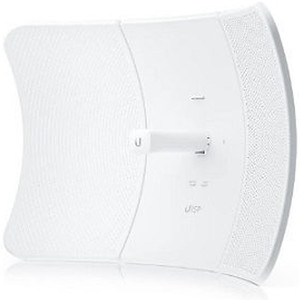
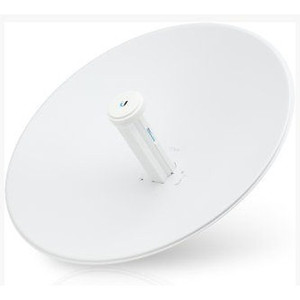
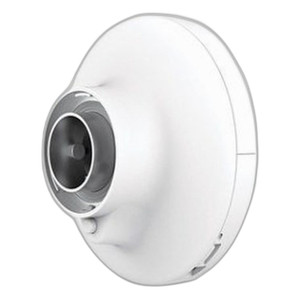
Ubiquiti IS-5AC Compact 5 GHz Wireless Bridge
Overview
The IS-5AC is a compact, fixed-position 5 GHz wireless bridge designed for point-to-point and point-to-multipoint deployments. Operating across worldwide 5150–5875 MHz frequencies with 14 dBi system gain and 45° beamwidth, it delivers reliable long-distance connectivity for security integrations, WISP networks, and enterprise backhaul. Its small form factor (5.2" × 5.2" × 2.6" without horn) enables discrete rooftop and wall mounting.
Technical Specifications
Single Gigabit Ethernet port with passive PoE 2-pair power delivery. Max power consumption: 8.5W. Operating temperature range: −40°C to +70°C. Supports 20–27V DC input via included 24V PoE adapter. Wind survivability rated to 200 km/h (125 mph). LED power indicator. FCC, CE, and IC certified.
Compatibility
UISP-ready management integration. Compatible with standard airMAX horn antennas for extended range applications. Passive PoE 2-pair (pins 4, 5+ and 7, 8 return) powers unit from standard PoE infrastructure.
Package Contents
- IS-5AC Bridge Unit
- Pole Mount Kit
- 24V 0.5A Gigabit PoE Adapter
Ted PerryPerspective based on aggregated IP Security Depot and affiliated engineering team experience.
I see the IS-5AC deployed most often as a dedicated backhaul link between detached buildings or remote camera clusters that can't justify fiber. The 5 GHz-only operation and 45-degree beamwidth make it straightforward to align for point-to-point runs up to about a mile in clean line-of-sight conditions. The passive PoE input is critical to understand—this unit requires 2-pair passive power (pins 4,5,7,8), not 802.3af/at, so you'll need the included adapter or confirm your switch supports that pinout. I've installed these to feed small 4–8 camera NVR setups at gate houses and parking structures where pulling copper or fiber wasn't practical.
One watch-out: the single Gigabit port is your ceiling. If you're aggregating multiple 4MP or 8MP streams with high retention framerates, calculate your sustained bandwidth before committing to this bridge. For three or four cameras it's fine. For eight cameras at full resolution, you're pushing close to the limit once you account for protocol overhead and any network management traffic.