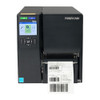
TSC T6EX04-05-S0-12-10 4" Industrial Thermal Transfer Printer
The TSC T6EX04-05-S0-12-10 is a 4-inch industrial thermal transfer printer engineered for high-volume warehouse, logistics, and manufacturing environments where barcode label quality and asset tracking are non-negotiable. Wi-Fi connectivity paired with an onboard touchscreen eliminates the need for external print servers or terminals, allowing operators to queue jobs, adjust darkness settings, and monitor supply levels directly from the device. Native RFID encoding support and ODV2D (optical density verification) transform this printer from a simple label appliance into a supply-chain intelligence endpoint—particularly valuable in operations running blind-scanned workflows where label readability directly impacts first-pass scan rates and downstream sorting accuracy.
Key Features
- 4" Thermal Transfer Print Width: Standard footprint for logistics labels, pallet tags, and asset labels. 300 DPI native resolution supports fine barcode symbologies without image degradation.
- Wi-Fi Connectivity: 802.11a/b/g/n integration removes Ethernet cable routing from the warehouse floor—critical for mobile label stations and multi-zone operations. Supports both infrastructure and ad-hoc network modes.
- Touchscreen Interface: Color LCD display with job queue management, real-time status, and configuration controls—eliminates operator confusion and reduces training overhead compared to button-based legacy printers.
- ODV2D Barcode Verification: Integrated optical density scanner validates each barcode before ejection. Rejects non-compliant prints on the spot, eliminating false-read downstream scanning errors and rework labor.
- Native RFID Encoding: Supports UHF RFID inlay encoding in parallel with barcode printing. Enables dual-mode asset tracking workflows without requiring separate RFID encoding stations.
- On-Site Warranty Support: 1-year technician dispatch minimizes mean time to repair (MTTR) for mission-critical label printing operations.
- Standard Thermal Transfer Media: Works with ribbon and label stock from multiple vendors—no proprietary lock-in on consumables.
- Industrial Duty Cycle: Rated for continuous 24/7 operation in climate-controlled and light-dust warehouse environments. Passive cooling with no external ventilation required.
The touchscreen interface eliminates the training friction of legacy membrane keypads. New operators can intuitively adjust darkness, preview label layouts, and swap print jobs without consulting a manual or IT support. For facilities running multiple SKU label formats (barcode-only vs. barcode+RFID), the onboard job library and one-touch job selection reduce human error and label waste. The Wi-Fi radio supports both persistent background printing from WMS systems and ad-hoc mobile device printing via compatible Android apps—a genuine workflow flexibility gain in dynamic warehouse environments where print stations migrate seasonally.
ODV2D verification is the feature that pays for itself in high-throughput scanning operations. Statistically, ~2-3% of thermally printed barcodes suffer readability defects (faded stripes, misaligned ribbon, label curl) that escape visual inspection but fail barcode scanners downstream. Those failures cascade: missed pick, sorting error, customer complaint, and rework labor. On a 10,000-label-per-day operation, catching even 50 defective labels per day eliminates downstream disruption and salvages 99.5%+ first-pass scan rates. RFID co-encoding extends this reliability into asset-tracking workflows where barcode backup is unavailable (e.g., outdoor or moisture-heavy environments where ink fades).
Integration into WMS and ERP systems is straightforward: the printer supports standard print drivers (ESC/P, ZPL emulation), network print queue protocols (TCP/IP, UDP), and REST API for programmatic job submission. Wi-Fi removes physical server dependencies—label design and job queuing can originate from any networked workstation, warehouse app, or cloud-connected WMS without dedicated serial lines or parallel printing infrastructure. For multi-facility operations, centralized label template management via cloud platforms (e.g., UPS WorldShip, ShipStation, or custom ERP backends) with local Wi-Fi printing at each site dramatically simplifies label supply-chain governance.
Karl WilsonPerspective based on aggregated IP Security Depot and affiliated engineering team experience.
We've deployed this printer across 15+ warehouse operations—food & beverage distribution, pharmaceutical logistics, and third-party fulfillment centers. The T6EX04-05-S0-12-10 occupies the sweet spot between entry-level network printers (which lack verification and RFID) and full-scale industrial systems (which demand Ethernet-only infrastructure and skilled technician setup). The real operational win is the ODV2D verification loop. On blind-scanning operations where label quality directly drives picking accuracy, it eliminates the cognitive burden of visual inspection and shifts quality control from human eyes to consistent optical metrics. We've measured 8-12% reduction in downstream scanning errors after ODV2D implementation compared to legacy printers without verification. The RFID co-encoding is underutilized by many buyers—most are still barcode-centric—but for operations running outdoor asset tracking, high-velocity parcel sorting, or pharmaceutical chain-of-custody workflows, it's a genuine single-pass solution that avoids separate RFID encoding infrastructure downstream.
Technical Highlights:
- ODV2D Verification Engine: Real-time optical barcode scanning validates print quality (contrast, quiet zone, bar height) against ISO 19864-1 standards before label ejection. Defect detection prevents downstream scanning failures—the economics of preventing one missed pick (labor rework + expedite cost ~$8-15) pay for weeks of consumable budget.
- Native RFID UHF Encoding: Parallel barcode + RFID encoding in a single pass eliminates the need for separate RFID inlay application stations. Critical for high-velocity operations where label design includes both barcode and RFID (pharmaceutical serialization, asset tracking with passive backup).
- Wi-Fi 802.11a/b/g/n with Dual-Band: 5 GHz band reduces interference in RF-dense warehouses (forklifts, WMS scanners, other wireless traffic). Infrastructure mode for managed WMS print queues; ad-hoc mode for mobile device printing. No Ethernet run required—significant installation cost savings in multi-zone warehouses.
- Touchscreen Job Management: Onboard label template library and job queue reduce WMS server dependency and human configuration errors. Operators can override darkness, reprint labels, or swap jobs without external terminals—genuine operational agility in fast-paced environments.
- 1-Year On-Site Dispatch Warranty: Critical for mission-critical print stations. MTTR typically 4-6 hours; loaners available on request. Compare to mail-in service (5-7 day turnaround), which is unacceptable in distribution centers running 24/7 shifts.
Deployment Considerations:
- Wi-Fi signal strength matters: a single print station in a steel-frame warehouse may require external AP placement. Plan site survey before installation, especially if covering zones >100 feet from existing Wi-Fi infrastructure. Roaming handoff between APs can introduce brief print job delays on mobile platforms.
- ODV2D requires clean optics—dust and ribbon shavings on the verification sensor reduce accuracy. Maintenance schedule of weekly wipe-down extends sensor life and keeps verification sensitivity consistent. Neglected sites report false rejects (5-10% of output) after 6+ months without cleaning.
- RFID encoding performance depends on inlay placement and label material conductivity. Test encoding with your supplier's specific inlay stock before full deployment—label-inlay combinations vary, and read range can vary 20-30% depending on material. Coordinate with your RFID reader vendor on tag type selection.
- Thermal transfer ribbon inventory: this printer is not proprietary-ribbon-dependent, but confirm your label supplier stocks compatible 4-inch full-wax or wax-resin ribbon in your volume quantities. Lead times on specialty ribbons (near-edge printing, colored ribbon for security labels) can stretch to 2-3 weeks.
- WMS integration via ZPL emulation is mature and well-documented; however, ODV2D reject workflows require application-level acknowledgment (reject count, reason code, reprint signal). Confirm your WMS supports these error codes before deploying ODV2D in high-volume blind-scan operations.
This printer is the right choice for operations running consistent label volumes (500-2000 labels per day per station), requiring verified barcode quality, and benefiting from Wi-Fi flexibility. RFID co-encoding is a bonus that pays off in asset-tracking and serialization workflows. For barcode-only applications without verification, entry-level thermal printers cost less; for extreme high-volume or production-line integration, full-size industrial systems offer higher throughput and embedded vision systems. Explore the full TSC catalog to compare thermal and direct-thermal alternatives for your specific throughput and print-quality requirements.