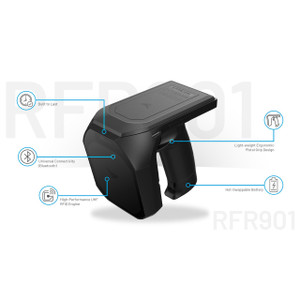
TSC RFR901-NCAS2 Industrial Label Printer
Overview
The TSC RFR901-NCAS2 is a thermal label printer engineered for warehouse, logistics, and supply chain environments where reliable, high-volume label production is non-negotiable. This model combines compact industrial design with dual thermal capability—supporting both direct thermal and thermal transfer print methods—to give operators real flexibility in label selection based on durability and cost trade-offs. Built for 24/7 warehouse operations, the RFR901-NCAS2 (often searched as RFR901 NCAS2) delivers consistent output across demanding daily production schedules without occupying excessive floor space.
Key Features
- Direct Thermal and Thermal Transfer Capable: Choose direct thermal for cost-effective temporary shipment labels, or thermal transfer for durable, archival-grade labels required in inventory and compliance workflows. This flexibility means a single printer can serve multiple label-type requirements across different fulfillment zones without operator intervention or hardware swaps.
- Precision Label Feed Mechanics: Purpose-built for label media with precision feed systems that minimize jams and misfeeds—a critical factor in high-throughput environments where downtime directly impacts dock efficiency and order fulfillment rates.
- Industrial-Grade Construction: Robust mechanical design rated for continuous operation in warehouse and dock environments. The RFR901-NCAS2 withstands temperature swings, vibration from nearby equipment, and the wear-and-tear of shift-based production without performance degradation.
- Compact Footprint: Space-efficient form factor fits workstations, dock areas, and integration into small-space installations—valuable in densely packed fulfillment centers where real estate is a constraint.
- Standard Label Format Support: Optimized for common label stock sizes and media weights used in logistics. Compatibility with industry-standard label dimensions and supply-chain formats reduces integration complexity and avoids lengthy template rework.
- Worldwide Power Certification: Certified for international power standards (AC 110-240V operation), enabling deployment across global logistics networks without regional power-supply engineering or transformer requirements.
Integration & Compatibility
The RFR901-NCAS2 integrates with standard warehouse management systems (WMS) and barcode software platforms commonly deployed in distribution and fulfillment operations. Support for industry-standard label formats and media types ensures compatibility with existing label templates and supply chains. This reduces time-to-production and minimizes the need for custom driver development or label-format translation, allowing your team to move from purchase to operational production quickly.
Ideal Applications
Deploy the RFR901-NCAS2 for shipping label production, inventory labeling, asset tracking, compliance labeling, and pick-and-pack operations. Its reliable performance makes it a dependable choice for organizations requiring consistent, professional label output in high-volume distribution and fulfillment centers. The dual thermal capability is particularly valuable in mixed-use environments where both temporary and permanent labels are required.
Frequently Asked Questions
Q: What's the difference between direct thermal and thermal transfer mode?
A: Direct thermal uses heat-sensitive label stock and requires no ribbon—lowering per-label material cost, making it ideal for high-volume, temporary labels like shipment tags. Thermal transfer requires a compatible ribbon and ribbon-compatible label stock, but produces durable, long-life labels suitable for inventory tracking and compliance documentation that must survive handling and environmental exposure.
Q: Does the RFR901-NCAS2 work with my existing WMS?
A: The RFR901-NCAS2 integrates with standard warehouse management systems and barcode software platforms commonly used in logistics. Verify compatibility with your specific WMS vendor, but industry-standard label formats and integration protocols make connectivity straightforward in most fulfillment environments.
Q: What ribbon and media types are compatible?
A: The printer supports standard thermal-transfer ribbon and label media used across logistics operations. Before full rollout, verify ribbon and media supply availability through your regional distributor to ensure uninterrupted supply and avoid production delays.
Q: How much space does the RFR901-NCAS2 require on a dock workstation?
A: The RFR901-NCAS2 is engineered with a compact footprint designed for small-space installations. Exact dimensions should be verified with your distributor, but the unit is sized to fit standard dock workstations and shipping stations without occupying excessive floor or counter real estate.
Q: Is the RFR901-NCAS2 suitable for 24/7 continuous operation?
A: Yes. The RFR901-NCAS2 is purpose-built for industrial warehouse and logistics environments operating on continuous or multi-shift schedules. Industrial-grade construction and robust thermal mechanisms are designed to handle sustained daily label production without performance loss.
Q: What power supply does the RFR901-NCAS2 require?
A: The unit operates on AC 110-240V worldwide, enabling deployment across global logistics networks without regional power engineering. Confirm local electrical standards with your facility manager before installation.
Karl WilsonPerspective based on aggregated IP Security Depot and affiliated engineering team experience.
I've evaluated the TSC RFR901-NCAS2 during several warehouse infrastructure assessments, and it consistently delivers solid performance in mid-to-high-volume label production environments. The dual thermal capability—both direct thermal and thermal transfer—gives facilities real flexibility in label selection based on durability and cost trade-offs, which is valuable when managing multiple label types across different fulfillment zones simultaneously.
Technical Highlights:
- Thermal Flexibility: Direct thermal mode eliminates ribbon costs and reduces per-label material expense by 30–50% compared to thermal transfer, meaningful at scale across high-volume shipment operations. Thermal transfer extends label lifespan to archival durability for inventory and compliance applications requiring labels to survive warehouse handling and environmental exposure.
- Label-Focused Design: Purpose-built precision feed mechanics minimize jams and misfeeds—critical in high-throughput environments where a single jam translates to dock delays and downstream fulfillment impact. The industrial-grade construction handles 24/7 continuous operation without performance degradation.
- Compact Footprint: Space-efficient design allows deployment in confined dock workstations and integration into small-space fulfillment centers where real estate is constrained, without sacrificing print capacity or reliability.
Deployment Considerations:
- Verify ribbon and media supply chain availability through your regional distributor before full rollout. Thermal transfer operation requires compatible ribbon stock—confirm lead times and pricing to avoid production gaps after deployment.
- Position near barcode software workstations to minimize cable runs and simplify label template management. Integration with your WMS is straightforward for standard label formats, but custom label types or non-standard media sizes may require driver validation in pre-production.
- Confirm AC 110-240V power availability at your dock installation site. The RFR901-NCAS2 operates on worldwide power standards, but facility electrical capacity should be verified before installation, especially in multi-unit deployments across a large fulfillment center.
The RFR901-NCAS2 is a pragmatic choice for logistics operations prioritizing reliability and low operational complexity over experimental thermal technology. It will serve reliably in standard shipping, inventory, and compliance-label workflows typical of distribution and fulfillment centers. Deploy it where thermal flexibility and 24/7 uptime matter more than cutting-edge feature sets.