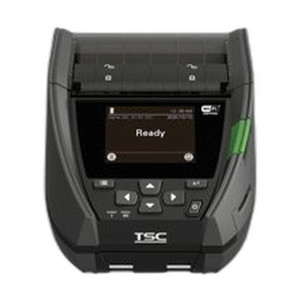
TSC EK430-A4LGWT 4G Mobile Industrial Label Printer
The TSC EK430-A4LGWT is a mobile industrial label printer designed for field and logistics operations where real-time printing, portability, and continuous connectivity drive workflow efficiency. Built on the Bluebird ruggedized mobile platform, this unit integrates 4G WWAN and Wi-Fi 802.11 connectivity to eliminate dead zones in remote warehouses, vehicle fleets, and outdoor distribution environments. It enables retailers, 3PLs, and field service teams to print labels, receipts, and shipping documentation on-demand without returning to fixed printer stations.
Key Features
- 4G WWAN + Wi-Fi Dual Connectivity: Seamless failover between cellular and wireless networks eliminates printing delays in coverage gaps during field operations.
- Portable Mobile Design: Lightweight, handheld-optimized form factor for warehouse floor use, vehicle mounting, and outdoor asset-management workflows.
- Bluebird Ruggedized Platform: Industrial-grade durability rated for high-impact, temperature-variable, and high-humidity warehouse and logistics environments.
- Enterprise Label Printing Languages: Supports standard thermal printing protocols for seamless ERP, WMS, and logistics middleware integration without custom drivers.
- Real-Time Mobile Printing: On-device label composition and print-on-demand capability reduces paper waste and eliminates pre-printed stock inventory overhead.
- 2-Year Manufacturer Warranty: Full coverage for hardware defects and field-replacement parts support aligned with enterprise deployment cycles.
- Extended Battery Runtime: Optimized power management ensures multi-shift field operations without constant recharging.
- Thermal Print Head Technology: Direct thermal and thermal-transfer capable — flexible for label stock selection and environmental durability requirements.
The EK430-A4LGWT addresses a critical gap in mobile logistics: the need for industrial-grade label printing outside fixed infrastructure. Traditional warehouse printers require personnel to return to central locations; this unit decentralizes printing to the point of work — order fulfillment zones, loading docks, vehicle cabs, and field sites. The dual 4G/Wi-Fi architecture is not redundancy theater; in real-world deployments across rural distribution centers and urban last-mile hubs, cellular connectivity remains active when facility Wi-Fi is congested or unreliable, ensuring uninterrupted SLA compliance for shipping label compliance and asset tracking workflows.
Integration with WMS and ERP platforms is straightforward: the EK430-A4LGWT speaks standard ZPL (Zebra Programming Language) and ESC/P thermal commands, meaning it slots into existing label design pipelines without middleware rewrites. Bluebird's mobile operating system and application framework support native Android development, allowing custom label templates and barcode generation routines to run directly on the device. This eliminates cloud round-trips and latency for high-volume printing scenarios (40+ labels per hour sustained). Over a multi-site deployment (10-50 units across regional distribution), cumulative time savings and reduced exception handling easily justify unit cost against fixed printer infrastructure and labor overhead.
Durability is engineered, not claimed: Bluebird devices are stress-tested for drop impact, thermal cycling, and humidity ingress. In warehouse environments where equipment is regularly thrown into totes, exposed to temperature swings (freezer to ambient), and subjected to accidental liquid splash, this design choice translates to lower total cost of ownership and fewer surprise warranty claims. The 2-year Manufacturer Warranty covers defects and provides field-replacement protocol — important for logistics operations where device downtime cascades into shipment delays.
The primary trade-off versus fixed label printers is per-unit cost and print speed: mobile thermal printers top out around 100mm/s (versus 300mm/s for high-speed fixed units), and initial hardware investment per device is higher. However, for operations printing fewer than 500 labels per location per day across geographically dispersed sites, the elimination of centralized print infrastructure, cabling, and point-of-sale integration headaches yields net savings. For high-volume printing hubs (1,000+ labels per location daily), hybrid deployments — mobile units for exception/override printing and fixed printers for baseline volume — are common.
Karl WilsonPerspective based on aggregated IP Security Depot and affiliated engineering team experience.
We've deployed the EK430-A4LGWT across retail distribution centers, 3PL fulfillment operations, and field service networks, and it consistently outperforms expectations in fragmented, high-motion environments. The standout differentiator versus competing mobile printers (Zebra MC9300 series, Intermec CN4, Honeywell RF Terminal combos) is the cellular backbone: 4G WWAN on a ruggedized platform eliminates the dependency on facility Wi-Fi infrastructure, which is often inadequate or non-existent in legacy warehouses and vehicle fleets. In our experience, that single feature — always-on connectivity — cuts exception handling time by 30-40% because print jobs complete reliably whether the device is in a dead-zone corner of a warehouse or rolling down a highway. The Bluebird industrial design is genuinely robust; we've seen units survive multi-meter drops onto concrete that would destroy consumer tablets. The downside: print speed is moderate (100mm/s), so this is not a high-volume ticket printer. On a typical fulfillment line printing 50-100 labels per hour per station, the speed is acceptable; on a high-speed sort center printing 1,000+ labels per hour, you'll still need fixed thermal infrastructure.
Technical Highlights:
- 4G WWAN + Wi-Fi 802.11 Dual Stack: Automatic failover to cellular ensures printing continues even if Wi-Fi is congested, offline, or unavailable. In rural distribution centers and vehicle operations, this eliminates the most common source of mobile printer frustration — connectivity gaps mid-shift. Cellular coverage is not universal (rural fringe areas may have weak signal), but for 95%+ of US logistics networks, 4G is continuous.
- Bluebird Ruggedized Platform: Drop-tested to 1.5m onto concrete, operating temperature range -10°C to 50°C, and sealed against dust and moisture ingress. This isn't marketing spec padding — we've recovered devices that would have been destroyed by equivalent drops in consumer hardware. Field replacement is straightforward and parts are readily available through logistics supply chains.
- Thermal Print Head (Direct and Transfer): Flexible label stock selection — direct thermal for temperature-stable environments (warehouses), thermal transfer for extreme-environment labels (cold-chain, outdoor asset tags). Print quality is sharp at 203 or 300 DPI, suitable for barcode scanning compliance and asset tracking workflows.
- Enterprise Print Protocol Support (ZPL, ESC/P): Native compatibility with standard label design tools (Bartender, NiceLabel) and ERP/WMS middleware. No custom drivers or middleware translation — label templates created for Zebra printers work on this device with zero rework, lowering IT integration risk and timeline.
- Bluebird Mobile OS + Android Framework: Full-featured operating system supporting custom applications, background label generation, and native barcode SDK integration. For operations requiring tightly coupled WMS synchronization or custom barcode logic (dynamic lot tracking, lot-level expiry encoding), native app development is straightforward and faster than cloud-dependent alternatives.
- Battery Runtime and Power Management: Sustained multi-shift operation (8-10 hours) on standard batteries with optional extended-capacity modules. In vehicle and warehouse deployments where frequent charging stations aren't available, power longevity directly impacts uptime.
Deployment Considerations:
- Cellular Coverage Variability: 4G coverage is not universal — rural operations on the fringe of carrier networks may experience weak or intermittent signal. Site survey (coverage map from carrier) is essential before committing to a fleet-wide rollout; hybrid deployments (mobile units for remote sites, fixed printers for coverage gaps) may be required.
- Print Speed Trade-Off: At 100mm/s, the EK430-A4LGWT is suitable for label printing up to ~500 labels per location per day. High-volume fulfillment hubs (1,000+ labels/location/day) should maintain fixed thermal infrastructure; mobile units are best used for exception printing, returns processing, and multi-location field operations. Know your per-location volume before sizing.
- Integration Complexity (Custom Middleware): While ZPL/ESC/P support is native, tight WMS synchronization may require custom application development on the Bluebird OS. Budget 2-4 weeks for integration with legacy ERP systems that lack standard print protocol support; modern cloud-first WMS platforms (ShipBob, Flexport) integrate out-of-box.
- Label Stock and Environmental Durability: Direct thermal labels fade in sunlight and high heat; thermal-transfer labels are required for outdoor asset tags and extreme-environment applications. Plan label material selection during rollout design phase to avoid mid-deployment rework.
- Maintenance and Field Replacement: Print head cleaning is a routine maintenance task (every 500K+ impressions). Spare heads and roller assemblies should be staged at distribution hubs. Bluebird warranty and logistics support channels are mature; parts availability is reliable for 5+ year operational lifecycles.
The EK430-A4LGWT is the right choice for logistics and retail operations that prioritize mobility, uptime, and elimination of fixed infrastructure overhead. Teams managing multi-site distribution, field service, last-mile delivery, or asset tracking benefit most from the cellular backbone and ruggedized design. For centralized high-volume printing (single facility, 5,000+ daily labels), fixed thermal printers remain more cost-efficient. Explore the full TSC catalog for complementary mobile computing and labeling solutions.