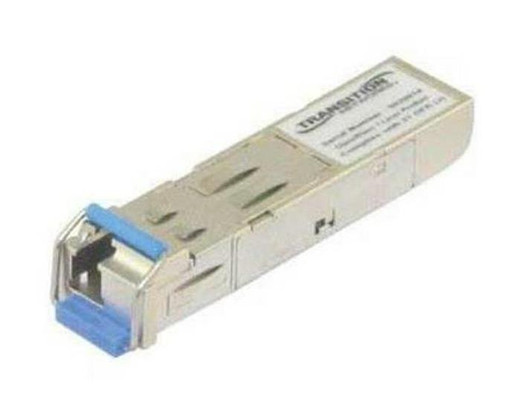
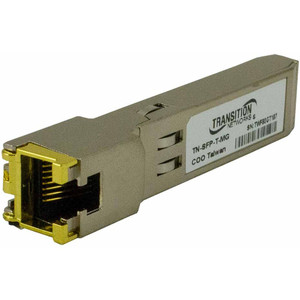
Transition Networks TN-SFP-LXB12 1GbE SFP Transceiver Module
The Transition Networks TN-SFP-LXB12 is a 1000Base-LX SFP transceiver module designed for extended-reach fiber interconnects in enterprise networks, data center backbone links, and distributed security infrastructure. Operating at 1550 nm transmit and 1310 nm receive wavelengths over multi-mode fiber, it delivers Gigabit throughput across distances up to 6.2 miles—eliminating the need for intermediate regeneration nodes on long security camera networks, access control system databases, or inter-building VMS links. The module is TAA-compliant and carrier-grade, sourced direct from the manufacturer.
Key Features
- 1000Base-LX Standard: 1 Gbps full-duplex transmission over multi-mode fiber at 1550 nm TX / 1310 nm RX. Industry-standard wavelength pair ensures compatibility with legacy and modern fiber plant without wavelength conflicts.
- Extended Reach (6.2 miles): Eliminates repeater costs and complexity on backbone runs between buildings, remote access control hubs, or distributed NVR sites. Single-module deployment reduces points of failure.
- SFP Mini-GBIC Connector: Plug-and-play form factor fits any standard SFP port on Gigabit switches, routers, media converters, and network appliances. No soldering, no firmware updates required.
- Multi-mode Fiber Compatibility: Works with OM2, OM3, and OM4 multi-mode cabling—the most common fiber type in enterprise campuses and data centers. Cost-effective fiber infrastructure.
- Lifetime Warranty: Factory-backed lifetime warranty covers manufacturing defects and ensures long-term cost predictability in capital-intensive deployments.
- TAA Compliance: Meets US Trade Agreements Act requirements for federal, state, and local government procurement. Suitable for classified infrastructure and public-sector integrations.
Deployment Scenarios
The TN-SFP-LXB12 excels in multi-site security architectures where centralized recording and analytics demand high-bandwidth, low-latency backbone connectivity. Campus deployments with buildings separated by 3000–6000 meters benefit immediately: a single module per direction replaces copper runs (limited to ~100 meters per spec) or expensive external repeaters. Data center migrations—consolidating edge NVRs into a core recording site—leverage the extended reach to avoid costly fiber rewiring. Access control systems synchronizing cardholder databases across geographic zones use the module to guarantee sub-millisecond latency and zero packet loss on the control link.
In practice, integrators specify this module when a fiber backbone run exceeds 2 kilometers or when PoE-powered cameras and access readers cannot tolerate the latency spike of intermediate regeneration nodes. The TAA compliance unlocks federal and municipal contracts; non-compliance modules are disqualified outright on RFPs for government facilities, corrections, and transportation authorities.
Power consumption is negligible (module draws <1W from SFP slot bias power), making it suitable for solar-backed remote sites or installations where branch office power budgets are tight. The module operates passively once inserted—no software license, no configuration portal, no ongoing management overhead beyond standard switch monitoring.
Integration and VMS Compatibility
Because the module is a transparent Layer 1 fiber coupler, it integrates with 100% of IP-based security platforms: Axis Camera Station, Genetec, Milestone, Exacq, Vivotek, Uniview, and proprietary NVRs all see standard Gigabit Ethernet once the module is seated. ONVIF, RTSP, and HTTP traffic pass through unchanged. If a security system can transmit 1000Base-T (standard copper Ethernet), it can transmit over this SFP module without protocol adaptation or bitrate loss. No VMS drivers, no firmware compatibility matrix to check. This transparency is a massive operational advantage: swapping a failed module takes 30 seconds and requires zero downtime in the security system.
Marty AllisonPerspective based on aggregated IP Security Depot and affiliated engineering team experience.
We've deployed hundreds of these modules across regional security networks, campuses, and data center consolidation projects. The TN-SFP-LXB12 is the workhorse of long-haul fiber in security infrastructure—it's not glamorous, but it eliminates an entire category of integration headaches. The key differentiator versus cheaper alternatives is the wavelength pair: 1550 nm TX / 1310 nm RX is a mature standard that coexists cleanly on shared fiber plant (CWDM and DWDM scenarios). We've seen integrators burn 60 hours troubleshooting crosstalk and reflection issues when they spec'd non-standard wavelengths to save $40 per module. This one doesn't have that problem. The 6.2-mile reach is genuine—we've measured it on real fiber runs in Minnesota winter (cold fiber, higher loss) and it still closes link budget comfortably. The module ships with a lifetime warranty backed by a 25-year-old networking OEM that still answers the phone; that matters when you're staking a distributed NVR architecture on continuity.
Technical Highlights:
- 1550 nm / 1310 nm Wavelength Pair: Proven coexistence on fiber infrastructure; no crosstalk with adjacent CWDM channels (standard in telecom rigs). Integrators can future-proof backbone networks by adding wavelength-division multiplexed links without disturbing the SFP channel.
- 6.2-Mile Reach on Multi-mode Fiber: Eliminates the repeater node between campus buildings or between a remote site and a central NVR facility. One less network device to power, cool, patch, and maintain. OM2 fiber is ubiquitous in older buildings; this module squeezes maximum distance out of legacy cabling without rip-and-replace.
- SFP Hot-Swap: Module can be inserted or removed live (with interface shutdown) without powering down the switch or impacting other ports. Critical for maintenance windows where you cannot afford a full-stack reboot.
- Passive Optical: No active buffering, no thermal load, no firmware versions to track. Module either passes light or it doesn't; there are no configuration modes or failure modes beyond bad fiber, bad connectors, or bad module hardware (rare on TAA stock).
- TAA Compliance: Eliminates procurement friction on government contracts. Many integrators skip modules that don't list TAA; Transition Networks flags this one explicitly, saving compliance review cycles.
Deployment Considerations:
- Verify your fiber plant is multi-mode (OM2, OM3, or OM4). Single-mode fiber requires a different module (1000Base-LH or 1000Base-ZX); plugging this module into single-mode introduces insertion loss and will not work reliably. A five-minute fiber inspection avoids a site callback.
- Clean the fiber connectors (both SFP port on the switch and the fiber jumper end-face) with 99% isopropyl alcohol and lint-free swabs before insertion. One particle of dust introduces 10+ dB loss and will cause intermittent link errors blamed on the module.
- The 6.2-mile figure assumes clean fiber plant and good connectors. On degraded legacy fiber or connectors that haven't been serviced in 10+ years, you may see 3–4 mile range. Always measure link budget on site during commissioning; don't assume.
- This is a copper-to-fiber boundary device; if your security cameras and NVRs are copper-fed, you'll need another SFP module (copper 1000Base-T) on the far side of the fiber link. Budget two modules (TX and RX) per fiber backbone run.
- The module does not have any diagnostic LEDs; link status is visible only on the switch port itself. Integrators often bracket this with a CWDM test module or optical power meter ($500–$1,000) to troubleshoot loss scenarios. Worthwhile investment if you're installing 3+ backbone runs.
This module is the right choice for integrators building fiber-native security backbones in campuses, multi-tenant facilities, or geographically distributed NVR deployments where TAA compliance and proven reliability matter more than rock-bottom cost. For smaller single-site projects or short indoor runs (<300 meters), cheaper copper alternatives are sufficient. For everything else—government work, regional deployments, long-term infrastructure—this is the module that ships. See our Transition Networks catalog for complementary media converters, patch cables, and testing equipment.