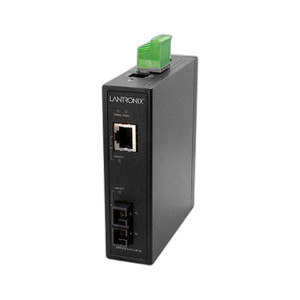
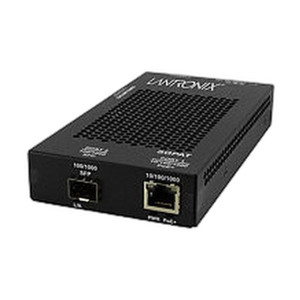
Transition Networks SISTG1014-211-LRT-B Gigabit Fiber Media Converter
Overview
The Transition Networks SISTG1014-211-LRT-B is a DIN rail-mountable Gigabit fiber media converter purpose-built for industrial and telecom infrastructure where extended cable runs demand fiber backbone connectivity. This converter bridges single-mode fiber (1310 nm wavelength) to copper Ethernet, supporting 10Base-T, 100Base-TX, and 1000Base-LX protocols. The 6.2-mile maximum transmission distance means you can run fiber across an entire campus, warehouse complex, or security perimeter without signal regeneration — a critical advantage over copper-only solutions that max out around 328 feet and demand active repeaters or costly conduit work.
Key Features
- Gigabit Data Rate (1 GBps): Full-duplex throughput at 1000 Mbps eliminates bottlenecks when aggregating video streams from multiple IP cameras or feeding a central NVR; no degradation to 100 Mbps or 10 Mbps fallback speeds needed.
- 1310 nm Single-Mode Fiber: Standard telecom wavelength ensures compatibility with existing fiber plant; single-mode fiber (SMF) reduces modal dispersion over long distances, critical for maintaining signal integrity across 6+ miles without costly repeater equipment.
- 6.2-Mile (10 km) Transmission Range: Eliminates distance constraints in sprawling industrial, warehouse, or campus deployments where running copper Ethernet would require conduit, shielding, or active equipment at midspan. Fiber immunity to EMI is a secondary but real benefit in electrically noisy environments.
- DIN Rail Mounting: Integrates directly into standard industrial control enclosures and 19-inch racks without additional adapters; compact form factor saves rack space and simplifies panel layout for security integrators and control system engineers.
- Auto-Negotiation Support: Automatically detects and adapts to 10/100/1000 Mbps copper-side speeds, removing manual configuration overhead and preventing mismatches between legacy equipment and modern gigabit infrastructure.
- Backward Compatibility: Supports legacy 10Base-T and 100Base-TX alongside 1000Base-LX and 1000Base-T, allowing mixed-speed deployments without swapping hardware — useful when phasing in gigabit cameras on older networks.
Integration and Deployment
The SISTG1014-211-LRT-B (often searched as SISTG1014 211 LRT B) operates transparently at Layer 1, requiring no configuration or IP address assignment. Pair it with gigabit network switches on the copper side and a fiber-rated transceiver or CWDM system on the optical side. Industrial environments benefit from its DIN rail footprint when building out extended surveillance architectures across multiple buildings or outdoor perimeters. The fiber backbone isolates security cameras and sensors from ground loops and radiated EMI common in warehouses, manufacturing floors, or near high-voltage equipment.
When to Consider Alternatives
If your deployment spans under 300 feet and runs entirely on copper Ethernet, a managed switch with VLAN segmentation will cost less and simplify power delivery via PoE. If you need bidirectional video conferencing or real-time two-way audio over the extended link, verify the converter's latency spec against your application requirements — media converters introduce minimal latency, but always confirm with a test bench run. For submarine or fully submersed fiber runs, specify armored fiber cable and connector termination separately; the converter itself is indoor/controlled-environment rated.
Frequently Asked Questions
Q: Does the SISTG1014-211-LRT-B require external power?
A: Specifications in the source evidence do not detail the power supply or consumption. Consult the manufacturer datasheet or contact a pre-sales engineer to confirm power requirements before finalizing your design.
Q: What type of fiber cable is required?
A: The converter operates on single-mode fiber (SMF) at 1310 nm wavelength. You will need single-mode fiber optic cable and appropriately terminated connectors (typically LC, SC, or ST depending on your fiber plant). Multi-mode fiber will not work at this wavelength and distance.
Q: Can I use this converter to extend a PoE-powered IP camera beyond the standard 328-foot Ethernet limit?
A: Yes, the fiber backbone handles the distance, but PoE power is limited to the copper segment reaching the camera. Deploy a local PoE injector or mid-span power supply near the camera end of the copper link, or use a powered camera with DC input and run a separate low-voltage power line alongside the fiber.
Q: Is the SISTG1014-211-LRT-B NDAA-compliant or manufactured domestically?
A: Compliance and manufacturing origin are not documented in the available specifications. If federal procurement or NDAA Section 889 compliance is required, verify directly with Transition Networks or an specialty distributor.
Q: Does auto-negotiation work reliably with older 100Base-TX cameras and switches?
A: The converter supports auto-negotiation across 10/100/1000 Mbps. Mixed-speed deployments are supported, but always validate interoperability in a test environment before production deployment, especially with legacy equipment that may have weak auto-sensing.
Q: What is the warranty period on the SISTG1014-211-LRT-B?
A: Warranty terms are not included in the available specifications. Contact the vendor or manufacturer for details on coverage, RMA procedures, and any extended service options.
Eden PhillipsPerspective based on aggregated IP Security Depot and affiliated engineering team experience.
The SISTG1014-211-LRT-B solves a real problem in distributed security infrastructure: copper Ethernet maxes out at 328 feet, and fiber optic backbone costs spiral when you need repeaters or multiple switch hops. This converter's 6.2-mile single-mode fiber reach means you can run a camera string across an entire warehouse campus or industrial perimeter on one fiber pair without active equipment at midspan. The auto-negotiating copper interface eliminates tedious manual speed configuration, and DIN rail mounting drops straight into any standard industrial enclosure — no external raceway adapters required.
Technical Highlights:
- 6.2-Mile (10 km) SMF Transmission: Single-mode fiber at 1310 nm eliminates distance bottlenecks and reduces modal dispersion; you deploy fiber once, not copper repeaters every 300 feet.
- Gigabit Full-Duplex Throughput: 1 GBps bidirectional capacity means no performance penalty when aggregating multiple HD or 4K camera streams toward a central NVR or edge storage device.
- 10/100/1000 Auto-Negotiation: The converter auto-detects copper-side speed and adapts; no manual pinning required, so mixed-legacy and modern camera networks coexist without swapping hardware.
Deployment Considerations:
- Single-mode fiber infrastructure must already exist or be installed separately; this converter only handles the optical-to-copper bridge. Budget for fiber termination (LC, SC, or ST connectors) and splice/fusion services if running new plant.
- Power requirements are not detailed in available specs — confirm external power needs with the manufacturer before committing to enclosure layout; some media converters draw minimal current, others require 12 VDC or 24 VDC supplies.
Deploy the SISTG1014-211-LRT-B when you're building a perimeter or multi-building surveillance backbone where fiber already runs or where future-proofing against EMI makes fiber economical. It's not needed for indoor single-building deployments under 300 feet — managed gigabit switches with PoE are simpler and cheaper there.