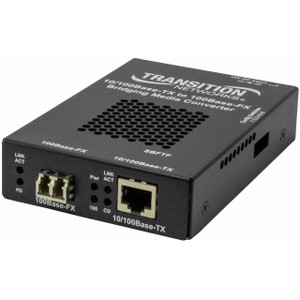
Transition Networks SGFEB1040-330-NA Dual 10/100/1000BT SFP Module
The Transition Networks SGFEB1040-330-NA is a dual-port SFP module designed to extend switching capacity on compatible Transition Networks switch platforms. This module supports mixed 10/100/1000 Mbps copper connectivity, allowing integrators to add flexible gigabit Ethernet ports without replacing entire switch hardware. Ideal for deployments where incremental port expansion is needed to accommodate additional network devices—cameras, NVRs, PoE injectors, access control panels, or aggregation switches—without disrupting existing infrastructure.
Key Features
- Dual SFP Slots: Two independent ports support 10/100/1000 Mbps copper Ethernet. Mix speeds on the same module—run a camera at 100 Mbps and an NVR at gigabit on the same expansion card.
- 10/100/1000 Auto-Negotiation: Automatic speed and duplex detection simplifies installation—plug any copper cable and the module adapts. No manual configuration required for speed matching.
- Hot-Pluggable Design: Install or remove the module without powering down the host switch. Supports non-disruptive network expansion on live infrastructure.
- Compact Form Factor: 6.9 x 5.2 x 3.4 inches. Fits standard SFP module slots on Transition Networks switch chassis without requiring external enclosures or additional rack space.
- Standard SFP Connector: Industry-standard SFP interface ensures compatibility across Transition Networks switch platforms with available SFP expansion slots.
- Lifetime Warranty: Backed by Transition Networks lifetime warranty—no annual support fees or expiration; parts coverage for the product lifetime.
- Low Power Consumption: Passive copper module draws minimal current from switch backplane—no external power supply needed. Reduces total system power overhead on PoE-starved deployments.
This module is purpose-built for security integrators and network architects who standardize on Transition Networks switching infrastructure. Common use cases include expanding a 16-port switch to 18 ports for a camera cluster, adding gigabit uplinks to an edge switch serving multiple buildings, or inserting copper ports into a fiber-primary backbone switch for local device termination. The module's ability to auto-negotiate speed means you can retire legacy 100 Mbps cameras and 10 Mbps IoT devices on the same ports without configuration overhead.
Integration is straightforward: the SGFEB1040-330-NA plugs into any available SFP slot on a compatible Transition Networks switch (such as the SGFEB-LE, SGFEB-LX, or similar product lines). No drivers, firmware updates, or special VMS configuration required—the ports appear as standard Ethernet interfaces to your monitoring system. ONVIF-compliant cameras and NVRs recognize the expanded ports immediately.
Network redundancy benefits from this module's hot-swappable design. If a port fails, you can replace the module during live monitoring without dropping connections on other ports. Mixed-speed support also extends equipment lifecycle: older 100 Mbps cameras remain productive on one port while new 1000 Mbps sensors connect to the second, deferring replacement costs. For PoE-powered devices, the module itself is passive (no PoE injection), so ensure your host switch has sufficient PoE budget for connected cameras or access points.
Transition Networks publishes detailed switch compatibility matrices in the product datasheet. Before ordering, confirm your host switch model supports dual SFP expansion and has available slots. Most mid-range and enterprise Transition Networks switches manufactured in the last five years accommodate this module without firmware changes.
Marty AllisonPerspective based on aggregated IP Security Depot and affiliated engineering team experience.
The SGFEB1040-330-NA is one of the quietest wins in mid-sized security deployments: a simple SFP module that solves the "we're one port short and don't want to replace the entire switch" problem. We've deployed these across parking structures, shopping centers, and campus networks where a 16-port Transition Networks switch was perfectly adequate for the installed camera count, but integrating a new zone or swapping in higher-bandwidth devices required just two more ports. Rather than rip out a working switch and buy a larger platform (capex + downtime + learning curve), a $200 module slides in and solves it. The lifetime warranty also means no surprise support expirations—important for integrators managing 50+ sites where tracking annual licensing becomes a burden.
The auto-negotiation is the real operational lever here. We've seen sites where a mix of older MJPEG cameras (streaming at 100 Mbps) and modern H.265 NVRs (requiring gigabit) co-exist on the same switch. This module handles both without manual speed configuration—something that matters when an installer is working onsite and doesn't want to SSH into the switch to tweak port settings. Plug it in, it works.
Technical Highlights:
- Dual Independent Ports: Each SFP port is electrically isolated—a link failure on port 1 does not affect port 2. Means you can run a critical NVR uplink on one port and a non-critical camera zone on the other without coupled risk.
- Auto-Negotiation Across Speed Range: Legacy 10 Mbps devices (rare but real in older installations) are supported alongside gigabit cameras. The module detects and adapts automatically, reducing the need for separate slow-speed vs. fast-speed switch segments.
- Passive Copper Module: No active processing, no firmware to update, no heartbeat pings. Failure modes are simple: cable connectivity or switch backplane power. Easier to troubleshoot than active modules when something goes wrong.
- Hot-Swap Capability: Insert or remove without shutting down the host switch. Critical for live camera networks where downtime is costly. Many competitors' older modules require a reboot to detect new ports.
- Compact Density: Two ports in a single SFP slot frees up physical space and reduces the number of expansion modules consuming power budget. Matters on compact industrial switches with limited thermal headroom.
Deployment Considerations:
- Verify host switch SFP slot availability and firmware version before ordering. Some older Transition Networks models released before 2018 may require firmware updates to recognize dual-port SFP modules. Check the datasheet compatibility matrix or contact Transition Networks TAC.
- This is a passive copper module — it does not provide PoE injection. If you're connecting PoE cameras via this module, ensure your host switch has sufficient PoE budget (typically 30–95W per port). A PoE injector on the camera side is an alternative if switch PoE is saturated.
- Cable length for copper RJ45 connections is limited to 100m per IEEE 802.3. If you're running camera feeds beyond that distance, use fiber SFP modules instead. This module is designed for short runs (under 50m) to cameras, NVRs, and local network equipment.
- Environmental rating: the module itself is rated for 0–50°C operation. If your switch is mounted in a harsh outdoor enclosure, ensure ambient temperature stays within spec. Most integrators install the switch indoors and run drop cables to outdoor cameras, so this is rarely a constraint.
- Mixed speed configurations (100 Mbps camera + gigabit NVR on the same module) work reliably, but be aware that the slower port may introduce minor latency on the faster port if both are saturated. For critical bandwidth-sensitive deployments, isolate high-speed traffic onto separate modules if possible.
The SGFEB1040-330-NA is ideal for integrators who have standardized on Transition Networks switching and need non-disruptive capacity expansion. It's a pragmatic alternative to forklift upgrades and carries a lifetime warranty that outlasts most security contracts. For detailed compatibility and ordering, see the Transition Networks catalog.