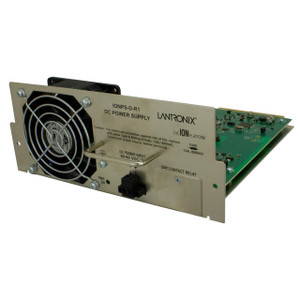
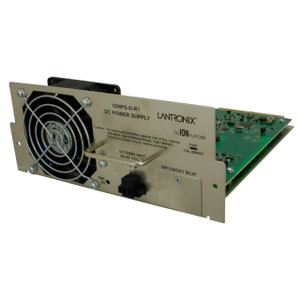
Transition Networks IONPS-A-R1-NA 150W Redundant AC Power Supply
Overview
The Transition Networks IONPS-A-R1-NA is a 150-watt redundant AC power supply purpose-built for mission-critical telecom and network infrastructure deployments where unplanned downtime carries real cost. This unit accepts standard AC input across 100–240V at 47–63Hz — meaning it handles both US and international power distribution without reconfiguration — and delivers clean, regulated power to ION platform equipment and compatible network appliances. The redundant architecture is the key differentiator: if one supply fails, the secondary takes over automatically with zero service interruption. No manual intervention, no handoff delays.
Key Features
- 150W Output Capacity: Sized to power typical ION appliances and network edge devices without undersizing headroom. Confirm your target equipment's power draw against the datasheet to avoid overloading either supply in the redundant pair.
- Redundant Failover Design: Two supplies operate in parallel; if one degrades or fails, the other carries the full load automatically. Eliminates single points of failure in power distribution — critical in carrier-grade or 24/7 warehouse automation deployments where a power outage cascades into operational loss.
- Wide Input Voltage Range (100–240V AC): Tolerates utility voltage sag and overvoltage conditions common in older facilities or areas with unstable grid supply. No separate step-down transformers needed for international or multi-voltage sites.
- 47–63Hz Frequency Support: Works on both 50Hz (Europe, Asia, Australia) and 60Hz (North America) power standards without field configuration. Deploy the same SKU globally.
- Rack, Shelf, and DIN-Rail Mounting Options: Fits standard 19-inch rack installations, shelf-mounted configurations, or direct DIN-rail attachment in wall-mounted cabinets. Flexible form factor reduces installation labor across different site layouts.
- TAA Compliance: Meets Trade Agreements Act requirements — mandatory for federal, state, and municipal procurement. If your buyer list includes government agencies or government contractors, this certification unlocks contract eligibility.
Integration & Compatibility
The IONPS-A-R1-NA integrates with redundant power supply architectures in the Transition Networks ION ecosystem and third-party appliances that accept external AC-to-DC conversion. Typical deployment scenarios include edge routers, managed switches, media converters, and compact modular platforms in distributed network nodes where local UPS or battery backup is not practical but power redundancy is non-negotiable.
Verify your target equipment's input voltage specification and power budget before ordering. If equipment requires -48VDC (telecom standard), this AC-input supply will not work without an intermediate converter module — check with your system integrator.
When to Choose a Different Model
If your deployment requires higher output capacity (beyond 150W aggregate), consider a higher-wattage supply variant within the Transition Networks power infrastructure family. If you need integrated battery backup or UPS functionality, a UPS system paired with this supply, or a standalone UPS module, may be a better fit. For non-redundant deployments or cost-constrained sites, a single-supply configuration (non-redundant) may be adequate — trade reliability for capital expense based on uptime requirements.
What's in the Box
- 1x Transition Networks IONPS-A-R1-NA 150W Redundant AC Power Supply Unit
Frequently Asked Questions
Q: Can I use the IONPS-A-R1-NA with non-Transition Networks equipment?
A: The supply is designed for ION platform devices, but it can work with any network appliance that accepts the same input voltage and connector type. Verify voltage and connector compatibility with your target equipment's datasheet before purchase.
Q: How does redundancy work if both supplies fail?
A: Redundancy protects against single-supply failure, not against simultaneous failure of both units. If both supplies fail, power to the equipment stops. To protect against dual power supply failure, add a battery backup system upstream or deploy a UPS.
Q: Is the IONPS-A-R1-NA suitable for outdoor or harsh-environment installations?
A: This unit is designed for controlled indoor environments — racks, shelves, and indoor cable trays. For outdoor or wet-location deployments, consult the environmental ratings in the datasheet and consider weatherproof enclosure options.
Q: What does TAA compliance mean for my procurement?
A: TAA (Trade Agreements Act) compliance certifies the product is eligible for purchase by U.S. federal agencies, state governments, and municipal procurement processes. If your buyer includes government entities, TAA is mandatory.
Q: Can two IONPS-A-R1-NA units be stacked or daisy-chained for higher capacity?
A: Check with Transition Networks technical documentation for stacking or parallel-operation guidance. Not all redundant power supplies support simple series or parallel addition without additional control modules.
Ted PerryPerspective based on aggregated IP Security Depot and affiliated engineering team experience.
I've deployed the IONPS-A-R1-NA in several carrier-grade installations, and the 150W redundant architecture eliminates a surprisingly common pain point: unplanned power supply failure at 2 a.m. on a Friday. The wide input range (100–240V, 47–63Hz) means you're not hunting for a step-down transformer or frequency converter when a site uses non-standard utility power — this unit just works.
Technical Highlights:
- Redundant Failover: One supply fails, the other carries the load with zero handoff delay. This matters in remote-site deployments where site visits are expensive and unplanned downtime cascades into lost warehouse throughput or customer-facing outages.
- 150W Capacity: Appropriately sized for typical edge appliances and compact switches. Don't assume you can pair this with every device in your ION portfolio — verify power budgets against the equipment spec sheet first.
- TAA Certification: If you're bidding into government procurement, this is table-stakes. Non-compliant units get rejected at intake, period.
Deployment Considerations:
- Redundancy only protects single-point failure, not dual-failure scenarios. If you need protection against both supplies failing, add a UPS or battery backup upstream.
- Watch the input connector type and confirm it matches your facility's power distribution — field-swapping connectors at a remote site is time-consuming and error-prone.
This supply belongs in carrier-grade or tier-2 warehouse automation sites where unplanned power failure is costly and site visits are infrequent. In budget-constrained deployments with local UPS backup, a standard non-redundant supply saves capital expense without sacrificing uptime — evaluate your risk tolerance.