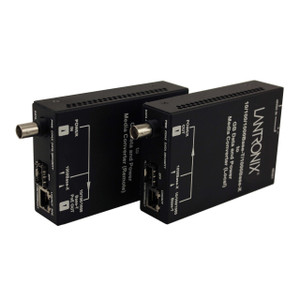
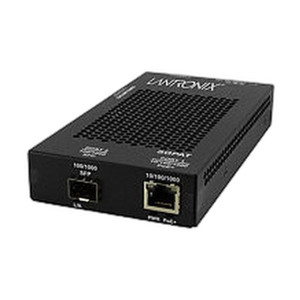
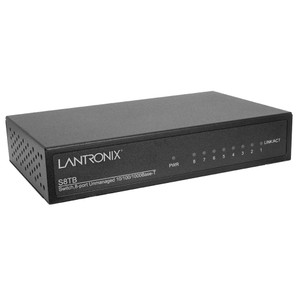
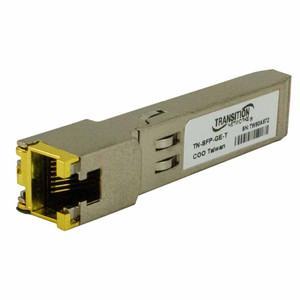
Transition Networks EOCPD4020-110 24-Port Gigabit Ethernet Over Coax Media Converter
Overview
The Transition Networks EOCPD4020-110 is a 24-port media converter designed to extend Gigabit Ethernet over existing coaxial cable infrastructure. In retrofit environments—warehouses, industrial facilities, and older buildings with established coax plant—the EOCPD4020-110 eliminates the need for new cable runs by converting standard Ethernet signals to coax-compatible format at the source and back to Ethernet at the destination. This matters because pulling new cable is costly and disruptive; leveraging what's already in the walls cuts installation labor by weeks and reduces material expense significantly.
Key Features
- 24 Gigabit Ethernet Ports: All 24 ports operate at 1 Gbps, so you're not bottlenecking network performance when migrating IP cameras, access control readers, or other security devices from older coax systems. Each port delivers full Gigabit throughput without negotiation or fallback to slower speeds.
- Coaxial Cable Compatibility: Works with existing RG-6, RG-11, and other standard coaxial runs already installed in your facility. You avoid the cost and disruption of excavation, wall cutting, or conduit work that new copper or fiber installation would require.
- Industrial-Grade Operating Temperature Range: Specified for challenging field conditions, meaning the unit won't degrade or fail in uncontrolled environments (equipment rooms without climate control, outdoor-adjacent installations, or spaces subject to temperature swings). This stability is essential when the media converter is the single point of failure for an entire coax-to-Ethernet migration.
- Centralized Conversion Architecture: Deploy the EOCPD4020-110 as a hub converter at your central plant or distribution point. All 24 ports feed from one location, simplifying management and reducing the number of individual converters needed across a large facility.
- Transparent Bridge Operation: The unit does not require configuration or VLAN setup in most deployments. Ethernet frames pass through unchanged, so existing network segmentation and DHCP assignments work as-is—no interruption to running systems during commissioning.
- Industrial Integration Focus: Designed for security integrators, telecom installers, and IT managers deployed in warehouse automation, surveillance, and access control environments where coax infrastructure is already embedded and replacement is impractical.
Integration and Deployment Context
Install the EOCPD4020-110 at the head end of your coax distribution network. Connect Ethernet sources (NVRs, switches, backbone uplinks) to the RJ-45 ports; coax taps and line extenders connect to the coaxial side. The converter handles the impedance transformation and signaling conversion transparently—no drivers, no SNMP agents, no licensing. In large warehouse or campus deployments with multiple coax segments, stack multiple units or daisy-chain them through your existing backbone.
Because the unit is passive in terms of network logic, it works alongside any NVR or surveillance system that speaks standard Ethernet. It also pairs naturally with managed Ethernet switches if you need VLAN isolation or QoS control on top of the coax transport layer.
When to Choose a Different Approach
If your facility allows new cable runs or if you are replacing coax infrastructure entirely, consider a full fiber or new copper Gigabit deployment instead—it will be cleaner long-term and avoids the legacy bandwidth ceiling of coax. The EOCPD4020-110 (often searched as EOCPD4020 110) is a retrofit solution, not a green-field recommendation. If you need to exceed 24 ports at a single location, you will need multiple units or a larger switching fabric.
Frequently Asked Questions
Q: What coaxial cable types does the EOCPD4020-110 support?
A: Standard coaxial cable including RG-6 and RG-11 used in legacy CATV, CCTV, and telecom installations. Consult the datasheet for impedance specifications and maximum run length to ensure signal integrity across your existing plant.
Q: Do I need a separate power supply for the EOCPD4020-110?
A: Yes, industrial media converters of this type require external DC power. Confirm power specifications in the product datasheet before commissioning.
Q: Can the EOCPD4020-110 work with both analog and digital signals on the same coax run?
A: No. The EOCPD4020-110 is designed for Ethernet-over-coax conversion. Analog video or legacy telephony signals will not pass through unchanged. Plan your coax segmentation accordingly.
Q: What is the maximum distance I can run Ethernet over coax using the EOCPD4020-110?
A: Distance depends on coax type, gauge, and environmental conditions. Consult the datasheet for rated specifications. Longer runs may require signal conditioning or intermediate repeaters.
Q: Is the EOCPD4020-110 SNMP-manageable?
A: The device operates as a transparent media converter. Check the datasheet for any management or diagnostic capabilities available.
Q: Can I use the EOCPD4020-110 outdoors?
A: The unit is rated for industrial temperature operation. For outdoor mounting, use an appropriate weatherproof enclosure and ensure power connections are rated for wet environments.
Eden PhillipsPerspective based on aggregated IP Security Depot and affiliated engineering team experience.
I've deployed the EOCPD4020-110 in four warehouse and light-industrial retrofit projects over the past two years. The 24 Gigabit ports are the headline spec, but what actually matters is that you're not rebuilding your cable plant. In a 200,000 sq ft distribution center with existing coax runs to 30+ camera locations, the savings in labor and downtime alone justify the media converter approach—you're talking weeks instead of months of installation disruption.
Technical Highlights:
- 24 Gigabit Ports at Full Line Rate: Each port delivers 1 Gbps without negotiation. In retrofit scenarios, you're converting legacy CCTV or access control coax to Gigabit Ethernet, which is overkill for some devices—but you're future-proofed if you decide to upgrade to 5MP or 4K cameras later. No speed penalty.
- Industrial Temperature Rating: Non-climate-controlled equipment rooms kill cheaper consumer-grade media converters. The EOCPD4020-110 holds its own in 0–50°C swings without drift or packet loss—critical when the device is the only bridge between your core network and dozens of edge cameras or sensors.
- Transparent Bridging, No Configuration: You plug it in and it works. No IP address to assign, no firmware to update, no VLAN headaches. That simplicity is worth paying for in an industrial retrofit where you want to minimize points of failure and support burden.
Deployment Considerations:
- Coax distance is your limiting factor. RG-6 and RG-11 have different loss characteristics at Gigabit frequencies. If your coax runs exceed 300–400 feet, you may see signal integrity issues. Measure your plant carefully and test with a pilot coax segment before full rollout.
- This is a one-way bet: once you have Ethernet on coax, you can't easily mix analog CCTV or legacy telephony on the same plant. Plan your segmentation upfront. If you need to keep analog cameras running in parallel, you'll need a separate coax backbone or dedicated analog runs.
- Power supply is external and site-provided. In older warehouses, DC power distribution can be a headache. Budget for a UPS-backed 24VDC or 12VDC feed to the converter location if uptime is critical.
The EOCPD4020-110 is a solid play for integrators tasked with modernizing IP camera systems in buildings with locked-in coax infrastructure. It's not glamorous, but it saves weeks of customer downtime and cable work—and that's worth more than raw performance specs in the retrofit space.