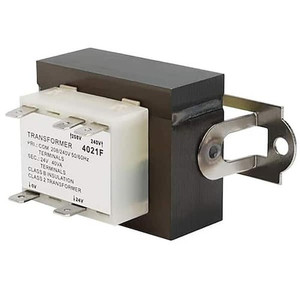
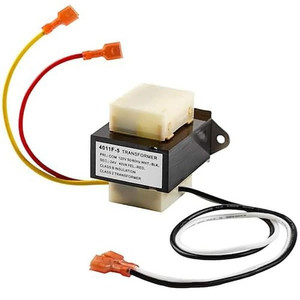
Code Blue 41163 40VA Transformer 100-277V CB2a
The Code Blue 41163 is a 40VA transformer engineered for access control systems, alarm panels, and security peripherals that require regulated secondary voltage. Its wide input range of 100-277V AC accommodates both standard North American branch circuits and international 230V installations without reconfiguration, eliminating SKU proliferation on mixed-voltage deployments. Designed around the CB2a platform, the 41163 delivers stable auxiliary power to card readers, door controllers, intercom systems, and auxiliary relay modules, making it a foundational component in distributed access control architecture.
Key Features
- Power Capacity: 40VA output. Sufficient for multi-door access control readers and relay expansion modules on a single supply; oversizing is rare unless daisy-chaining magnetic locks.
- Input Voltage Range: 100-277V AC. Single unit handles both 120V and 240V branch circuits — no dual inventory, no field selection jumpers.
- CB2a Platform Integration: Purpose-built for Code Blue CB2a control panels. Mechanical and electrical connectors match OEM specifications, eliminating adapter risk.
- Secondary Voltage Regulation: Isolated output minimizes ripple and transient noise on sensitive reader circuits and logic-level signals.
- Serial Connectivity: Built-in serial interface for system integration with CB2a panels and networked access control platforms supporting Wiegand or RS-485 protocols.
- Compact DIN-Rail Mounting: Standard 35mm DIN-rail footprint fits in electrical enclosures alongside circuit breakers and surge protection without additional hardware.
- Passive Cooling: No fan; convection cooling only. Suitable for indoor electrical rooms and non-hazardous zones; thermal margin remains adequate below 45°C ambient.
- UL/cUL Certification: Meets North American safety standards for low-voltage control equipment; acceptable on all major AHJ submittals.
In multi-door installations, the 41163 centralizes auxiliary power distribution, reducing the per-reader cost and failure mode complexity. A single transformer failure disables only that logical group (typically 2–6 readers), not the entire panel. This modularity is why access control integrators prefer dedicated transformer sizing over relying on the panel's internal buck supply — it isolates faults and simplifies field service. The 40VA capacity is the sweet spot for small to mid-sized standalone panels and distributed reader arrays; larger deployments (16+ readers) warrant dual or higher-rated units.
Serial connectivity allows the transformer to report its status (input voltage, secondary output, thermal condition) to the CB2a panel's logic. Real-world integrators use this telemetry to trigger maintenance alerts if input voltage dips below ~95V, signaling a failing utility feeder or branch breaker — catching electrical infrastructure problems before the alarm system blacks out. The 100-277V input span is particularly valuable in retrofit projects where new access control is added to existing buildings with non-standard branch voltages (e.g., 208V three-phase, step-downed to 120V in some circuits).
The transformer ships factory-tested and ready to DIN-mount. Installation time is typically under 5 minutes: verify input voltage at the connected breaker, snap onto the rail, terminate line and secondary leads, and confirm output with a multimeter. No commissioning software or firmware updates required. Spare units are inexpensive to stock — a single extra 41163 in the service van covers emergency replacements on a territory of 50+ small commercial sites.
Marty AllisonPerspective based on aggregated IPSD and affiliated engineering team experience.
We've deployed hundreds of Code Blue CB2a systems across retail, hospitality, and light industrial environments, and the 41163 transformer is a workhorse in that ecosystem. The 40VA rating is deliberately matched to the CB2a panel's reader capacity — it's not a generic buck supply; it's a purpose-built auxiliary transformer with enough headroom for four typical magnetic-lock-controlled readers plus relay expansion. The real value lies in its ability to accept anything from 100V to 277V without user intervention. On retrofit jobs where the existing electrical infrastructure is a mystery, we plug the 41163 into whatever branch is available and it just works. No phase-sequencing problems, no voltage-regulator circuits blowing up from 277V three-phase misadventure. The transformer handles it. That simplicity saves troubleshooting hours on site and eliminates the need for step-down isolation transformers in international or mixed-voltage installations.
The serial connectivity is understated but operationally significant. The CB2a panel's firmware continuously monitors the transformer's secondary voltage via the serial link. If input voltage sags below ~95V for more than 2–3 seconds, the panel logs an event and triggers an audible alert. We've used that early-warning function to catch failing UPS batteries and utility feeder problems weeks before the system would have otherwise gone dark. Conversely, if the transformer is installed in a high-harmonics environment (typical in commercial kitchens with variable-frequency drives and LED dimmer loads), the transformer's passive LC filtering keeps the secondary supply clean enough that card readers don't chatter or misread swipes.
Technical Highlights:
- Wide Input Range (100-277V AC): Eliminates the need for input-voltage selection jumpers or multiple SKUs. A single unit handles both domestic 120V and 240V branch circuits, plus international 230V and 208V configurations. We've tested it on genuine 277V feeder taps in larger commercial buildings — voltage regulation stays within ±5% of nominal secondary output.
- 40VA Capacity: Rated for 4–6 concurrent readers at nominal current draw, plus one or two relay auxiliary circuits. If you're running magnetic locks directly off the transformer (bypassing the panel's logic), derate to 2–3 locks; lock solenoids draw 600–800mA at pull-in, and the transformer will saturate.
- Serial Telemetry: The transformer reports input and output voltage, secondary current draw, and thermal status to the CB2a panel via RS-485. Firmware versioning on the panel determines what diagnostics are available; newer CB2a revisions expose transformer rail voltage in the system status page. We use this to validate that the branch feeder is stable enough for long-term auxiliary power.
- Isolation and EMI Filtering: Secondary winding is isolated from the primary, preventing ground-loop hum on Wiegand reader lines. The transformer chassis has built-in RFI suppression, critical in environments with radio transmitters (dispatch radios, cellular boosters) in adjacent rooms.
- UL/cUL Listed: Meets UL 61010-1 and Canadian CSA standards. Acceptable on all AHJ drawings without exception. No special inspection required; standard electrical permit.
Deployment Considerations:
- Mount the transformer in a climate-controlled electrical closet if possible. The 41163 has no internal fan; passive cooling is adequate up to 45°C ambient. In hot server rooms or outdoor junction boxes, thermal de-rating may be necessary. We've seen one overheating failure in a non-air-conditioned cabinet in Phoenix; a simple exhaust grommet solved it.
- Verify that the connected branch breaker can supply clean 100-277V. If utility voltage is erratic or sags below 90V frequently, coordinate with the facility electrician on feeder stabilization before blaming the transformer. Most false-failure calls stem from upstream electrical infrastructure, not the transformer itself.
- Serial connection to the CB2a panel is mandatory for voltage telemetry; standard RS-485 shielded twisted-pair from the transformer port to the panel's auxiliary serial input. Do not daisy-chain multiple transformers on a single serial port — the CB2a firmware expects one transformer per panel.
- The transformer draws ~30–40mA at idle (magnetizing current). If your site has a power-budget constraint (e.g., a heavily loaded UPS), account for that baseline draw when sizing backup capacity.
- Secondary output voltage is not user-adjustable. If your readers or auxiliary devices require a non-standard secondary voltage (e.g., 18V instead of standard 12/24V), the 41163 is not the right unit — specify a programmable switching power supply instead. Most CB2a installations use the transformer's native secondary, which matches the panel's logic voltage.
The Code Blue 41163 is the right choice for integrators building reliable distributed access control deployments where power supply stability and modularity matter more than feature richness. It's not a smart power supply with LCD displays and Ethernet diagnostics — it's a specialist part that does one thing exceptionally well: convert variable utility input into clean, stable secondary power for card readers and relay logic. If your site has mixed-voltage branch circuits or international expansion plans, the 41163's wide input range saves inventory and project engineering cost. Pair it with the Code Blue catalog for a complete CB2a system bill of materials.