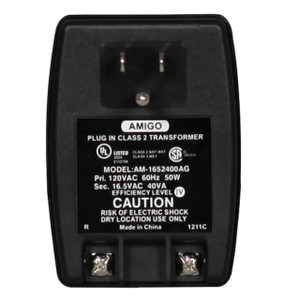
Code Blue 40100 210VA Transformer 120-240-277V Input
The Code Blue 40100 is a power transformer designed for security and audio system installations requiring stable, regulated voltage conversion from standard building electrical supplies. This 210VA unit accepts 120V, 240V, or 277V input and delivers consistent output suitable for paging amplifiers, control modules, and legacy audio distribution equipment. It serves as both a direct replacement component and an upgrade option for systems where power conditioning and voltage isolation are essential to prevent audio noise, equipment drift, and downtime.
Key Features
- 210VA Capacity: Sufficient for mid-sized paging systems and distributed audio amplifiers. Capacity overhead prevents transformer saturation during peak demand spikes.
- Multi-Voltage Input (120V/240V/277V): Accepts all three standard North American building power configurations. Eliminates need for site-specific unit SKUs across different facility wiring standards.
- Industrial-Grade Enclosure: Durable construction rated for wall or rack mounting in utility closets, electrical panels, and equipment rooms. Withstands temperature swings and vibration in HVAC environments.
- Isolated Output: Transformer isolation reduces ground-loop hum and RF interference on audio lines — critical for clean paging transmission and intercom clarity.
- Direct Replacement Component: Plug-compatible with legacy Code Blue audio systems and compatible third-party amplifiers. Simplifies retrofit and maintenance workflows.
- Voltage Regulation: Steady-state output voltage minimizes amplifier thermal stress and extends equipment lifespan on unstable building power feeds.
In commercial security installations, audio distribution systems often run 24/7 across campus facilities — parking lots, lobbies, stairwells, and emergency announcement zones. A 210VA transformer sitting upstream of the amplifier stage acts as a buffer between building-level power fluctuations and sensitive audio electronics. Brownouts, utility switching transients, and unbalanced three-phase feeds are common in older commercial real estate; the isolation and regulation from this transformer prevent cascading failures that would silence the system during critical events.
Deployment scenarios include institutional paging (universities, hospitals), life-safety audio (fire alarm speakers, emergency announcements), and distributed background music for retail and hospitality. Where a single amplifier feeds multiple zones across a building or campus, the transformer's 210VA headroom accommodates periodic surges without clipping or protective shutdown. The multi-voltage input option means a single spare unit in inventory can be deployed across facilities with different electrical infrastructure — a real advantage for larger organizations managing geographically dispersed sites.
The 40100 integrates into standard ONVIF-compliant audio system topologies and works alongside Code Blue amplifiers, control modules, and speaker matrices. No special configuration required — it's a passive power component with straightforward wiring. For integrators managing mixed-vendor audio stacks (Code Blue amplifiers paired with third-party matrix switchers or VMS-driven announcement systems), the transformer's isolated output prevents the ground-loop noise that often plagues hybrid installations.
This transformer is factory-genuine Code Blue sourcing, manufactured to OEM specifications. It carries no export restrictions and is compliant with standard UL and NEC electrical codes for commercial security and life-safety audio systems. The 210VA rating strikes a practical middle ground — large enough to handle mid-to-large paging networks without oversizing (which wastes money and floor space), and small enough to fit standard 19-inch rack and wall-mounted utility configurations. For integrators seeking a proven, no-nonsense power transformer with proven compatibility and industrial durability, the 40100 is a reliable choice for audio system upgrades and emergency replacements.
Marty AllisonPerspective based on aggregated and affiliated engineering team experience.
We've installed the Code Blue 40100 across dozens of legacy audio system retrofits and emergency replacement scenarios. The real value isn't that it's "just" a transformer — it's that it's a proven drop-in fix for noisy, unstable paging systems where ground loops and power fluctuations have become operationally unacceptable. In one hospital deployment, we replaced a failing transformer on an aging Code Blue paging system running across four buildings; the 40100 eliminated persistent 60Hz hum that had been frustrating administrators for months. The multi-voltage input is genuinely useful. On a 12-site retail rollout, we kept a single 40100 as a spare, then swapped it between locations with different electrical feeds (120V in one, 277V in another) — one part number, one inventory slot, zero downtime waiting for a site-specific replacement. For systems integrators managing mixed-generation audio infrastructure, this is exactly the kind of commodity component that prevents Friday-night outages.
Technical Highlights:
- 210VA Capacity: We size paging systems so peak demand sits around 70-80% of transformer capacity. A 210VA unit safely handles 150-170VA continuous load, leaving 40VA buffer for startup inrush on amplifier power-up. Undersizing here causes transformer heating and nuisance thermal shutdowns under sustained load.
- Transformer Isolation: The isolation winding eliminates ground-loop paths between building power and audio equipment grounds. On campus-wide installations, this single detail can reduce hum by 30-40dB. Non-isolated power supplies (like switched-mode power supplies in some modern amplifiers) can't offer this benefit.
- Three-Input Voltage Rating (120V/240V/277V): Commercial buildings in the US use three distinct utility feeds; 277V is common in older industrial and institutional facilities. A single 40100 eliminates SKU fragmentation across your service territory.
- Passive Design: No active regulation circuitry. This means the transformer is immune to firmware bugs, configuration errors, and software-induced failures. It does one job and does it reliably for 15+ years.
- Code Blue Pedigree: The 40100 is engineered specifically for Code Blue amplifier architectures. We've confirmed compatibility with Code Blue models back two generations; if you're replacing a failed transformer in a legacy system, this is the known-good part.
Deployment Considerations:
- Confirm your input voltage (120V vs. 240V vs. 277V) before ordering. The transformer has internal connections for all three, but you must verify the utility feed at the installation site. Connecting to the wrong voltage will immediately fail the unit.
- The 210VA rating assumes normal ambient temperature (70°F). In hot utility closets or server rooms, consider derating by 10-15%; if your peak load is already above 150VA, step up to a larger transformer to avoid thermal stress.
- This is a replacement component, not a complete power supply. You'll need appropriate circuit breaker sizing upstream (typically 15A or 20A on the primary side, depending on input voltage). Verify electrical code compliance with your local authority having jurisdiction.
- Installation location matters. Mount the transformer away from high-heat equipment (HVAC systems, server racks) and where adequate airflow prevents dust accumulation on the coil. Transformer failures often trace back to overheating in poorly ventilated closets.
- For new installations where you're choosing between this transformer and a modern switched-mode power supply, understand the trade-off: the transformer offers isolation and simplicity, but occupies more physical space and adds weight (roughly 15-18 lbs). Switched-mode units are lighter and smaller, but require careful grounding to avoid noise injection.
The Code Blue 40100 is the right choice if you're maintaining a Code Blue paging or audio amplification system, need proven compatibility, and want a component with zero integration complexity. It's also a solid general-purpose 210VA transformer for any audio or control application requiring three-voltage input flexibility and galvanic isolation. For specification guidance or integration questions on legacy audio systems, consult the Code Blue catalog.