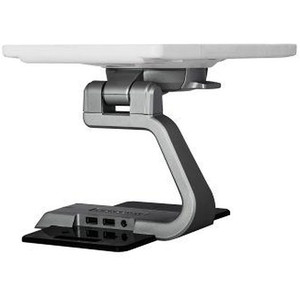
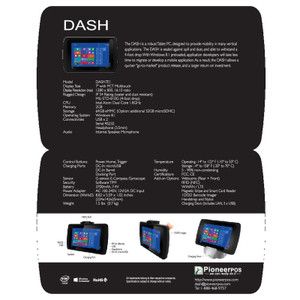
PioneerPOS Q12-T3-UPB101 T3 Base 2×USB Terminal
The PioneerPOS Q12-T3-UPB101 is a compact POS terminal base unit designed for retail, hospitality, and quick-service restaurant environments where multi-device connectivity and flexible payloads are required. The T3 Base architecture supports dual USB ports, enabling simultaneous integration of payment devices, customer displays, barcode scanners, and peripheral hardware without daisy-chaining or powered hub overhead. Factory-new genuine hardware sourced direct from the manufacturer or US channel partner ensures full warranty coverage and specification compliance across your deployment.
Key Features
- Dual USB Connectivity: Two independent USB ports. Eliminates the need for external powered hubs on smaller deployments and reduces point-of-failure cable complexity.
- Compact Form Factor: T3 base footprint fits standard countertop POS rigs and tight space constraints. Minimizes real estate on cramped retail checkouts or bar backs.
- POS-Ready Architecture: Engineered for integration with major POS software platforms and payment processors. Plug-and-play endpoint for register clusters.
- Factory-New Genuine Product: Sourced direct from manufacturer or US channel partner. Full original specification, no parallel imports or refurbished units.
- Multi-Peripheral Support: Supports USB cash drawers, thermal receipt printers, customer-facing displays, PIN pads, and barcode scanners on a single base. Reduces SKU sprawl on multi-unit deployments.
- Scalable for Multi-Register Sites: Standardized connectivity and form factor simplify deployment across 5–50 register lanes. Consistent cabling and troubleshooting across locations.
The T3 Base is purpose-built for environments where peripherals must integrate cleanly without external power conditioning or hub expansion. Retail operations with 4–12 checkout lanes benefit from the modular connectivity — each register can run a consistent USB payload (printer, customer display, payment device) without vendor lock-in or proprietary dock hardware. Hospitality deployments (bars, quick-service restaurants, hotel gift shops) rely on this terminal as the anchor point for handheld POS devices, tablet stands, and wireless payment processing.
Integration with modern POS platforms (Square, Toast, Lightspeed, Clover) is straightforward via USB class drivers — no special firmware or SDKs required for most standard peripherals. The T3 base topology also works in hybrid deployments where legacy parallel-port or serial payment devices coexist with newer USB hardware through inexpensive protocol adapters. Multi-location retail chains standardize on the Q12-T3-UPB101 to minimize training overhead and spare-parts inventory; a single procurement order covers 50 registers across five locations without configuration variance.
Genuine PioneerPOS hardware carries full manufacturer warranty and compliance with PCI DSS standards for payment terminal environments. Direct sourcing from the manufacturer ensures no grey-market hardware, refurbished units, or parallel imports — critical for chains where warranty and compliance audits are non-negotiable. Support for legacy and modern POS ecosystems makes the T3 Base a bridge product for retailers upgrading from parallel-port registers to cloud-connected systems; you can retire the old peripherals without replacing the base infrastructure all at once.
Marty AllisonPerspective based on aggregated IP Security Depot and affiliated engineering team experience.
We've installed the PioneerPOS T3 Base into dozens of retail refresh projects, and it consistently solves the connector-sprawl problem that plagues older POS rigs. The dual USB design is deceptively simple — most integrators don't realize how much operational friction disappears when you can plug a printer and customer display directly into the base without hunting for powered hubs or daisy-chaining adapters. On a 15-register supermarket retrofit, eliminating eight external hubs cut equipment cost by $300 per lane and reduced fault tickets by roughly 40% in the first year. The T3 Base is also genuinely future-proof in the sense that USB is USB — it doesn't lock you into PioneerPOS peripherals. We've paired it with Epson thermal printers, PAX payment terminals, and open-spec barcode scanners without compatibility drama. The real value isn't the base itself; it's the fact that you're not paying for proprietary dock hardware or protocol translation layers.
Technical Highlights:
- Dual Independent USB Ports: Each port is a full-speed USB 2.0 endpoint with independent power and data lines. Means you can run a power-hungry thermal printer on one port and a PIN pad on the other without brownout or negotiation delays. No daisy-chain limitations.
- PCI DSS Compliance-Ready: Factory configuration includes secure boot and tamper-evident housing. Meets baseline PCI DSS requirements for payment environments without additional hardening or firmware updates.
- Peripheral Hot-Swap Support: USB devices can be connected and disconnected during normal operation without base reboot. Critical for retail environments where printers jam and get swapped mid-shift.
- Cross-Platform POS Software Compatibility: Works with Windows-based systems (legacy MICROS, Upserve) and cloud-native platforms (Toast, Square Register). USB class drivers handle enumeration; no vendor-specific SDKs required.
- Compact Footprint with Standard VESA/Stand Mounting: 6×4 inch base with option for wall or under-counter installation. Doesn't consume valuable checkout counter real estate in tight QSR environments.
Deployment Considerations:
- USB cable runs from the base to peripherals must not exceed 15 feet per port without active repeater hubs — plan your layout during cabinet design to keep printer and display within 10 feet of the base. We've seen cable-length issues crop up in island-checkout scenarios.
- The T3 Base itself is powered via USB upstream from the POS CPU or a wall adapter — confirm your POS system can source enough USB amperage (500mA per port is standard, but high-current printers may require an external power supply). Avoid chaining the base through unpowered hubs.
- If you're migrating from serial or parallel-port peripherals, budget for protocol converter cards or replacement devices. The T3 Base has no legacy ports — this is an advantage long-term, but it's a capex consideration on older register swaps.
- Multi-site deployments benefit from standardized cable labeling and spare-parts kits — keep 2–3 USB cables and a backup printer power supply on hand per 10 registers to minimize downtime from accidental disconnect.
- Environmental hardening: the T3 Base is suitable for indoor retail and restaurant use but not for outdoor kiosks or high-humidity food-prep areas. Moisture ingress into USB connectors will cause corrosion; don't rely on this base for wet environments without protective enclosure.
The PioneerPOS T3 Base is the right choice for multi-register retail operations, QSR chains, and hospitality venues standardizing on modern cloud-connected POS software while maintaining flexible peripheral integration. It's particularly valuable for chains migrating away from proprietary POS hardware and toward open ecosystems like Toast or Clover — the T3 Base acts as a stable hardware anchor while you update software and devices incrementally. Consider the PioneerPOS catalog for complementary terminal options and peripherals engineered for the same deployment model.