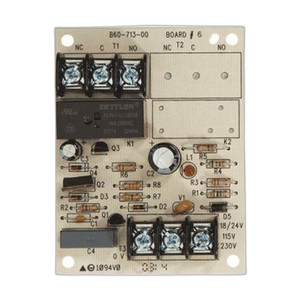
System Sensor PR-3 Multi-Voltage Dual Form C Relay Module
The System Sensor PR-3 is a network-integrated relay module designed to extend switching and signaling capability in fire alarm and security system architectures. Unlike standalone relay modules that require separate power supplies for different voltage standards, the PR-3 accepts both 115V and 230V input on a single unit — meaning you maintain one SKU across facilities with different power configurations, cutting procurement complexity and spare-parts overhead.
Key Features
- Dual Form C Relay Contacts: Each contact can be configured as normally open (NO), normally closed (NC), or changeover — flexible for both alarm signaling (horn circuits, strobe relays) and control signaling (HVAC shutdown, door unlock). This single contact configuration covers more deployment scenarios than dedicated NO-only or NC-only modules.
- Multi-Voltage Design (115V / 230V): Eliminates the need to stock and install region-specific relay modules. A facility switching from 115V to 230V power infrastructure doesn't require hardware replacement — critical in multi-building campuses or international deployments where voltage standards vary.
- TCP/IP Network Integration: The PR-3 connects to compatible System Sensor fire detection and security platforms via TCP/IP, enabling remote relay status monitoring and remote actuation from a central management console. No isolated relay logic or manual status checking required.
- Compact Modular Form Factor: Designed for integration into control cabinets and distributed alarm network nodes without demanding large floor space or dedicated enclosure real estate.
- Remote Status Reporting: Network connectivity means you can see relay state (open/closed) and actuation history in real time from your management platform — useful for troubleshooting false alarms or verifying secondary device operation.
- Dual-Contact Redundancy Option: Two independent relay contacts allow for paired signaling scenarios — one for primary alarm signal, one for backup or secondary device trigger — without needing a second relay module.
Integration & Compatibility
The PR-3 integrates with System Sensor fire detection systems and compatible security platforms supporting TCP/IP relay modules. It is commonly deployed in multi-building campuses where centralized relay control reduces on-site wiring complexity, distributed alarm networks where remote relay activation improves response time, and hybrid fire/security installations where a single relay module must handle both alarm signaling and integrated security control (door locks, HVAC, lighting). Verify TCP/IP compatibility with your control panel before procurement — not all legacy systems support network relay modules.
When planning network architecture for distributed relay control, ensure your TCP/IP network has adequate bandwidth and latency tolerance for real-time relay signaling. A relay actuation delay of 100–300 ms is typical for network-based modules and acceptable for most alarm and control applications; if sub-50 ms response is required, a hardwired relay module remains the correct choice.
Frequently Asked Questions
Q: Can the PR-3 operate on both 115V and 230V simultaneously, or must I choose one?
A: The PR-3 is designed for single-voltage operation per installation — you configure it for either 115V or 230V at setup. It does not operate on both voltages at the same time. The multi-voltage capability means you can use the same hardware in different facilities without redesigning the module.
Q: What is the contact rating for the Form C relays?
A: Contact ratings are specified in the manufacturer datasheet. Typical relay modules in this class support 16A at 250V AC or 8A at 30V DC. Verify the exact contact rating against your specific switching load (horn relays, strobe circuits, door strikes) before deployment — undersized contacts will fail prematurely.
Q: Does the PR-3 include a TCP/IP interface card, or do I need to source one separately?
A: The PR-3 is a relay module. Integration into a networked system requires a compatible control panel or gateway that supports TCP/IP relay modules. Confirm your panel's relay module compatibility before purchase.
Q: How many PR-3 modules can I network on a single control panel?
A: Network capacity depends on your control panel's relay module support. Consult the panel manual or contact the panel manufacturer for maximum relay module count and addressing limits.
Q: Is there a DC-powered variant of the PR-3 for UPS-backed systems?
A: The PR-3 is specified for AC operation (115V or 230V). For DC-backed battery systems, check the System Sensor product family for a 12VDC or 24VDC relay module variant.
Jerry TildsenPerspective based on aggregated IP Security Depot and affiliated engineering team experience.
The PR-3 occupies a middle ground in network-based relay control: it's more flexible than hardwired relay packs (thanks to dual Form C contacts and remote actuation), but slower than direct wired relay logic. For most fire alarm and integrated security deployments, that tradeoff is worth it — especially across multi-building campuses where centralizing relay logic into a network-managed control panel cuts wiring runs and maintenance overhead.
Technical Highlights:
- Dual Form C Contact Flexibility: One Form C relay can serve as your primary alarm signal (NO to close a horn circuit), while the second handles a secondary function (NC to unsupply a door strike on alarm). This dual-contact design eliminates the need for a second relay module in most common fire/security integration scenarios.
- Multi-Voltage Inventory Consolidation: Operating from 115V or 230V on the same hardware means regional facilities with different power standards share a single spare-parts bill of materials — a meaningful cost and logistics win over three to five years in large distributed networks.
- TCP/IP Real-Time Status: Network-delivered relay state updates provide visibility into secondary device operation (did the strobe actually actuate? is the door strike responding?), which hardwired logic cannot offer without manual inspection or dedicated status circuitry.
Deployment Considerations:
- Network latency: TCP/IP relay actuation introduces 100–300 ms delay compared to hardwired relays. Not a problem for horn circuits or door strikes, but confirm acceptable for any time-critical signaling in your design.
- TCP/IP network dependency: If your control panel's network connection fails, remote relay control is unavailable — even though the module may still be powered. Plan for manual override or a fallback hardwired relay for critical functions (e.g., emergency lighting cutoff).
- Contact rating validation: Form C relay ratings vary by manufacturer. Verify the PR-3's contact amperage (typically 8A @ 30V DC or 16A @ 250V AC) against your actual load — undersized relays will weld or burn open within months on high-current circuits.
The PR-3 is the right choice for networked fire alarm and security systems where you need centralized relay control across multiple buildings or floors, you want to avoid separate DC relay modules for different voltage regions, and you can tolerate network-based latency for secondary device signaling. Skip it if you require sub-50 ms relay response or if your control panel doesn't support TCP/IP relay modules — in those cases, a hardwired relay pack in the control cabinet itself is simpler and more reliable.