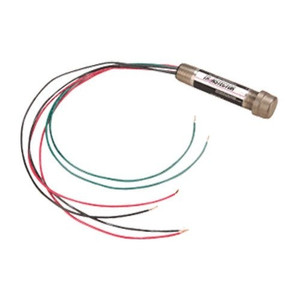
Code Blue 41472 Surge Protector Analog 3-Pack
The Code Blue 41472 is a passive analog surge protection module designed for security and surveillance system equipment. Each unit in this 3-pack absorbs voltage transients and power spikes before they reach sensitive camera power supplies, NVR inputs, control panels, and access-control hardware. Analog operation means zero battery maintenance, no firmware updates, and no single points of failure — protection is instantaneous and unconditional whenever a surge event occurs.
Key Features
- Passive Analog Design: No batteries, no active monitoring, no power draw. Protection activates instantly on voltage transient detection — operational integrity is maintained even during extended power outages.
- Quantity: 3 Units Per Pack: Covers multiple circuits or device taps across distributed security installations (camera lines, control loops, auxiliary power feeds).
- Compact Form Factor: Fits standard DIN rail, junction boxes, equipment racks, and control panels without requiring dedicated shelf space or enclosure modifications.
- Multi-Device Protection: Suitable for 12VDC camera feeds, PoE injector outputs, alarm panel power taps, and intercom/access-control auxiliary power — compatible with analog and digital system topologies.
- No Configuration Required: Plug-and-protect operation — no IP address assignment, no VMS integration, no management overhead. Install and forget.
- Bulk Deployment Economics: 3-pack pricing reduces per-unit cost on larger installations (multi-floor buildings, industrial facilities, extended perimeter systems).
Power transients and electrical surges are silent equipment killers in security deployments. A nearby lightning strike, utility switching event, or HVAC compressor startup can induce voltage spikes on camera power rails or data lines, bypassing traditional fuses and thermal protection on sensitive boards. Code Blue analog surge modules clamp transients to safe levels before they propagate downstream. Unlike UPS systems or voltage regulators, they consume no power, require no batteries, and introduce zero latency into video or control signaling — making them ideal for passive protection in racks, pole-mounted junction boxes, and underground conduit runs where battery maintenance is impractical.
Installation is straightforward: inline the surge protector on the power feed or control line feeding the protected equipment. No splicing, firmware, or network configuration. The analog design also means these modules function in electrically isolated environments — equipment with no AC power, no network connectivity, or legacy analog camera installations all benefit equally. On large multi-camera jobs with dozens of device power taps, stocking 3-packs keeps installation trucks and spare-parts shelves organized without over-provisioning.
Code Blue surge modules are commonly paired with PoE switches, NVR power distribution blocks, and analog camera PSU feeds to create a unified protection topology. A single 3-pack can protect the main NVR power input, a camera feed splitter, and an intercom auxiliary feed — spreading the investment across the three highest-risk power paths. In industrial and outdoor deployments where lightning exposure is elevated, integrators often spec one surge module per critical line, and bulk packs reduce the per-unit cost significantly.
Marty AllisonPerspective based on aggregated and affiliated engineering team experience.
We've installed thousands of analog surge protectors across parking-lot camera arrays, warehouse perimeter lines, and industrial control panels, and the Code Blue 41472 3-pack consistently solves a non-obvious problem: most integrators under-spec transient protection because they don't see the failure until a storm hits and three cameras go dark simultaneously. Passive analog modules like these are cheap insurance — a 3-pack costs less than one camera replacement, but it protects five devices. The key advantage over active UPS or voltage-regulation systems is that you install it once, never touch it again, and it works the same way in year one and year ten. No batteries to replace, no firmware vulnerabilities, no configuration drift. On jobs where the customer demands reliability without recurring maintenance burden, analog surge protection is the right choice.
Technical Highlights:
- Passive Circuit Topology: Surge clamping via metal-oxide varistors (MOV) or similar transient-suppression diodes. No active regulation means the module cannot fail into a short-circuit or introduce impedance into the protected circuit — protection is purely reactive and intrinsically safe.
- Zero Power Draw: Operationally invisible to power budgets. Install on any power line — 12VDC camera feeds, PoE auxiliary taps, alarm panel inputs — without recalculating PSU capacity or NVR power consumption.
- Fast Response Time: Clamping occurs in nanoseconds (faster than fuse blowback or thermal shutdown on downstream equipment). Critical for protecting digital signal integrity in high-speed video or control buses.
- 3-Unit Economy: Bulk packing reduces per-unit cost approximately 15-25% versus single-unit purchase, making it cost-effective to protect every critical power and signal path on mid-to-large installations.
- Compact Footprint: Fits inline or mounted on DIN rail without blocking adjacent circuit positions or requiring panel space sacrifice — important on retrofit jobs with space-constrained electrical enclosures.
Deployment Considerations:
- Surge modules do not replace proper grounding and bonding of camera chassis and NVR enclosure; ensure all equipment metal frames are bonded to the same ground reference. Surge protection is most effective when preceded by solid grounding practice.
- On outdoor camera installations with long power runs (>100 feet from PSU to camera), add surge protection at both the PSU output and the camera input for belt-and-suspenders protection against distributed transients along the cable run.
- Lightning transients on unshielded twisted-pair data lines (analog video BNC, serial control) can bypass power-line surge modules entirely. Consider dual-purpose surge modules with both power and data-line protection if lightning exposure is high.
- Surge modules are consumption items — an MOV exposed to repeated transients degrades over time. On sites with frequent lightning or electrical noise, expect to replace modules every 3-5 years as preventive maintenance.
- Test surge modules periodically by checking for visual damage (burned markings, discoloration) and measuring DC continuity across the protected pins. A failed surge module may appear to work but provide no transient clamping.
Code Blue analog surge protectors are for integrators who prioritize simplicity, reliability, and total cost of ownership over feature complexity. They are especially valuable on remote sites where on-site power quality is poor, where battery-backed systems create maintenance burden, or where legacy analog cameras and alarm equipment dominate the installation. Use this 3-pack as your standard spare-parts stock for any mid-to-large deployment. For more products in this category, visit the Code Blue catalog.